
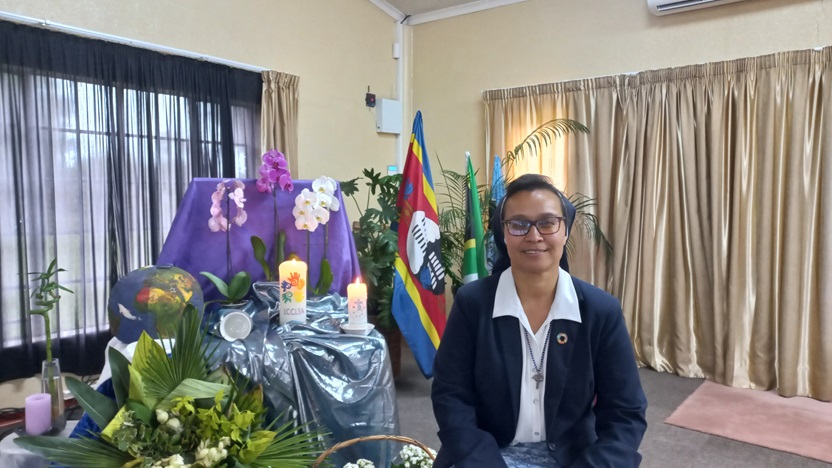
At the conclusion of the 2026 Annual General Meeting (AGM) of the Leadership Conference of Consecrated Life in Southern Africa (LCCL-SA), the President, reflected on the conversations that shaped the gathering held at Lumko Institute and Conference Centre in Benoni.
In an interview with the Southern African Catholic Bishops Conference (SACBC) communication office, Sr Zelna Oosthuizen RGS spoke about the priorities emerging from the assembly — safeguarding, vocation promotion, the empowerment of women religious, and the Church’s growing engagement with young people in a rapidly changing world.
“I can’t believe it’s already one year,” she said, recalling her election as president at the 2025 AGM. “It has been a very full year — many visits, many encounters — and many opportunities to reflect on the life and mission of consecrated persons.”
Safeguarding Remains a Moral Responsibility
Among the issues that drew strong attention during the gathering was safeguarding — a responsibility that Sr Oosthuizen described as essential to the credibility and integrity of religious life.
“Coming from the mandate of the Holy Father, we are all responsible to make sure that everybody who enters our communities and ministries is safe,” she said. “Leadership carries that responsibility at every level.”
Her remarks echoed the wider commitment of the Church in Southern Africa to strengthen safeguarding structures and ensure that religious communities remain places of trust and protection, particularly for children and vulnerable persons.
A Call to Renew Vocation Culture
Reflecting on the theme of the AGM ‘Missionaries of Hope and Joy in Search of New Life’ Sr Oosthuizen explained that the emphasis on “new life” was not limited to new vocations but included new ways of working together as religious communities.
“We had the image of a dead stump with new shoots coming out,” she said. “Even when something looks finished or discouraged, there is always the possibility of new life when we collaborate and share our resources.”
That sense of renewal was reinforced by the findings of recent vocation surveys presented during the meeting. The surveys, which gathered responses from 240 participants — including 169 young people and 69 religious men and women — revealed both challenges and opportunities for vocation ministry in the region.
One of the most significant insights, Sr Oosthuizen noted, was that many young people have little exposure to consecrated life.
“The sample we received really spoke loudly,” she said. “Young people do not always know much about vocations. They want to be listened to. They want to be exposed to the life of religious men and women.”
Indeed, many youth respondents indicated uncertainty about the meaning of vocation and called for greater awareness and guidance from religious leaders and parish communities.
Visibility and Presence Among Young People
For Sr Oosthuizen, the message from young people was clear: religious leaders must become more visible and more present in their lives.
“It challenged us as leaders to ask how we encourage our sisters, brothers, and priests to be more present and to listen to the young,” she said.
The surveys also revealed that while some vocation initiatives are bearing fruit, others struggle due to limited resources, lack of personnel, or outdated methods. Several religious respondents noted that social media engagement has opened new opportunities for contact with young people discerning their vocation.
At the same time, Sr Oosthuizen acknowledged concerns about changing social realities, including academic pressures and demanding school schedules, which can limit young people’s participation in catechism and parish life.
“These are the spaces where faith is nurtured and where vocations often begin,” she said. “When those spaces disappear, we need to find new ones.”
Listening Before Acting
A recurring theme throughout the interview was the importance of listening – a principle strongly emphasized in the Church’s synodal journey. “In the past, we often thought about what young people needed and then gave it to them,” she said. “Now we must listen first. We must allow them to share their concerns and their hopes.”
Sr Oosthuizen believes that authentic listening can create trust and openness, encouraging young people to explore their faith and vocation more deeply. “When young people feel heard, they become more willing to ask questions and to consider new possibilities,” she added.
Empowering Women Religious for Leadership
The interview also touched on the growing call to strengthen the role of women in the Church, particularly through education and leadership formation.
Sr Oosthuizen welcomed recent discussions encouraging religious sisters to pursue higher studies, especially in theology and pastoral ministry. “It is not something new, but it is becoming more urgent,” she said. “We need to support our sisters who go for further studies, because we need women who can speak with confidence and competence on the same platform as others.”
She stressed that empowerment is not simply about academic achievement but about ensuring that women religious can contribute fully to the mission and decision-making processes of the Church.
Preparing for the Digital Future
Another emerging priority highlighted in the interview was the Church’s response to technological change, particularly the growing influence of artificial intelligence and digital communication.
Sr Oosthuizen recalled the strong interest generated by a session on cybersecurity during the AGM, which introduced participants to practical ways of protecting themselves online. “We discovered many small things that can help prevent us from becoming victims,” she said. “It made us realize that we need more formation in this area.”
Future programmes, she indicated, will include workshops on artificial intelligence and digital communication, helping religious leaders understand the digital world in which young people live. “Our younger generation understands the language of technology,” she said. “If we want to accompany them, we must also learn that language.”
Hope Rooted in Witness
In her concluding remarks, Sr Oosthuizen returned to the central message she believes emerged from the gathering – that the future of consecrated life depends on authentic witness.
“The most important thing is how we live our vocation,” she said. “When people see our joy, our commitment, and our faith, they begin to ask questions.”
0 Comments