
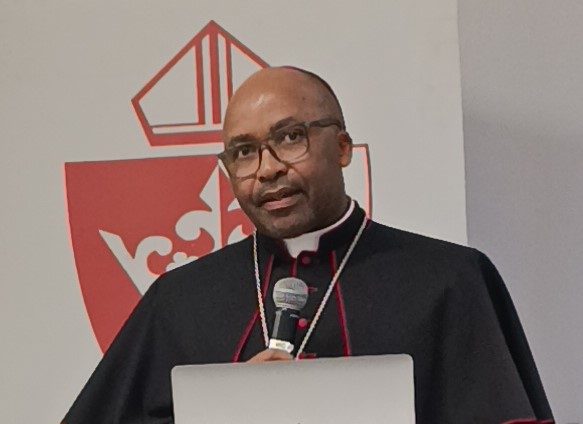
Amid ongoing discussions and questions within the Church about Synodality misconceptions, South African Canon Lawer offered important clarification on synodality, canon law, and the proper exercise of dialogue and authority in the Catholic Church.
In an interview held at Khanya House, the headquarters of the Southern African Catholic Bishops’ Conference (SACBC) in Pretoria, Bishop Thulani Victor Mbuyisa CMM emphasised that synodality should not be confused with democracy.
Synodality Is Not Democracy
While the Church supports good governance and recognises the value of democratic systems in society, synodality does not operate on majority rule or political processes. Rather, it is rooted in listening to the Holy Spirit and to one another, with the aim of discerning God’s will for the Church.
Drawing on history, Bishop Mbuyisa noted that even democracy itself has long been recognised as imperfect, requiring checks and balances. Similarly, the Church follows a distinct model of governance, guided by faith, tradition, and ecclesial structures.
Quoting Pope Francis, Bishop Mbuyisa highlighted that the Holy Spirit fosters “harmonia” – harmony and unity. Wherever there is genuine communion and a commitment to the common good, the Spirit is present. Division, disorder, and scandal, he stressed, are not fruits of synodality.
Voices in the Church and Proper Channels
Responding to recent public protests and media disputes within some dioceses, the chairperson of the Department for Integral Humen Development (previously known as Social Action Department) affirmed that all the faithful – lay, religious, and clergy – have the right to express their views and concerns.
However, he underlined that this right must be exercised within the proper structures of the Church. Bishop Mbuyisa noted that the Church possesses well-established mechanisms, rooted in canon law, which are often older than modern legal systems.
At parish level, issues should first be addressed through bodies such as the Parish Pastoral Council (PPC). Matters should not immediately escalate to bishops, Rome, or public platforms.
The Local Ordinary of Kokstad Diocese cautioned against the misuse of social media and mass media to air grievances, noting that such actions can cause scandal, harm reputations, and even expose individuals to canonical or civil penalties. Canon Law, particularly Canon 220, protects the right of every person to a good name.
Addressing Concerns About Bishops
When concerns involve the diocesan bishop, Bishop Mbuyisa explained that the faithful may respectfully request engagement with their shepherd, express concerns constructively, and follow established processes.
Should dissatisfaction persist, there remains a right to appeal, always within the Church’s legal framework. Seeking guidance from a canon lawyer can assist individuals or groups in navigating these processes responsibly.
The Church, he stressed, is not without rules, laws, or accountability mechanisms; rather, its structures function precisely to safeguard communion and justice.
Authority, Discipline, and Pastoral Care
On the question of discipline and excommunication, Bishop Mbuyisa clarified that bishops possess the authority necessary to govern and shepherd their dioceses, including correcting serious errors or disruptive behaviour.
Such authority, however, is to be used sparingly and as a last resort, after pastoral efforts such as dialogue, admonition, and calls to repentance have failed.
Excommunication, he explained, is not primarily punitive but medicinal aimed at calling the person back to communion with the Church.
The Implementation Phase of Synodality
Turning to the implementation phase of the Synod on Synodality, the Vice Chairperson of the SACBC Commission for Synodality outlined key priorities for the church in South Africa, Botswana and Eswatini.
Each diocese is required to establish a synodal team to assist the bishop in embedding synodal practices. These teams are registered with both the Episcopal Conference and the Synod Secretariat in Rome.
Formation initiatives, including recent training sessions at St John Vianney Seminary, are equipping diocesan teams with a deeper understanding of synodality. The Commission for Synodality has also prepared summaries of the Final Document of the 2024 Synod, with plans for translation into local languages to ensure accessibility across the region.
Workshops, diocesan visits, and ongoing accompaniment form part of the Conference’s strategy, alongside collaboration and dialogue with other episcopal regions worldwide.
Walking Together as Church
In concluding, Bishop Mbuyisa reaffirmed that synodality calls the Church to walk together, grounded in prayer, listening, respect, and unity, while making responsible use of the structures that safeguard communion.
0 Comments