
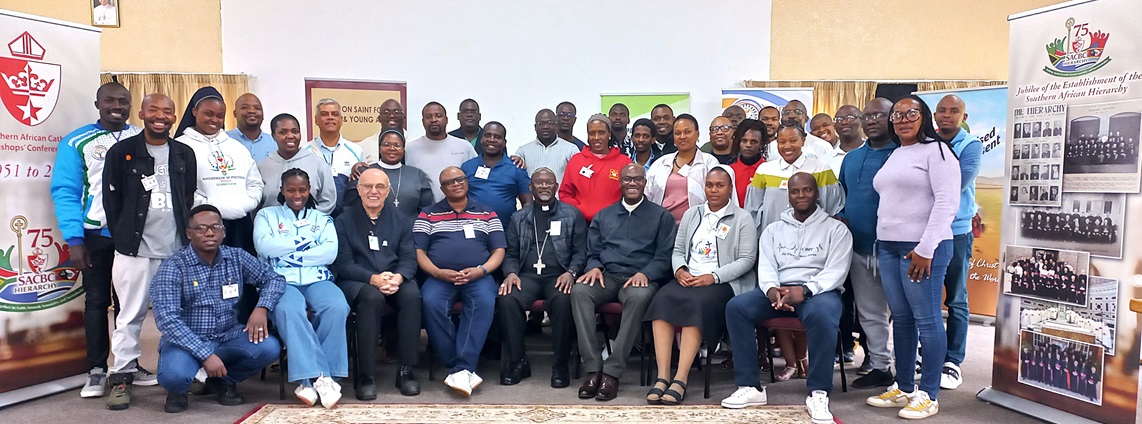
Youth chaplains and diocesan coordinators from across Southern Africa have gathered at the Lumko Institute and Conference Centre in Benoni for the annual four-day conference of the Southern African Catholic Bishops’ Conference (SACBC) Youth Department.
The 23 to 26 February meeting, which brings together around 40 participants from South Africa, Botswana and Eswatini, opened the year’s pastoral programme with a strong focus on listening, sharing experiences, and discerning common pastoral priorities for youth ministry in the region.
On Tuesday, 24 February, delegates presented diocesan reports that revealed both shared challenges and hopeful developments. Among the recurring concerns were high youth unemployment, the resulting lack of financial sustainability for youth programmes, the need for stronger formation, and ongoing uncertainty around the definition and pastoral focus of different age groups — young people, youth, and young adults. Participants also reflected on the role and impact of sodalities in youth formation.
At the same time, several dioceses shared positive developments, including diocesan youth pilgrimages, leadership formation initiatives, and structured youth leadership programmes that are bearing visible fruit in local Churches.
Speaking to the SACBC Communication Office, the Liaison Bishop for the SACBC Youth Department, said the reports offered a deeply honest picture of the state of youth ministry across the conference.
“The reports that we had today were really touching in many ways,” Bishop Siphiwo Devilliers Paul Vanqa SAC said. “They showed clearly what is happening in our dioceses — the struggles, but also the progress. And what became very clear is that the reality of the youth cannot be the responsibility of one diocese alone. It is something we must face together as a conference.”
Bishop Vanqa acknowledged that rural dioceses in particular face greater difficulties, especially in creating opportunities for youth employment and sustainable youth structures, while some metropolitan clusters are making notable progress.
“Some clusters are doing very well, and we must learn from them,” he said. “We must share experiences and work together, so that what is working in one place can help another.”
Reflecting on the celebration of 75 years of the establishment of the Church hierarchy in Southern Africa, Bishop Vanqa underlined that the Church’s mission today is no longer only about building structures, but about forming people.
“It is no longer about building buildings,” he said. “It is about building people — forming our young people to become the next missionaries of the Church.”
Addressing the question of youth formation, the Local Ordinary of Queenstown Diocese highlighted the challenges facing Catholic formation in a changing educational landscape, where the Church no longer has the same access to schools and formal structures for faith education.
“We now have to rely on our own communities — our parishes and our families,” he said. “Formation must become the responsibility of everyone in the Church. If we want to form our youth, we must all be part of that mission.”
The Bishop also reflected on the upcoming SACBC Youth and Young Adults pilgrimage in honour of Blessed Benedict Daswa, describing him as “a saint for all the people of Southern Africa,” and calling for broader participation across cultures and communities.
“He belongs to all of us,” Bishop Vanqa said. “We must invite everyone — without fear — to walk together in faith, unity, and hope.”
As the conference continues, participants will focus on practical strategies for collaboration, shared formation programmes, and sustainable models of youth ministry that respond to the real social, economic, and spiritual challenges faced by young people in Southern Africa today.
0 Comments