
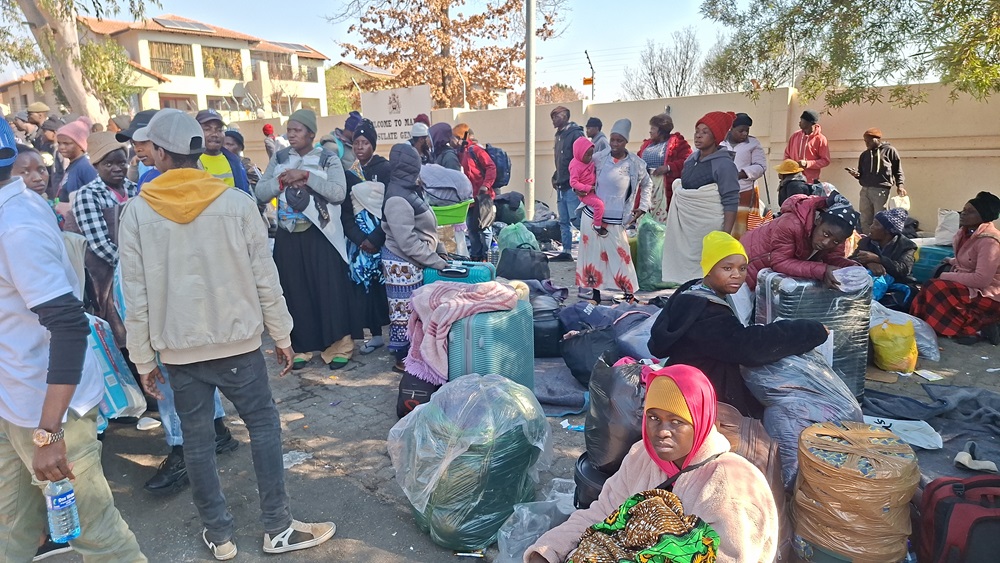
Fearing for their safety after weeks of anti-undocumented migrant protests across South Africa, hundreds of undocumented migrants continue to gather outside the Malawian and Zimbabwean consulates, waiting for transport home. Many say they have chosen to return voluntarily after being evicted from their homes, losing their jobs, or fearing further intimidation, while others are being deported through South Africa’s immigration processes.
On Sunday, the Southern African Catholic Bishops (SACBC) communication office visited the Malawian Consulate in Johannesburg, where about 300 Malawians were waiting to be repatriated. Some boarded buses for Musina later that afternoon, while many others remained behind, uncertain when the next transport would arrive.
Most had little more than a suitcase and a blanket beside them—the few belongings they could carry onto the buses. Mothers cradled infants while children played quietly among families waiting in the winter cold.
“The situation is not good”
Among those visiting the undocumented migrants was Charles Ephraim Luhanga, a member of the Knights of da Gama, who came after Sunday Mass to assess the situation. “The situation is not good,” he told the SACBC communication office. “There are no tents, and at night it becomes extremely cold. There are children here, mothers with babies, and people sleeping on the ground. Many now feel that returning home is their only option.”
He described a lack of basic services, including medical assistance and sanitation, and appealed for a stronger pastoral presence. “We feel the Church can do more. These families need blankets, food, hygiene items, and simply to know that they are not forgotten.”
“I have no choice”
Among those waiting was Bissni Chioza, a young Malawian mother carrying her two-week-old son. She told Vatican News that after being evicted by her landlord, she had nowhere else to go.
Having lived in South Africa for only a year after leaving Malawi in search of a better life, she now sees returning home as her only option. “The only thing she wants,” her interpreter explained, “is to go back home.”
Emergency without preparation
Members of Malawi’s Democratic Progressive Party were also present, preparing food for those waiting outside the consulate.
Joseph Muiza Kayoyo said the repatriation process had become an emergency that neither governments nor communities had anticipated. “So many people suddenly decided they wanted to return home,” he explained.
“The governments cannot transport everyone at once.”
He acknowledged that conditions in Musina, where migrants wait before boarding buses to Malawi, remain extremely difficult. “It is just an open place with toilets. Food has to be supplied; water has to be supplied. It is not a place that was prepared for this number of people.”
Some Malawians, he added, have attempted to return using private transport through Mozambique, only to become stranded in Maputo after exhausting their resources.
A crisis beyond South Africa’s borders
Meanwhile, the Southern African Catholic Bishops’ Conference (SACBC) has remained in close contact with the Episcopal Conferences in Malawi, Zimbabwe and Mozambique as thousands of returnees begin arriving home.
Speaking with the communication office, SACBC Secretary General Fr Hugh O’Connor said the neighbouring Churches were facing an unexpected humanitarian challenge.
“I spoke with one of the bishops in Malawi, who said this has come as a tremendous surprise and shock. No one was prepared.” Many of those returning, he explained, have spent decades living in South Africa.
“They are now returning to communities that may struggle to receive them. There are children who have spent their entire education in South Africa and now have to adapt to completely different school systems. Many families are returning with very little to countries whose economies are already under severe strain.”
For the Church, he said, the challenge is not simply logistical but pastoral.
“The bishops’ conferences must now help rebuild communities, accompany families and assist people who are beginning life again.”
Looking beyond labels
Fr O’Connor also believes the crisis exposes deeper wounds affecting the entire region.
“We must look beyond the labels—beyond legislation, politics and xenophobia,” he said.
“There are South Africans who feel abandoned because of unemployment and economic hardship, and there are migrants who have become scapegoats. There is suffering on every side.”
He noted that the departure of thousands of migrants is already affecting township economies and informal businesses that depended on migrant labour and entrepreneurship.
For Fr O’Connor, however, the Church’s mission reaches beyond humanitarian assistance.
“What can the Church do besides words? Besides handing things out?” he asked.
“How do we truly touch the lives of South Africans, migrants, refugees, and undocumented people? How do we change the way we see one another?”
As buses continue to leave South Africa’s consulates carrying families towards uncertain futures, the Church insists that accompaniment cannot end at the border. The task now, Fr O’Connor said, is to help heal divisions, restore dignity and remind every person—regardless of nationality or legal status—that they remain members of the one human family.
According to the South African government, more than 53,000 foreign nationals have been deported or voluntarily repatriated since the launch of its intensified migration management campaign. Most are from Malawi, Zimbabwe, and Mozambique, and the numbers continue to rise.
While Mozambican nationals seeking to return home have been gathering at the Mozambican Embassy in Pretoria, from where they are transported directly to Mozambique, Malawians and Zimbabweans are first taken by bus to Musina before continuing to their respective countries.
0 Comments