
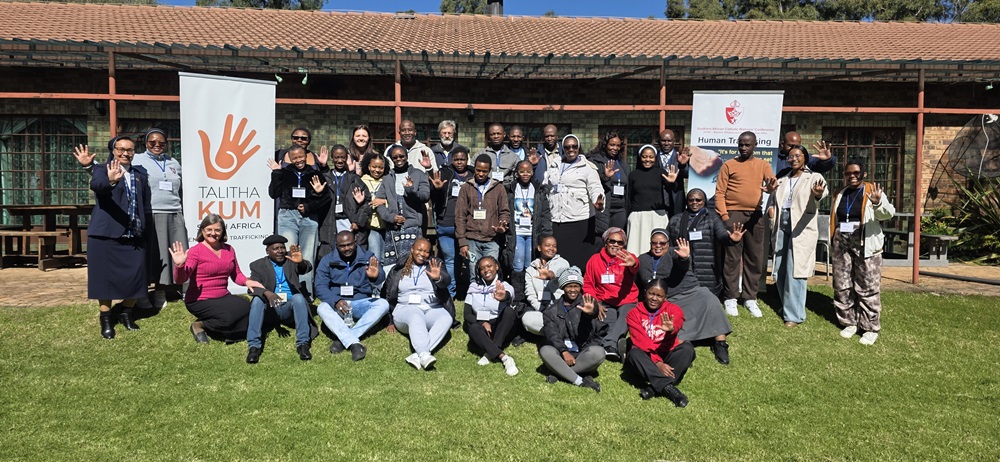
At the heart of the Catholic Church’s growing response to human trafficking in Southern Africa, young people are increasingly being recognised not only as beneficiaries of protection, but as protagonists of prevention, advocacy, and healing. This vision came into focus during a recent Talitha Kum South Africa workshop, where youth ambassadors, religious leaders, and Church partners gathered to strengthen collaboration against modern-day slavery.
Participants at the 11 to 15 May workshop described the gathering organised by Talitha Kum South Africa, the Southern African Catholic Bishops’ Conference (SACBC) Office for Migrants, Refugees and Human Trafficking, and the Leadership Conference of Consecrated Life – Southern Africa (LCCLSA), as a concrete experience of synodality — walking together in mission.
In an interview with the SACBC Communication office, Sr. Jane Frances Mohlala SCP, National Coordinator of Talitha Kum South Africa, reflected on the significance of the partnership between Talitha Kum, SACBC, and LCCLSA, especially in relation to the growing involvement of young people.
“Talitha Kum is nothing without LCCLSA,” she said. “We are children of LCCLSA, and we share the same vision and mission of combating human trafficking.”
Sr. Mohlala explained that the integration of youth ambassadors into the national structures of Talitha Kum South Africa followed discernment inspired by studies conducted through Talitha Kum International with young people across Africa.
“We realised that without young people we cannot engage effectively on issues that involve them,” she said. “They are the ones most targeted by traffickers. We need them close to us so that we can understand their realities and walk with them.”
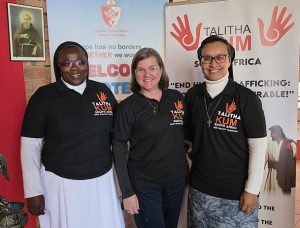
For the first time, youth ambassadors were invited to study and contribute to the Talitha Kum South Africa Guidelines before their final endorsement. The guidelines place particular emphasis on safeguarding and accountability. Youth ambassadors between the ages of 18 and 30 are expected to engage in peer education, social media awareness campaigns, and prayer initiatives, while adhering to strict safeguarding standards and survivor-centred accompaniment.
The urgency of the mission was repeatedly highlighted throughout the workshop. According to estimates shared during the meeting, nearly 155,000 people are currently living in conditions of modern slavery in South Africa. Women, children, migrants, and economically vulnerable individuals remain the most affected, while major cities such as Johannesburg, Cape Town, Durban, and transit towns continue to be identified as trafficking hotspots.
Rooted in the Gospel account of Jesus raising Jairus’ daughter — “Talitha Kum” (“Little girl, arise”) — the guidelines reaffirm the network’s commitment to restoring dignity and life to victims and survivors of exploitation. The document emphasises prevention, protection, reintegration, advocacy, policy engagement, partnership, and prayer as the pillars of Talitha Kum South Africa’s mission.
For Sr. Zelna Oosthuizen RGS, President of LCCLSA, the workshop represented the response of consecrated life in Southern Africa to a global call from the Church to confront the scourge of trafficking.
“Religious conferences throughout the world were invited to partner together in fighting modern-day slavery,” she explained. “We are only four years old — still crawling at the moment — but soon we will be walking.”
Sr. Oosthuizen spoke of the importance of listening to the voices of the youth, noting how their questions revealed both urgency and hope.
“They kept asking: ‘What is the Church going to do?’” she recounted. “And I had to remind them: ‘We are the Church. What are we going to do together?’”
She said the presence of young people was already renewing the confidence and vision of religious leaders engaged in anti-trafficking ministry.
“The fact that they are asking difficult questions and wanting to make a difference gives us courage,” she said. “They are the ones most targeted, but they are also becoming leaders in prevention and awareness.”
Also present at the workshop was Sr. Neide Lamperti MSCS, Coordinator of the SACBC Office for Migrants, Refugees and Human Trafficking, who highlighted the importance of partnership in responding to vulnerabilities faced by migrants and youth.
“When we work together, we are stronger,” she said. “We can make the mission of the Church and religious life more visible.”
Drawing from her office’s outreach in schools, dioceses, and border communities, Sr. Lamperti warned that trafficking increasingly takes place through digital spaces and online manipulation.
“The vulnerable youth of today can become victims through the internet and social media,” she cautioned. “We need to help young people become more aware and more careful in how they use these forms of communication.”
She added that collaboration between SACBC, Talitha Kum, and LCCLSA has enabled the Church to reach more communities and accompany more vulnerable people.
“When we work together, we can reach more hearts and perhaps save more lives,” she said. “This is true synodality in action.”
The workshop concluded with youth ambassadors drafting concrete action plans for implementation in their dioceses and local communities. According to Sr. Mohlala, the next step is transforming formation into action.
“They have studied the realities of human trafficking and the values of Talitha Kum,” she said. “Now they must put their faith into action.”
0 Comments