
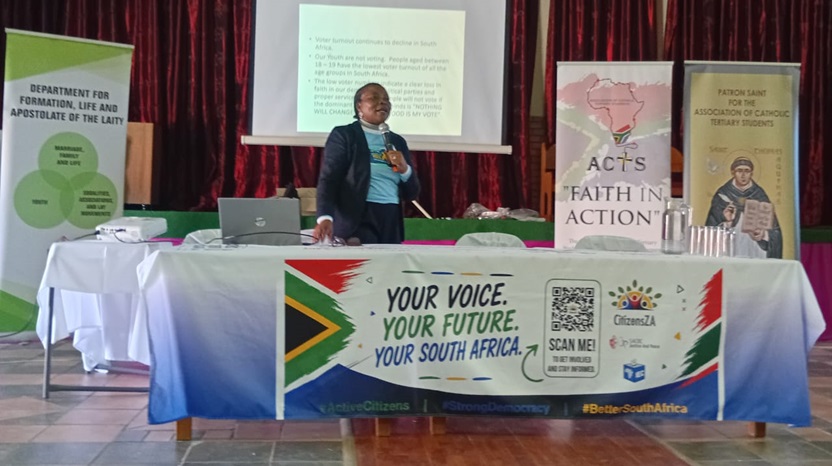
Forming young people to become responsible citizens is an essential part of the Church’s mission, participants at the Association of Catholic Tertiary Students (ACTS) Annual National Conference heard during a civic participation session jointly organised by the Southern African Catholic Bishops’ Conference (SACBC) Justice and Peace Commission, Citizens ZA and South Africa’s Independent Electoral Commission (IEC).
The gathering, held on 1 July during the ACTS national conference, invited young Catholics to reflect on the relationship between faith, citizenship and democratic participation. The conference, taking place from 29 June to 3 July at Mater Dei Pastoral Centre in Limpopo, brings together Catholic students from across South Africa for leadership formation, prayer and dialogue.
Opening the session, Judy Bassingthwaighte, Director of Citizens ZA, reminded participants that Christian discipleship extends beyond the walls of the Church and calls believers to serve society with integrity and compassion.
“One of the Church’s enduring missions is to help form people who not only grow in faith, but who also live out that faith through service, responsibility and a commitment to the common good,” she said.
She explained that the partnership between Citizens ZA and the Southern African Catholic Bishops’ Conference has given rise to a Youth Leadership and Civic Participation Initiative designed to encourage young South Africans to become informed, responsible, and active citizens.
Although the initiative comes ahead of South Africa’s 2026 Local Government Elections, Bassingthwaighte emphasised that its purpose reaches far beyond encouraging electoral participation.
“Our hope is to inspire a generation of young people who will lead with integrity, serve their communities and play an active role in shaping South Africa’s future throughout their lives,” she said.
She encouraged participants to understand citizenship as a daily vocation, lived through service, volunteerism, leadership in schools, universities, and parishes, and participation in democratic processes.
Young voices matter
Following the introduction, Bassingthwaighte handed over to a five-member IEC delegation, led by Mrs Martina Maphoso.
Addressing the young delegates, Maphoso underscored the importance of youth participation in safeguarding and strengthening the country’s democracy. Presenting data from the 2024 national elections, she revealed that significant numbers of young South Africans either registered but did not vote or failed to register altogether.
The figures, she explained, point to a worrying trend that diminishes young people’s influence over public policy and legislation, leaving decisions about their future increasingly in the hands of others.
To encourage practical engagement, the IEC established a voter registration and verification desk at the conference venue, allowing participants to check their voter registration status and register on-site.
Searching for the causes of disengagement
The presentation gave way to an open and lively dialogue, with participants raising questions about voter registration procedures, electoral processes and democratic participation.
Bassingthwaighte then invited the young Catholics to reflect more deeply on why so many of their peers appear reluctant to engage in political life.
The discussion revealed widespread concern about declining public trust in political institutions.
Participants pointed to inadequate voter education, repeated unfulfilled promises by political leaders, perceptions that elected representatives often pursue personal or partisan interests rather than the common good, and the tendency for politicians to engage communities primarily during election campaigns before disappearing once elected.
Despite these concerns, the conversation did not end in pessimism. Rather, participants reflected that disengagement only weakens democracy further and deprives young people of opportunities to influence decisions that affect their own lives and communities.
The exchange encouraged participants to see active citizenship not simply as a political responsibility, but as an expression of solidarity, accountability and service.
Faith in action
The session echoed the principles of Catholic social teaching, which affirms participation in public life as both a right and a responsibility. By encouraging young Catholics to become informed citizens, engage constructively in democratic processes and contribute to the common good, the initiative seeks to foster a culture of ethical leadership rooted in Gospel values.
Throughout the discussion, participants were reminded that building a more just society requires more than criticism of public institutions. It also demands citizens willing to participate, hold leaders accountable and offer their own gifts in service of their communities.
The civic participation session formed part of the wider ACTS Annual National Conference, which combines spiritual formation, leadership development and dialogue on issues affecting young Catholics in South Africa.
0 Comments