
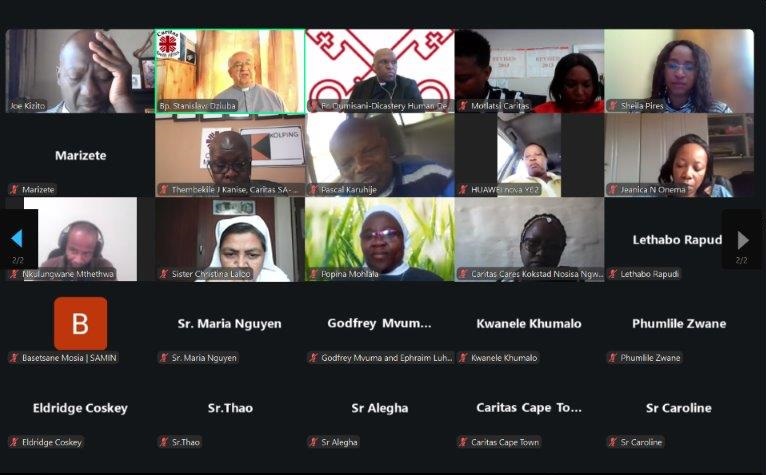
More than 40 diocesan coordinators, Church leaders, and partners gathered online on 4 March for a high-level workshop addressing the growing challenge of statelessness and undocumented persons in Southern Africa.
Organised by the Southern African Catholic Bishops’ Conference (SACBC) Migrants, Refugees and Human Trafficking Office in collaboration with Caritas South Africa, the webinar formed part of the Caritas Africa Project on Migration and Statelessness in the region. The session brought together legal experts and pastoral practitioners to strengthen coordinated action to defend human dignity.
In his opening remarks, the SACBC Liaison Bishop for Migrants, Refugees and Human Trafficking reminded participants that the Church cannot turn away from those without identity or belonging.
“We cannot close our eyes to our neighbour,” said Bishop Joseph Mary Kizito. Recalling 1 John 4:20 and Matthew 25:40, the Local Ordinary of Aliwal Diocese went on to say that “Christ is present in those stateless children and in those people without identity, without a future, without a home.” Bishop Kizito urged dioceses and partners to become “the voice of the voiceless” and to translate pastoral plans into concrete action.
In a message from the Dicastery for Promoting Integral Human Development, Fr Dumisani Vilakati reaffirmed the Holy See’s support for local Churches accompanying migrants and stateless persons. Fr Vilakati highlighted solidarity as a core principle of Catholic Social Teaching; he reiterated Pope Francis’ four verbs: welcoming, protecting, promoting, and integrating.
Meanwhile, legal expert Ms Palesa Maloisane of Lawyers for Human Rights unpacked the root causes of statelessness, including forced migration, poverty, and administrative failures. She addressed the human rights framework and the tension between national security concerns and the protection of fundamental human dignity.
Concrete pastoral responses were presented by Sr Marizete Garbin mscs of Johannesburg Archdiocese Pastoral Care department. Sr Garbin outlined seven structured programmes assisting migrants and refugees — from parish accompaniment and legal orientation to language classes, microcredit for women, leadership training in over 30 parishes, and food distribution reaching approximately 5,000 people monthly. “This is not theory,” she stressed, “but something concrete that we are doing.”
Participants at the 4 March webinar also heard a testimony from the Diocese of Aliwal North, which illustrated the daily impact of statelessness on families. One father shared how his daughter had been excluded from government school transport and denied access to the school nutrition programme because she lacked proper documentation. Each day, he struggled to provide food for her during school hours. With assistance from the diocesan stateless desk, the child was eventually registered at Home Affairs, obtained a birth certificate, and now receives a social grant. She has since been included in school transport and nutritional support.
The testimony also revealed the scale of the crisis: eight local schools in the area are currently being assisted, with 214 undocumented children identified. The Aliwal diocesan office provides school uniforms annually and supports costly DNA testing processes required for citizenship confirmation — in one case, assisting three families at significant expense. Yet overwhelming demand, lack of operational funding, documentation barriers, and inconsistent information from applicants remain serious challenges.
In his concluding message, Bishop Stanisław Jan Dziuba OSPPE, President of Caritas South Africa, called for sustained collaboration and renewed commitment to advocacy, pastoral care, and systemic solutions.
The workshop concluded with an appeal for deeper coordination between dioceses, Caritas structures, and partner organisations. Participants were encouraged to move from dialogue to decisive action, ensuring that stateless and undocumented persons are not left invisible in society.
0 Comments