
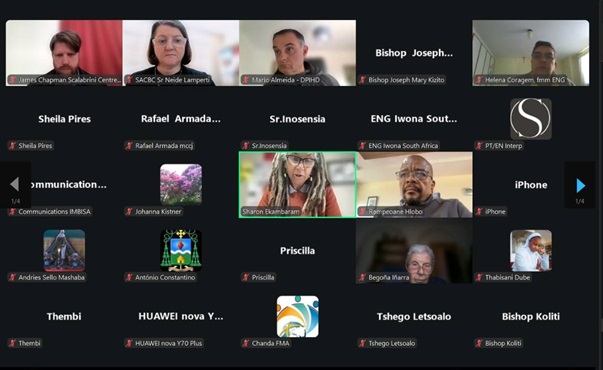
Participants in a webinar organised by the Southern African Catholic Bishops’ Conference (SACBC) Migrants, Refugees, and Human Trafficking Office and the Inter-Regional Meeting of Bishops of Southern Africa (IMBISA) have issued a strong appeal for faith-based leaders to become more vocal and proactive in confronting rising anti-migrant protests in South Africa.
The online meeting, held on Friday, 8 May, brought together over 80 participants, including Church leaders, civil society organisations, refugee advocacy groups, legal experts, and humanitarian workers, to reflect on the growing hostility faced by migrants and refugees in several parts of South Africa. The discussion unfolded against the backdrop of increasing anti-migrant demonstrations, particularly in KwaZulu-Natal and Gauteng, as well as renewed national debate on undocumented migration.
Opening the webinar with prayer, the SACBC Liaison Bishop for Migrants, Refugees, and Human Trafficking Office, Bishop Joseph Mary Kizito, called for compassion and solidarity with “the men, women, and children searching for peace, dignity, and a better life.” He prayed that African societies should become “communities that welcome, protect and promote human integrity.”
In his opening remarks, Bishop António Manuel Bogaio Constantino MCCJ acknowledged the complexity of migration in Southern Africa, stressing that the Church must help governments seek humane and sustainable responses to migration challenges. He said the crisis was not only South Africa’s burden but “a problem for all countries around South Africa,” requiring dialogue, cooperation, and pastoral accompaniment.
Much of the webinar focused on concerns that religious leaders have not spoken forcefully enough against anti-migrant rhetoric.
Mr. James Chapman of the Scalabrini Centre in Cape Town warned that xenophobic sentiment had become widespread, especially on social media platforms, fuelling threats, violence, and intimidation against migrants and organisations defending their rights.
“Where are faith-based communities? Where is the Church in all of this?” Chapman asked. “We cannot sit idly by while some are actually fuelling anti-migrant sentiment and xenophobia.”
He described how organisations advocating for refugee protection have themselves become targets of online abuse and threats, while anti-migrant groups continue to gain visibility through public marches and political rhetoric.
Representatives from Lawyers for Human Rights, the Consortium for Refugees and Migrants in South Africa (CoRMSA), and Refugee Social Services highlighted the trauma experienced by migrants and refugees, including fear, assaults, school disruptions for children, and difficulties accessing healthcare services.
They also criticised the role of social media in spreading hate speech and misinformation, while warning that migrants are increasingly being blamed for unemployment, poor service delivery, and economic hardships rooted in deeper structural inequalities.
Fr. Rampe Hlobo SJ, director of the Jesuit Justice and Ecology Network Africa (JENA), said the Church must address migration with both compassion and responsibility. He called on political leaders not to exploit public frustrations for electoral gain ahead of South Africa’s upcoming elections.
“True leaders do not divide communities; they bring them together,” he said, warning against the manipulation of fear and social tensions.
Several participants insisted that faith leaders must move beyond statements and become more visible in promoting social cohesion, solidarity, and education against xenophobia. They called for stronger preaching from church pulpits, greater collaboration among churches, and coordinated advocacy campaigns involving civil society and regional bodies.
During the discussion, participants also reflected on South Africa’s historic ties with the rest of Africa during the anti-apartheid struggle, saying many South Africans have forgotten the solidarity offered by neighbouring countries during the liberation era.
Closing the webinar, Bishop Kizito acknowledged that churches have spoken out against anti-migrant sentiments, but admitted that Christian communities are often “speaking from different corners” rather than with one united voice.
“We need to talk together. We need to sing from the same page,” he said, urging stronger cooperation among churches, government departments, legal organisations, and humanitarian groups.
The webinar took place shortly before South African President Cyril Ramaphosa issued a national statement condemning violent protests targeting foreign nationals, while also calling for stricter enforcement of immigration laws. In his weekly newsletter published on Monday, 11 May, the President stressed that “there is no place in South Africa for xenophobia, ethnic mobilisation, intolerance or violence.”
Participants in the webinar agreed that while migration challenges require lawful and responsible management, violence and scapegoating cannot be tolerated. They concluded with a renewed appeal for faith-based leaders across Southern Africa to raise their voices more boldly in defence of human dignity, peace, and solidarity among African peoples.
0 Comments