
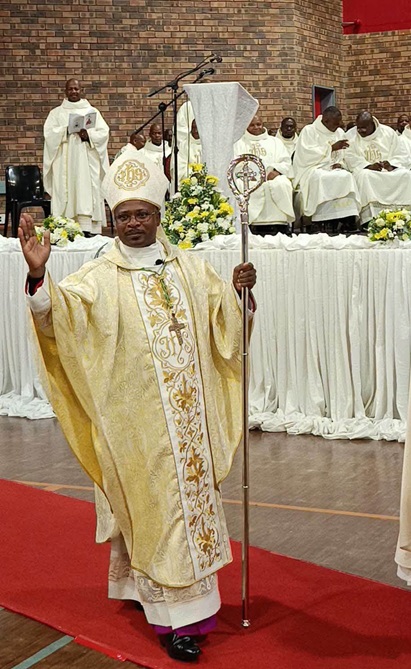
The appointment and episcopal ordination of Bishop Motlatsi Meshack Phomane as the first South African-born bishop of the Diocese of Bethlehem is a visible sign that the Catholic Church has taken deep root in Southern Africa, according to the Apostolic Nuncio to Southern Africa, Archbishop Henryk Mieczysław Jagodziński.
Speaking to the Southern African Catholic Bishops’ Conference (SACBC) Communication Office, the Holy See’s representative described the growing number of indigenous bishops across the region as evidence of a Church that has matured and now increasingly draws its leaders from among its own people.
“The native bishop is a sign of the maturity of the Church in Southern Africa,” Archbishop Jagodziński said.
“We now have many local priests and local bishops. This is the testimony of a flourishing Church. It is very important that the Church becomes part of the land and part of the people—not something foreign, but something that has taken root in the local soil.”
The Nuncio’s remarks came following the episcopal ordination of Bishop Motlatsi Meshack Phomane on Saturday, 4 July, when he became the fifth Bishop of Bethlehem and the first South African-born bishop to shepherd the Free State diocese since its establishment.
For Archbishop Jagodziński, the moment extends far beyond one local Church.
“It is a great joy not only for South Africa but also for Namibia, Botswana and the entire universal Church,” he said. “It is important to be rooted where we live while never forgetting that we belong to the one, holy, catholic and apostolic Church, united with the Holy Father, the Successor of Saint Peter.”
A shepherd from among the people
For Bishop Phomane, whose appointment was announced while he was attending a regional pastoral meeting in Gqeberha, the call to the episcopacy was both unexpected and overwhelming.
“I was very anxious,” he admitted during an interview with the SACBC Communication Office on the day of his appointment on 14 April 2026.
“I was very happy as a priest in Mthatha. Suddenly, I was being uprooted and sent to a place that I did not know. But I accepted it with openness and with hope that, by God’s grace, things would go well.”
Reflecting on becoming the first South African-born bishop of Bethlehem Diocese, Bishop Phomane described the appointment as another milestone in the growth of the local Church.
“It is an important moment for the Church in Southern Africa,” he said. “We are moving from being a missionary Church to becoming a fully established Church, where local clergy and local people increasingly take responsibility for the mission.”
The appointment comes during the year in which the Catholic Church in Southern Africa commemorates the 75th anniversary of the establishment of its ecclesiastical hierarchy.
“It shows that the Church is growing,” he said. “The Holy Father has confidence in the local Church and in local leadership.”
A vocation shaped by sacrifice
Behind Bishop Phomane’s appointment lies a vocation forged through years of sacrifice, perseverance, and trust in God’s providence.
He began school only at the age of eleven. While still in high school, he first sensed the call to the priesthood after witnessing the pastoral needs of his home parish, which had gone several years without a resident priest.
Yet family circumstances led him to set that dream aside. “I wanted to work so that I could support my family financially,” he recalled.
After matriculating, he held various jobs, such as security officer, labourer, and quality controller. Although professionally settled, he increasingly sensed that God was calling him elsewhere.
“I felt something was missing in my life,” he said. “Whenever I prayed and asked what I needed to do, the answer was always the same: ‘You must become a priest.'”
Even after being accepted into seminary formation, he postponed entering because he remained the only member of his family with employment. The decisive turning point came during the annual Kevelaer Pilgrimage in 2003.
Watching bishops and priests process into the celebration of the Eucharist, he found himself overcome with emotion. “I cried,” he remembered. “I had such a deep desire to be among them as a priest.”
Soon afterwards, he resigned from his employment, completed his notice period and entered seminary formation in 2004—a decision that would shape the rest of his life.
Looking back today, he sees God’s patient guidance through every stage of that journey.
Formed for service
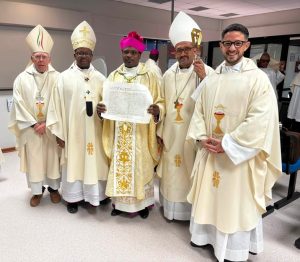
Ordained to the priesthood in 2012 by Archbishop Sithembele Sipuka, then Bishop of Mthatha, Bishop Phomane continued to embrace lifelong formation, always seeking to respond to the needs of the local Church.
After completing studies in Business Management, Archbishop Sipuka encouraged him to pursue Canon Law, recognising the Diocese of Mthatha’s growing need for a qualified canon lawyer.
Bishop Phomane obtained a Licentiate in Canon Law from the Catholic University of Eastern Africa in Nairobi in 2018, before undertaking Honours studies in Translation Studies after recognising the need to make Church teaching and canonical texts accessible to Sesotho-speaking Catholics.
“We need our people to have access to the teachings and judgments of the Church in their own language,” he explained. “As the Church grows, we must also develop our own resources.”
His academic formation enabled him to serve in diocesan administration, ecclesiastical tribunals—including the Metropolitan Tribunal of the Archdiocese of Durban—and the wider Church.
He also became one of the leaders of the synodal process in the Diocese of Mthatha, helping to prepare the diocesan implementation plan and pastoral handbook following the Synod on Synodality.
As he begins his ministry in Bethlehem, Bishop Phomane says his first task is to listen.
“I do not yet know the Diocese of Bethlehem,” he said. “I first want to understand the people, their reality, and their needs. Much good work has already been done by my predecessors, and I hope to continue building on those foundations.”
“He completed the work he began”
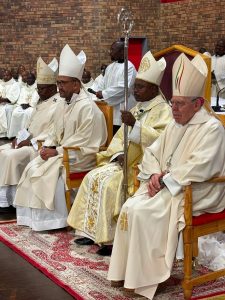
Among the most moving moments of Bishop Phomane’s episcopal journey was seeing Archbishop Sithembele Sipuka preside as the principal consecrator at his episcopal ordination on 4 July.
For the newly ordained bishop, the moment carried profound personal significance.
Speaking to the SACBC Communication Office on the day of his appointment, Bishop Phomane had expressed one heartfelt wish.
“I thank Archbishop Sipuka,” he said. “He ordained me to the priesthood, encouraged me to study Canon Law, and I hope that he will complete the work he began in me by being one of the bishops who ordains me to the episcopacy.”
That hope became a reality, as Archbishop Sipuka served as the principal consecrator at the episcopal ordination, a deeply symbolic moment linking the beginning of Bishop Phomane’s priestly ministry with the beginning of his ministry as the fifth Bishop of Bethlehem.
The fulfilment of his wish to be ordained by the same bishop who first laid hands on him as a priest became a visible sign of the continuity of apostolic ministry and the enduring bond between shepherd and disciple.
A ministry entrusted to God
Despite his years of pastoral ministry, academic formation and diocesan leadership, Bishop Phomane insists that humility remains the foundation of his episcopal ministry.
“The Church and the Holy Father have found me worthy,” he reflected. “But I myself do not see that worthiness.”
Entrusting his ministry entirely to God’s providence, he appealed to the faithful of both the Diocese of Mthatha and the Diocese of Bethlehem to accompany him with their prayers.
“I ask the people of Bethlehem, the people of Mthatha and all the faithful of the Church to pray for me,” he said. “With God’s grace, I believe that together we will fulfil the mission entrusted to us.”
Echoing Archbishop Jagodziński’s reflection, Bishop Phomane’s journey—from a young man who delayed his vocation to support his family, to a factory worker who answered God’s persistent call, to a priest formed through study and pastoral service, and now the first South African-born Bishop of Bethlehem—has become a living witness to a local Church that continues to bear lasting fruit, raising shepherds from among its own people for the service of the Gospel.
0 Comments