
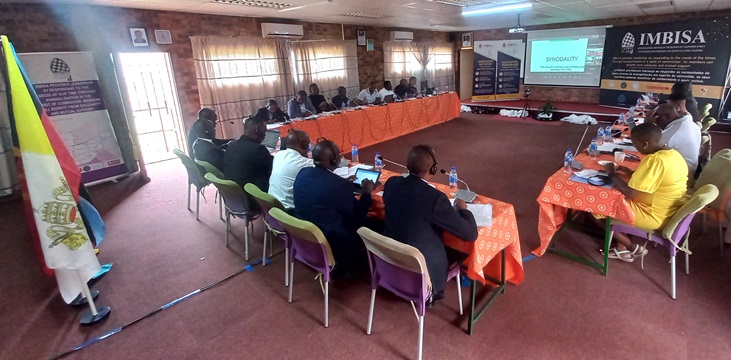
Major seminary rectors from across Southern Africa are meeting in Pretoria to develop a curriculum that will embed listening, communal discernment and shared responsibility in priestly formation, as the Catholic Church continues to implement the Synod on Synodality.
Organised by the African Synodality Initiative (ASI), housed by the Jesuit Conference of Africa and Madagascar, in collaboration with the Inter-Regional Meeting of the Bishops of Southern Africa (IMBISA), the five-day workshop runs from 26 to 30 October at the Padre Pio Retreat Centre.
The gathering brings together rectors from the six episcopal conferences that make up IMBISA: the Episcopal Conference of Angola and São Tomé (CEAST), Lesotho Catholic Bishops’ Conference (LCBC), Namibia Catholic Bishops’ Conference (NCBC), Episcopal Conference of Mozambique (CEM), Southern African Catholic Bishops’ Conference (SACBC) and Zimbabwe Catholic Bishops’ Conference (ZCBC).
Preparing future priests for a synodal Church
ASI Programme Coordinator Caroline Kavita said the initiative had accompanied different groups across Africa and Madagascar since 2021, when Pope Francis launched the Synod on Synodality. This work has included the formation of over 800 seminarians.
Speaking to SACBC Communications office, Kavita explained that seminary formation had repeatedly emerged as an important aspect of the synodal process.
“Those are the people that will be sent to communities, to churches, to be the people of God,” she said, explaining why ASI had prioritised preparing future priests to lead in a synodal way.
The initiative has worked with seminaries across Africa and collaborated with the Regional Episcopal Conferences of West Africa (RECOWA) on developing synodality formation. The new partnership with IMBISA aims to make this formation sustainable through a curriculum that seminaries can incorporate into their programmes.
Kavita noted that providing formation across all seminaries requires significant resources, while demand for synodality training continues to grow. A structured course, she said, would enable seminaries to continue the work and prepare future generations of priests for synodal leadership.
Listening, discernment and shared responsibility
During the opening sessions on Tuesday, 27 October, rectors from Angola, Zimbabwe, Lesotho and Mozambique shared their experiences of introducing synodality into seminary formation, highlighting progress and ongoing challenges.
Jesuit Fr Agbonkhianmege E. Orobator examined the history of the Synod of Bishops and reflected on the Synod on Synodality’s Final Document and its implications for the life and mission of the Church. Meanwhile, Jesuit Fr Marcel Uwineza invited rectors to foster a culture of listening, discernment and shared responsibility, preparing seminarians for communion rather than individualism and servant leadership rather than clericalism.
Discussions also explored prayerful conversation, respect for diversity and the African value of ubuntu, emphasising the dignity and contribution of every person in the Church.
Several major seminaries have already introduced synodality formation. In Angola, third-year theology students received training during a 2025 study week organised by Mosaiko, an institute for civic development, with sessions presented by Sheila Leocadia Pires who served as the Secretary of the Commission for Information of the Synod on Synodality. In Lesotho, Bishop Masilo John Selemela of Pretoria Archdiocese has also provided formation on Synodality, while in Mozambique, Sister Ester Lucas and Bishop Osorio Citora Afonso IMC have contributed to workshops for seminarians. Zimbabwean seminaries have also benefited from initiatives led by bishops who participated in the Synod on Synodality.
Developing a curriculum for priestly formation
During the discussions, rectors raised questions about distinguishing synodality from political democracy, addressing resistance to its implementation and translating the vision of the Second Vatican Council into the everyday life of seminaries.
The workshop includes a review of a draft syllabus, giving participants the opportunity to assess its content, propose adaptations for their local contexts and consider piloting the course in their respective seminaries. The workshop is expected to conclude with recommendations on the curriculum and the next steps for collaboration between ASI and IMBISA.
0 Comments