
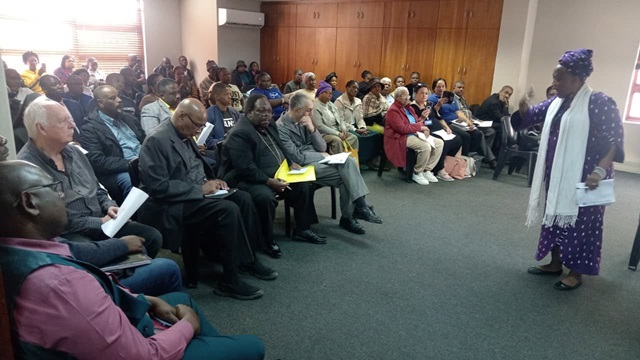
Amid growing tensions over migration and a recent surge in anti-migrant protests across South Africa, the Catholic Archdiocese of Durban convened faith leaders, civil society organisations, migrant representatives, and community members for a Social Cohesion Dialogue to promote peaceful coexistence and address the root causes of social unrest.
The dialogue, held at the Diakonia Centre in Durban, was organised by the Archdiocese’s Justice, Peace and Development Commission (JPDC) and attended by representatives from Africa Unite, the KwaZulu-Natal Christian Council (KZNCC), the International Humanitarian Organisation for Migration (IHOM), the March and March Movement, ProBono.Org, Lawyers for Human Rights, Refugee Social Services, and members of the local community.
A Church Committed to Dialogue
Addressing participants, Archbishop Siegfried Mandla Jwara CMM of Durban explained why the Church felt compelled to facilitate the conversation.
“The Church is called to bring people together, especially when society is divided,” he said, noting that migration has always been part of human history and that South Africa itself has benefited from the contributions of migrants.
Archbishop Jwara acknowledged the frustrations felt by many South Africans struggling with poverty, unemployment, and poor service delivery, but cautioned against blaming migrants for problems rooted in governance failures.
“It is not the immigrants who have a problem,” he said. “The question is how they come in. If the government is not doing its job, then we must address that reality honestly.”
The Local Ordinary of Durban Archdiocese pointed to long-standing social inequalities that continue to affect many communities.
“People are fighting over scarce resources because, after thirty years, many still do not have access to basic services. These are the issues we should be addressing,” he said.
Cardinal Napier Calls for Respect and Honest Dialogue
Also present was the Archbishop Emeritus of Durban and Apostolic Administrator of Eshowe, who stressed the importance of mutual respect and truthful engagement.
“The principle I believe in is that I must respect you as you respect me,” said Cardinal Wilfrid Fox Napier OFM.
While acknowledging the anger and frustrations expressed during the dialogue, Cardinal Napier urged participants not to allow emotions to undermine constructive engagement.
“Dialogue does not mean we will all agree,” he said. “There will be times when we disagree, but we must respect one another in our disagreements.”
Cardinal Napier challenged narratives that place sole responsibility for South Africa’s difficulties on migrants.
“The government is there, not the immigrants,” he said. “Immigrants do not control Home Affairs. The government has that responsibility.”
Drawing on Scripture, Cardinal Napier reminded participants of the biblical call to care for the vulnerable.
“The Bible keeps speaking about the orphan, the widow, and the stranger. We are called to be kind, just, and helpful,” he said.
The Apostolic Administrator of Eshowe Diocese described the gathering as “only the starting point” of a process that must continue through ongoing engagement between communities, government, and civil society.
Diverse Perspectives Heard
Among those contributing to the discussion was Jacinta Ngobese-Zuma of the March and March Movement, one of the organisations advocating for stronger action against illegal immigration.
Ngobese-Zuma argued that many South Africans feel excluded from economic opportunities and public services while migration pressures continue to increase.
She maintained that concerns about jobs, education, healthcare access, and public resources should not be dismissed and called for better enforcement of immigration laws.
Her intervention generated strong reactions among participants and highlighted the depth of feeling surrounding migration issues in South Africa. Despite moments of tension, organisers said the dialogue succeeded in creating a platform where different viewpoints could be expressed openly and respectfully.
Church Leaders Condemn Violence
The Durban dialogue took place against the backdrop of strong statements from both Catholic and ecumenical church leaders.
In a pastoral letter issued on 20 May, the Southern African Catholic Bishops’ Conference (SACBC) condemned violence, intimidation, and displacement directed at migrants and refugees, describing such actions as “a grave assault on human dignity.” The bishops warned politicians against exploiting migration concerns for political gain and stressed that governance failures, corruption, unemployment, and inequality lie at the heart of the current crisis.
Similarly, the South African Council of Churches (SACC), led by Archbishop Sithembele Sipuka, issued a pastoral letter on 9 June condemning hostility and violence against foreign nationals and calling on Christians and all people of goodwill to uphold the dignity of every person and reject xenophobia.
The gathering comes at a time when anti-migrant demonstrations have spread across several provinces, leading to violence, displacement, and growing fears among foreign nationals. In recent weeks, countries including Ghana, Mozambique, Malawi, and Nigeria have begun repatriating some of their citizens from South Africa following attacks and threats linked to anti-migrant unrest. Reports indicate that thousands of citizens have already returned home, while more have registered for voluntary repatriation programmes.
While anti-migrant groups have promoted a 30 June deadline for undocumented migrants to leave South Africa, government authorities have stated that no official government ultimatum exists and have warned against vigilantism.
Tshwene-kalie Nathan Senyane from the Archdiocese of Durban – Justice, Peace and Development Commission contributed to this article
0 Comments