
Founded in 1970, Caritas South Africa is working to strengthen its national structure and improve coordination while building on the charitable work carried out by dioceses across the country.
Caritas South Africa is renewing efforts to strengthen national coordination and support the charitable work carried out by dioceses, as the Catholic Church seeks to respond more effectively to poverty, hunger, unemployment and humanitarian emergencies.
Founded in 1970 in response to the poverty and inequality experienced under apartheid, Caritas South Africa has promoted human development, economic justice, peace and reconciliation. Its work encompasses food security, sustainable livelihoods, healthcare, early childhood development and assistance to vulnerable families.
Diocesan structures have remained central to this mission, responding directly to the needs of local communities. Efforts to establish a stronger national organisation have sought to bring these initiatives together, facilitate collaboration and strengthen the Church’s service to the poor.
Building a national Caritas structure
In 2014, the Southern African Catholic Bishops’ Conference (SACBC) began renewed discussions about the future of Caritas South Africa, with the aim of establishing a more effective national agency for the Church’s work of charity.
These efforts gained momentum in 2019 under the leadership of Cardinal Wilfrid Napier OFM, then president of Caritas South Africa, with Sr Maria De Lourdes Lodi Rissini MSCS serving as national coordinator.
A three-day conference held at the Lumko Institute in Benoni, Gauteng, in September 2019 brought together national and international representatives to discuss the organisation’s future amid financial challenges.
Participants included Aloysius John, then secretary-general of Caritas Internationalis, and Moira Monacelli, who headed its institutional development and capacity strengthening department.
The conference identified six strategic priorities: establishing Caritas South Africa as a national organisation, strengthening resource mobilisation, improving communication and advocacy, enhancing coordination, promoting integral human development, and strengthening disaster response and risk management.
Cardinal Napier presented the Caritas South Africa constitution, which had been approved by the SACBC at its August 2019 plenary.
The objective was to build a national structure capable of supporting diocesan initiatives, encouraging the sharing of resources and experience, and coordinating the Church’s response to the needs of vulnerable communities.
Diocesan initiatives sustain the mission
When Sr Maria De Lourdes Lodi Rissini’s term as national coordinator ended in 2023, responsibility for Caritas South Africa rested with the SACBC Secretariat. National coordination became limited between 2023 and 2026, although diocesan initiatives continued to serve local communities.
Reports presented at a meeting of diocesan Caritas representatives on 30 September 2026 highlighted the breadth of this work.
Caritas Tzaneen assisted migrants at the Musina repatriation centre, while Caritas Port Elizabeth helped arrange transport for migrants returning to their countries of origin. Caritas Aliwal North assisted 21 families involving 26 children experiencing difficulties obtaining birth certificates.
Other diocesan initiatives address food insecurity through community gardens, feeding schemes and food-parcel distribution. Caritas structures also support skills development for unemployed young people, assist vulnerable children with school uniforms, accompany people living with HIV and provide relief to communities affected by flooding.
These activities illustrate the importance of diocesan structures in putting the Church’s charitable mission into practice. Strengthening national coordination is therefore essential to supporting this work, improving communication and enabling dioceses to share experience and respond collectively to emerging needs.
A renewed structure for integral human development
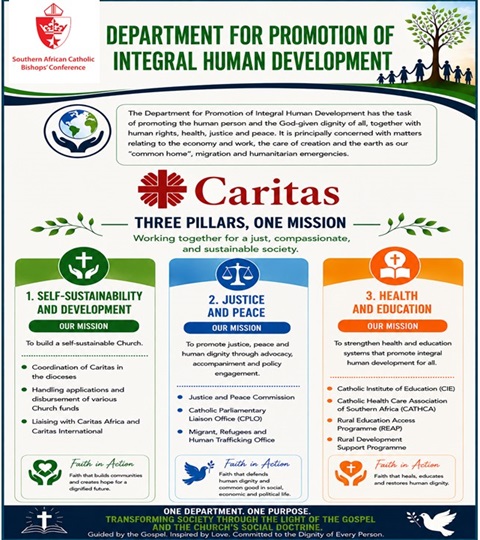
Caritas South Africa now falls under the SACBC’s Department for the Promotion of Integral Human Development, reflecting the mission of the Vatican’s Dicastery for Promoting Integral Human Development.
The department brings together three strategic areas of work: Caritas, Justice and Peace, and Health and Education.
Fr Stan Muyebe OP serves as the department’s coordinating secretary and coordinator of Caritas South Africa. This structure provides a framework for greater collaboration across the Church’s social mission and for strengthening links between diocesan initiatives and the national office.
During a visit to Khanya House in October 2025, Monsignor Pierre Cibambo Ntakobajira, president of Caritas Africa, emphasised the importance of connecting grassroots initiatives with effective national coordination.
He explained that Caritas must go beyond emergency assistance to accompany communities, strengthen their capacity and address the root causes of poverty. He also called for the appointment of a national director for Caritas South Africa, stressing the need for competent leadership grounded in compassion and a commitment to serving the poor.
Strengthening collaboration and communication
At the September 2026 meeting, diocesan representatives identified inadequate and unpredictable funding, shortages of volunteers and weaknesses in communication and reporting as continuing challenges.
Addressing these difficulties will require sustained collaboration, improved resource mobilisation and stronger links between diocesan structures and the national office.
The priority is to develop a national structure that supports rather than duplicates the work already taking place in dioceses, helping local initiatives access resources, share experience and coordinate their responses to humanitarian and social challenges.
As Caritas South Africa works to strengthen its national organisation, its continued effectiveness will depend on building on the diocesan structures that have sustained its mission over the years: accompanying vulnerable people, responding to immediate needs and promoting human dignity in local communities.
0 Comments