
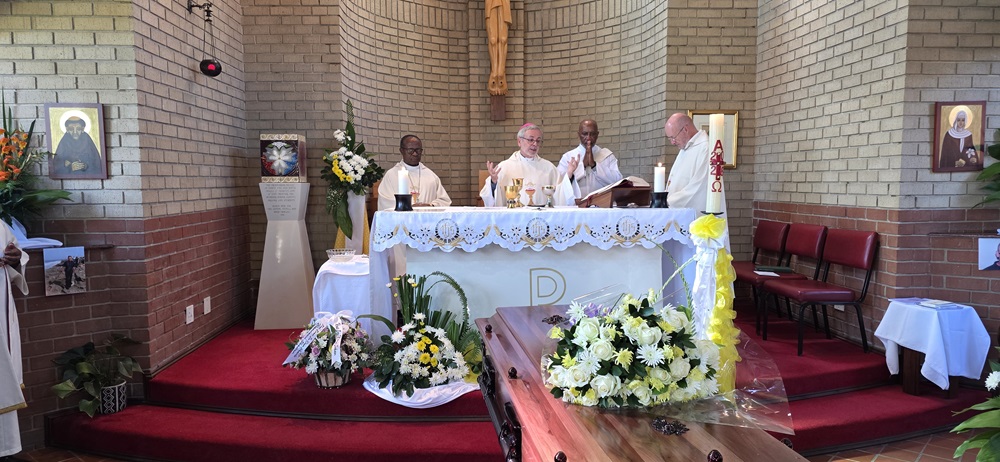
A profound sense of gratitude, sorrow, and Christian hope marked the Funeral Mass of Johan Viljoen, celebrated on Wednesday, 13 May, at Khanya House, the headquarters of the Southern African Catholic Bishops’ Conference (SACBC) in Pretoria, where bishops, priests, religious, humanitarian workers, family members, and friends gathered to honour a man remembered for dedicating his life to peace, justice and solidarity with the suffering.
The Eucharistic celebration was presided over by Bishop José Luís Gerardo Ponce de León, IMC, while the President of the Episcopal Conference of Mozambique, Archbishop Inácio Saúre, IMC, concelebrated alongside several priests and close collaborators of Johan. Their presence reflected the many dimensions of Johan’s humanitarian and ecclesial service, particularly through the SACBC Aids office, Migrants and Refugees Office, the Jesuit Refugee Service, and the Denis Hurley Peace Institute.
In his homily, Bishop Ponce de León reflected on the Gospel account of Jesus at the foot of the Cross, describing it as the image that immediately came to his heart when he learned of Johan’s passing.
Recalling one of their last conversations, the Liaison Bishop for the Dennis Hurley Peace Institute, shared how Johan had accompanied him to the car after a meeting at Khanya House and quietly mentioned that he knew his time “among us was coming to an end” and that he had prepared everything for that day.
Bishop Ponce de León then turned to the Gospel passage from Saint John, where Mary, the women disciples, and the beloved disciple remain standing beside the crucified Christ. He described their presence not as one capable of removing suffering, but as a faithful and compassionate refusal to abandon the innocent victim.
“They did not leave Him alone. They did not add loneliness to His suffering,” Bishop Ponce de León said.
Drawing a direct connection between the Gospel and Johan’s life, the bishop added: “Like those by the Cross, Johan chose to stand by the cross of many innocent people in our continent and beyond.”
The homily traced Johan’s longstanding commitment to humanitarian service, beginning with his work during the HIV/AIDS pandemic through the SACBC AIDS Office, where Bishop Ponce de León first came to know him nearly twenty-five years ago. Their collaboration later continued through the Denis Hurley Peace Institute, where Johan became widely respected for his advocacy on behalf of displaced communities and victims of violence across Africa.
The Local Ordinary of Manzini Diocese recalled in particular their visit to Pemba in northern Mozambique, at the height of the Cabo Delgado conflict, where they encountered thousands of displaced families living in refugee camps.
“I can still see ourselves seated at the bishop’s residence in Pemba,” he said. “Johan would never be a spectator. Without thinking twice, he would suggest an immediate plan of action — and a very ambitious one. It was never about himself. It was about them and how to ease their suffering.”
Throughout his reflection, Bishop Ponce de León repeatedly returned to the image of the Cross, saying Johan not only chose to stand beside the suffering, but also worked tirelessly to ensure that the suffering of innocent people would not be ignored or forgotten.
“Today the crucified are easily pushed aside and forgotten,” the bishop said. “Johan worked to open the eyes of many to the causes of their suffering.”
The bishop noted that Johan possessed a remarkable understanding of the African continent and its challenges. Several bishops had expressed gratitude for the regular updates and analysis he shared regarding ongoing conflicts, migration crises, and humanitarian concerns affecting different regions of Africa.
Messages received following his death also testified to the deep relationships Johan formed through his work. Bishop Ponce de León recalled a message sent by the Prefect of the Dicastery for Promoting Integral Human Development, Cardinal Michael Czerny SJ, who remembered Johan’s efforts to promote peace in areas affected by violence and exploitation linked to natural resources.
Archbishop Saúre, who travelled from Mozambique for the Funeral Mass, had also written that Johan had become “not only a tireless collaborator” of the Archdiocese of Nampula’s Caritas “but also a true brother and friend.”
Even in the final days of his life, Johan remained engaged in the work he loved. Bishop Ponce de León noted that Johan had attended a board meeting of the Denis Hurley Peace Institute just days before his passing.
Concluding his homily, the bishop urged those present not only to remember Johan himself, but also the countless suffering people for whom he gave his life in service.
“It would not be right for us to remember Johan today and forget the crucified,” he said. “We thank God for the gift of his life and service, and we pray that he is welcomed home and sees the Lord face to face.”
Following the Funeral Mass, Johan Viljoen’s remains were taken for cremation, as the Church in Southern Africa gave thanks for the life of a man who, until the very end, remained close to those carrying the heaviest crosses.
0 Comments