
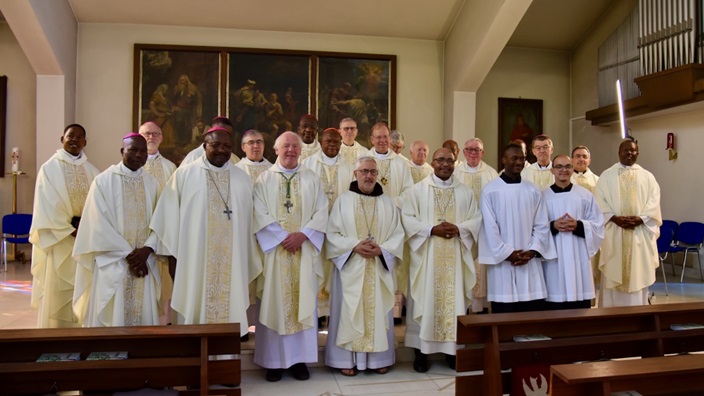
Bishops from Africa and Europe gathered in Luxembourg from 25 to 28 May for a joint seminar organised by the Council of European Bishops’ Conferences (CCEE) and the Symposium of Episcopal Conferences of Africa and Madagascar, reflecting on the theme “Evangelisation and Synodality: Continental Pathways.”
Among the participants was Bishop Thulani Victor Mbuyisa CMM, Bishop of Kokstad and Vice-Chairperson of the Southern African Catholic Bishops’ Conference (SACBC) Commission for Synodality, who described the gathering as a valuable opportunity for mutual listening, discernment and shared learning as local Churches continue implementing the fruits of the Synod on Synodality.
Held every two years, the CCEE-SECAM seminars provide a platform for dialogue between the Churches of Africa and Europe, strengthening collaboration and fostering the exchange of pastoral experiences. The Luxembourg meeting followed the previous seminar held in Nairobi in 2024 and focused on how local Churches across both continents are embracing synodality as a way of living the Church’s mission.
The gathering began with participation in the traditional celebrations of Saint Willibrord, the missionary bishop credited with evangelising the region. Delegates joined the local Church in Echternach for liturgical celebrations and the historic procession held annually in his honour, drawing inspiration from a missionary legacy that continues to shape the Church’s evangelising mission today.
A shared journey of implementation
Reflecting on the discussions, Bishop Mbuyisa said participants examined both the progress and challenges emerging as episcopal conferences and dioceses move into the implementation phase of the Synod.
“We were looking at where we are as episcopal conferences and local Churches in the implementation process,” he explained. “At the same time, we were asking how Africa and Europe can work together more effectively in the service of the Gospel.”
Participants noted that synodality is increasingly being embraced across both continents. While implementation varies according to local realities and pastoral contexts, there was broad agreement that the synodal journey has generated renewed enthusiasm for participation, communion and mission.
One recurring concern was the need to involve clergy more deeply in the synodal process.
“In some places there is a perception among priests that they were not sufficiently involved from the beginning,” Bishop Mbuyisa noted. “Yet the successful implementation of synodality depends on the participation of everyone in the Church.”
The seminar also highlighted the importance of formation, especially for lay people, enabling them to contribute more effectively to the life, mission and discernment processes of the Church.
Addressing common pastoral challenges
Discussions revealed that many of the pastoral challenges facing Africa and Europe are shared, even if they manifest differently in each context.
Participants reflected on issues including migration, armed conflict, youth ministry, secularisation, evangelisation and the emergence of new religious movements.
Migration emerged as a particularly significant topic. Both continents continue to experience major movements of people, creating pastoral opportunities and challenges for local Churches.
Delegates considered how best to accompany migrants, refugees and displaced persons, ensuring they remain integrated into the life of the Church while preserving their dignity, cultural identity and sense of belonging.
The seminar also explored practical experiences related to communicating synodal documents in multilingual contexts. Drawing on his own pastoral experience, Bishop Mbuyisa observed that many dioceses are required to work simultaneously in several languages and often need to simplify complex texts so that they can be understood and received by local communities.
Participants exchanged experiences on translating, adapting and disseminating Church documents while remaining faithful to their original meaning and intent.
Signs of hope for the Church
Despite the many challenges discussed, participants repeatedly pointed to signs of hope emerging across both continents.
Reports presented during the seminar highlighted a growing number of people entering the Catholic Church in several parts of Europe, particularly young adults searching for meaning, spiritual direction and authentic community.
“This is often not the kind of news that receives much attention,” Bishop Mbuyisa observed. “Yet many people are searching for God, searching for hope and searching for a place where they belong.”
Africa, meanwhile, continues to be characterised by a youthful and vibrant Church. However, participants acknowledged the need for stronger accompaniment of young people to help them remain engaged in the faith amid rapidly changing social realities.
“Conversion takes time”
A central theme running through the seminar was the recognition that synodality cannot be reduced to structures, programmes or organisational reforms.
While participants acknowledged the timeline leading towards the Ecclesial Assembly scheduled for 2028, many emphasised that genuine synodal renewal requires a deeper spiritual transformation.
“It is easy to create structures,” Bishop Mbuyisa reflected. “But synodality is ultimately about conversion, and conversion takes time. We cannot place a timetable on the work of the Holy Spirit.”
For Bishop Mbuyisa, this understanding lies at the heart of the Church’s synodal journey. Structures may support participation and dialogue, but true synodality requires a continual conversion of attitudes, relationships and ways of exercising responsibility within the Church.
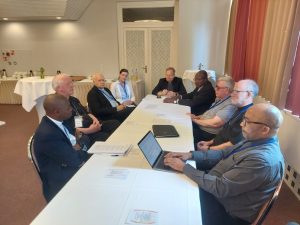
This conviction shaped many of the group discussions and “Conversations in the Spirit,” during which participants shared experiences, challenges and best practices from their respective regions.
Strengthening missionary cooperation
The seminar also dedicated considerable attention to missionary cooperation between Churches in Africa and Europe.
Participants reflected on the growing presence of African missionaries serving in Europe and discussed ways of strengthening collaboration between sending and receiving dioceses.
Discussions focused on the importance of discernment, formation and accompaniment for missionaries, while also examining the pastoral care of migrant Catholic communities and the needs of dioceses that continue to depend heavily on clergy and religious from abroad.
As a member of the Dicastery for Evangelization, Bishop Mbuyisa welcomed the emphasis placed on missionary collaboration and the exchange of gifts between local Churches.
Participants stressed the importance of ensuring that missionary assignments take place within appropriate ecclesial structures and through cooperation between bishops and dioceses, rather than through isolated individual initiatives.
Looking towards 2028
The Luxembourg meeting took place as local Churches continue preparations for the next phase of the synodal journey and the upcoming Consistory convened by Pope Leo XIV, scheduled to take place at the Vatican from 26 to 27 June.
According to Bishop Mbuyisa, the discussions reflected a growing awareness that synodality is not a temporary programme but an essential dimension of the Church’s life and mission.
“There is a greater appreciation today of what synodality is about,” he said. “People increasingly see it not as an end in itself but as a way of evangelisation and a way of being Church.”
As the seminar concluded, participants agreed on the importance of continuing dialogue and collaboration between Africa and Europe in the lead-up to the 2028 Ecclesial Assembly.
The next CCEE-SECAM seminar is expected to take place in Africa, continuing a journey marked by listening, communion and shared mission.
0 Comments