
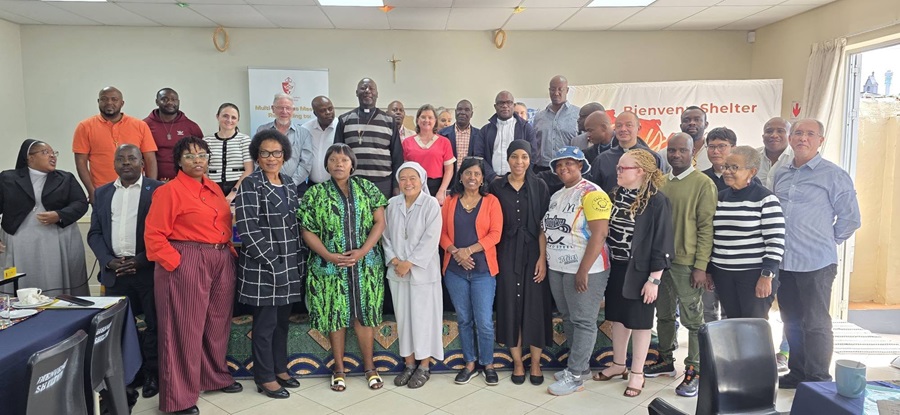
The Catholic Church, together with ecumenical and humanitarian groups, continues to intensify efforts to address statelessness, migration challenges, and rising xenophobia in Southern Africa, following a strategic multi-religious meeting held in Johannesburg.
In an interview with the Southern African Catholic Bishops’ Conference (SACBC) Communication Office, the Liaison Bishop for the SACBC Migrants, Refugees and Human Trafficking Office emphasized the urgent need for dialogue with government authorities, stating that engagement with the Department of Home Affairs can no longer be delayed.
“Our meeting with the Minister of Home Affairs is overdue,” said Bishop Joseph Mary Kizito. “We need to sit down together, identify the challenges, and find practical solutions for people who are struggling to regularise their status,” he added.
Documentation Delays and Systemic Challenges
In the Friday, March 27, interview, Bishop Kizito highlighted the backlog in processing documentation for migrants, asylum seekers, and foreign clergy.
Bishop Kizito explained that many individuals wish to comply with immigration laws but face administrative delays that prevent them from regularising their status.
“People do not want to live illegally,” he said. “They want to follow the law, but the system is often slow and difficult to navigate.”
He added that delays in renewing permits have affected not only lay migrants but also religious workers serving in parishes and dioceses across the region.
Barriers to Education for Stateless Learners
Another pressing issue discussed during the meeting was the situation of undocumented students who complete their schooling but are unable to access the official certification required for further education.
Bishop Kizito noted that such students may pass their final examinations but cannot obtain the necessary documentation to enrol in universities or vocational colleges.
“This is very painful for young people,” Bishop Kizito said. “They work hard, they succeed in school, but their future is blocked because they lack the proper documents.”
He described the situation as a serious social and moral challenge that requires urgent attention from policymakers.
A Strategic Gathering to Address Statelessness
The meeting, convened on 25 March 2026 at the Mother Assunta Training Centre in Johannesburg, brought together leaders from various religious traditions, civil society organizations, and humanitarian agencies to develop concrete responses to statelessness and migration-related challenges.
Organised by the SACBC Migrants, Refugees and Human Trafficking Office in partnership with ecumenical and humanitarian groups, the gathering focused on strengthening collaboration among faith communities in addressing xenophobia, prejudice, and the exclusion of undocumented persons.
According to Bishop Kizito, participants examined research findings, legal developments, and the lived experiences of migrants and refugees, while also sharing successful local initiatives aimed at providing support to vulnerable communities.
Practical Initiatives Making a Difference
Across dioceses in South Africa, Botswana, and Eswatini, Church-based initiatives continue to assist migrants and stateless persons in obtaining legal documentation and accessing essential services.
Bishop Kizito cited recent progress within his own diocese, where Church workers helped several children obtain official documentation after years of waiting.
“When a child receives documentation, that child receives identity and dignity,” he said. “It means they can go to school, receive healthcare, and participate fully in society.”
The meeting also highlighted innovative community responses, including parish-based health services such as the São Carlos Health Centre in La Rochelle that provide medical care to undocumented women and children. According to Bishop Kizito, such initiatives demonstrate how local faith communities can offer practical support while advocating for systemic change.
Rising Xenophobia and the Need for Dialogue
Despite these efforts, participants expressed concern about growing anti-migrant sentiment and the increasing use of migration issues in political discourse.
Humanitarian organizations reported that fear and discrimination continue to affect migrants and refugees, particularly during times of social and economic stress.
Bishop Kizito warned that such tensions can undermine social cohesion and threaten the safety of vulnerable communities.
“This trend is worrying,” he said. “We must promote dialogue, understanding, and solidarity. The Church has a responsibility to build bridges and encourage peaceful coexistence.”
The Role of Religious Leaders
During the meeting, religious leaders were encouraged to strengthen their pastoral response to migration challenges by listening to the experiences of affected individuals and advocating for justice. “We are bridge builders,” he said. “Our mission is to connect people, promote justice, and protect human dignity.”
The bishop concluded by reaffirming the Church’s commitment to building a society rooted in justice, compassion, and solidarity. “We are not simply observers,” he said. “We are called to act, to stand with the vulnerable, and to be witnesses of hope.”
A Call for Partnership and Action
As the Church continues to advocate for migrants and refugees, Bishop Kizito emphasized the importance of collaboration between religious leaders, civil society organizations, and government authorities.
He expressed hope that constructive dialogue with the Department of Home Affairs will lead to practical solutions that protect the rights and dignity of all people.
“We believe that through cooperation and goodwill, we can overcome these challenges,” he said. “Our mission is to serve, to accompany, and to ensure that no one is left behind.”
0 Comments