
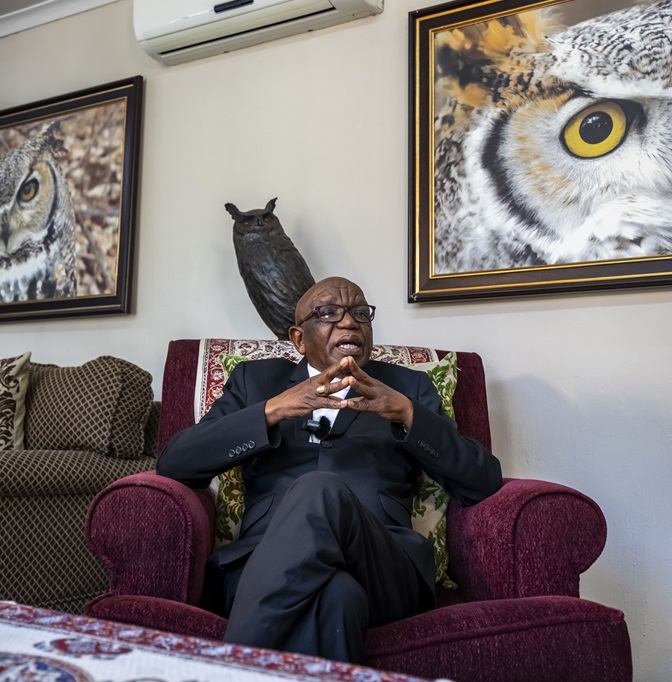
As South Africa marks fifty years since the Soweto Uprising of 16 June 1976, retired Archbishop Buti Joseph Tlhagale OMI has reflected on the pivotal role played by young people in confronting apartheid and reviving a spirit of resistance that had lain dormant for years.
In an interview with the Southern African Catholic Bishops’ Conference (SACBC) Communication Office, Archbishop Tlhagale recalled his first years of priesthood in Soweto, where he witnessed firsthand the events that would become a turning point in South Africa’s liberation struggle.
Ordained a priest in 1976 after completing his studies in Rome, the young Fr Tlhagale was assigned to Regina Mundi Parish in Soweto, a church that would become synonymous with the struggle against apartheid.
“Regina Mundi became a popular gathering place because of its size,” he explained. “It was the only building in Soweto that could accommodate close to 5,000 people.”
At the time, apartheid laws severely restricted public gatherings, allowing people to assemble only under a roof. As a result, Regina Mundi became one of the few places where community leaders, students, and activists could gather to express their hopes and frustrations.
More than a protest against language
While the Soweto Uprising is often remembered for students’ opposition to the compulsory use of Afrikaans as a medium of instruction, Archbishop Tlhagale stressed that the deeper issue was opposition to the apartheid system itself.
“There was nothing wrong with Afrikaans as a language,” he said. “The problem was that it was imposed on students. They were expected to study subjects like science and agriculture in Afrikaans. For young people, that was clearly an imposition.”
Yet beneath the language dispute lay a broader rejection of apartheid.
“Almost everybody in the country wanted apartheid to go,” he recalled. “There was a tangible hatred towards the apartheid political system.”
After years of political repression following the imprisonment of liberation leaders in the 1960s, the uprising provided an opportunity for people to once again express their opposition to injustice.
The Church stands in solidarity
Archbishop Tlhagale described the Catholic Church’s role during those turbulent years as one of solidarity and support.
While not all priests were directly involved in political activism, many opened church buildings for meetings, led prayers at gatherings, and accompanied grieving families whose children had been killed during protests.
“The priests were supportive,” he said. “They made churches available for meetings and helped families during difficult times. They stood in solidarity with the people.”
Regina Mundi became a focal point for annual June 16 commemorations, attracting thousands of young people. Church leaders and prominent anti-apartheid figures regularly addressed the crowds, including Archbishop Desmond Tutu and members of the Committee of Ten.
The gatherings were often met with a heavy police presence. According to Archbishop Tlhagale, confrontations between security forces and young people became almost inevitable after commemorative events.
“The police had no mercy,” he recalled. “But the young people kept coming back year after year.”
A generation that refused to surrender
One of the most remarkable features of the struggle, Archbishop Tlhagale noted, was the determination of young people despite constant harassment and intimidation.
Student leaders were routinely targeted by the authorities. Many were detained, forced into exile, or fled the country to avoid arrest. As a result, new leadership emerged almost every year.
“Each year you could almost guarantee that there would be a different leadership,” he said. “The leaders disappeared, but the young people never gave up.”
The annual commemorations at Regina Mundi became more than memorial events. They were occasions for communities to express collective grief, anger, and hope for a democratic future.
Among those who addressed the crowds was Zindzi Mandela, who spoke about her imprisoned father, Nelson Mandela, at a time when many South Africans knew his name but had little knowledge of the man himself.
Reviving the struggle
Reflecting on the significance of the Soweto Uprising, Archbishop Tlhagale believes the students of 1976 succeeded in reigniting a national movement for freedom.
“It is that environment that brought about a passion and a love for freedom,” he said. “Before that, many people had simply given up.”
The uprising, he argued, laid the foundations for the labour protests, civic movements, and political mobilisation that gained momentum during the 1980s and eventually contributed to the dismantling of apartheid.
“The fire became a huge one because of the students,” he said. “They drew the attention of the world to what was happening in South Africa.”
Their courage not only intensified international pressure against apartheid but also inspired new generations of South Africans to continue the struggle for justice and equality.
0 Comments