
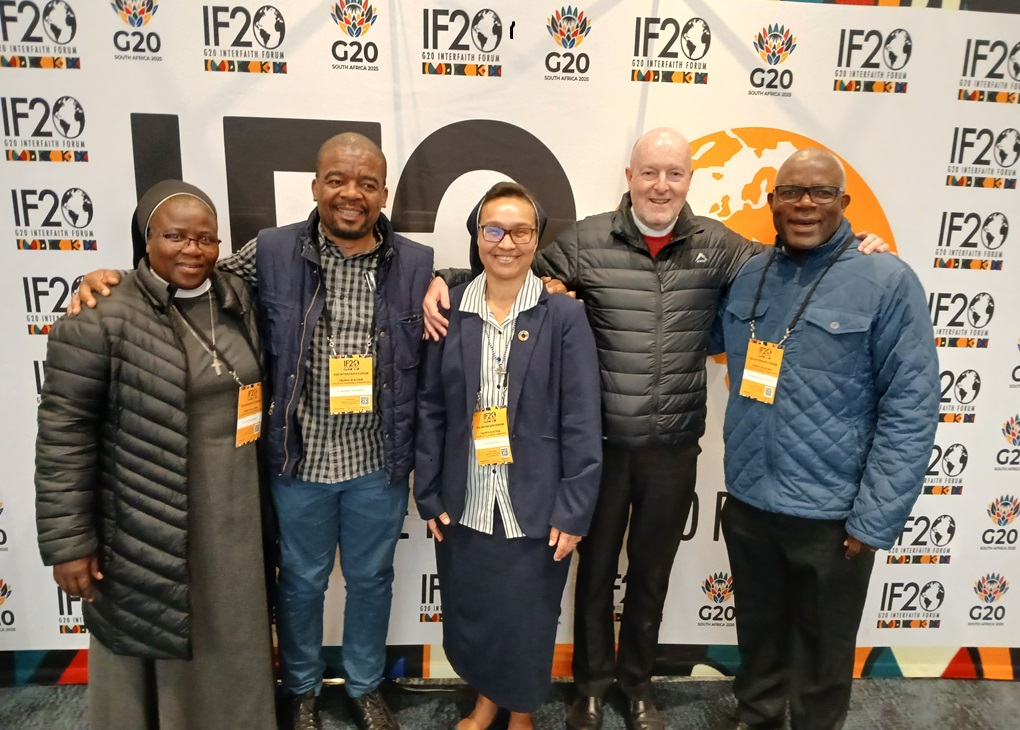
Religious leaders from across the globe gathered in Cape Town from August 10 to 14 for the G20 Interfaith Forum, held under the theme Ubuntu in Action: Focus on Vulnerable Communities. The annual event brought together faith-based organizations, civil society actors, and policymakers to address urgent global and local challenges, particularly those affecting the most marginalized.
In a report shared with the Southern African Catholic Bishops’ Conference (SACBC), Fr. Bonaventure Mashata, a member of the Congregation of Missionaries of Africa (MAfr) and Coordinating SACBC Secretary for the Department of Ecumenism, Interreligious Dialogue and Dialogue with the Secular World, said the Catholic Church was “locally and globally present” and “actively engaging in discussions” at the forum.
According to Fr. Mashata MAfr, who attended the gathering alongside the SACBC Secretary General, Fr. Hugh O’Connor, and Dominican priest Fr. Stan Muyebe, the Cape Town forum focused on five interconnected priority areas: food security and poverty; economic and financial action; addressing interreligious tensions through education; migration, refugees and human trafficking; and disaster prevention, response and recovery.
Speaking about food security, Fr. Mashata MAfr stressed that this “vital aspect of life” should not be left to politicians alone, highlighting the work of organizations such as Caritas, World Vision, and Islamic Relief. He also raised concerns about renewed debt crises in Africa, asking, “Why is debt back again and yet it was relieved during the Jubilee 2000 Campaign?” and calling for ethical financial systems that promote sustainable development.
On education and peacebuilding, Fr. Mashata MAfr pointed to initiatives such as Cross-Cultural Religious Literacy and Learning to Live Together as examples of how interreligious tensions can be reduced. These, he said, are part of broader efforts by faith leaders to combat gender-based violence and strengthen family life.
Migration and human trafficking also featured prominently in the discussions, with religious leaders urging compassion for displaced people and committing to coordinated action against modern slavery. Fr. Mashata MAfr noted that faith communities often act as “first responders” in crises, playing an essential role in disaster relief, climate resilience, and environmental stewardship.
In his report, Fr Mashata MAfr, recalled the United Nations Resident Coordinator in Lesotho, intervention during the forum, calling on faith leaders to “walk the talk.”
“We need to walk the talk. We have been compromised. The line between politicians and religious leaders is blurred”, said Amanda Khozi Mukwashi.
According to Fr. Mashata MAfr the gathering was not merely a platform for dialogue but “a call to action,” urging faith leaders to lead with integrity, collaborate across traditions, and embody Ubuntu in tangible ways.
The G20 Interfaith Forum (IF20) began in 2014 as a platform for global religious leaders and policymakers to collaborate on solutions to pressing challenges. It operates in parallel with the G20 Leaders’ Summit, offering recommendations rooted in moral and ethical values.
Past forums have tackled climate change, migration, gender equality, and global health. While independent from the G20’s political process, IF20 aims to ensure the voices of faith communities inform global policymaking.
The Cape Town 2025 edition marked the first time the forum was hosted on African soil, giving prominence to the continent’s perspectives on justice, development, and peacebuilding.
This year’s G20 Interfaith Forum also built on momentum from the Cape Town Declaration on Global Justice and Solidarity, adopted in July 2025 at the G20 International Symposium on Global Justice and Solidarity.
The SACBC Social Action Department, represented by the chairperson Bishop Thulani Victor Mbuyisa CMM, together with directors of the sub-commissions, joined faith leaders, academics, and multilateral organizations in calling for systemic reform of global financial and governance systems.
The declaration highlighted interconnected crises of climate change, debt relief, food security, and lack of access to development finance, urging coordinated, morally grounded international responses.
In his concluding remarks, Fr. Mashata MAfr said, “The momentum built in Cape Town must translate into concrete actions,” underscoring the Church’s moral duty to ensure no one is left behind.
0 Comments