
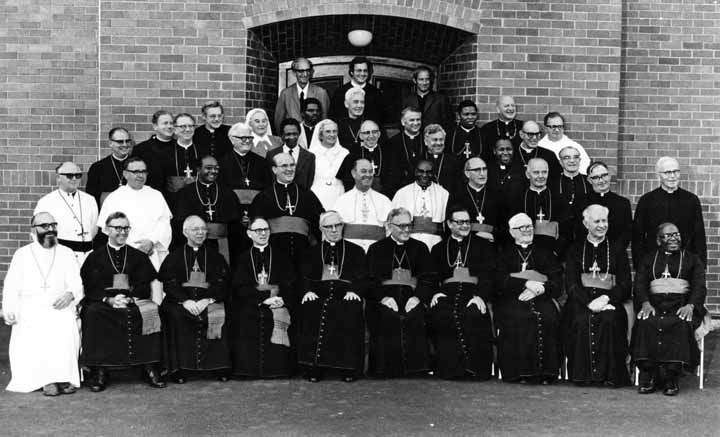
As the Church enters 2026, Cardinal Stephen Brislin has described the year as a “very special year for the Church in Southern Africa” as it marks the 75th anniversary of the establishment of the Southern African hierarchy, an event that shaped the pastoral, missionary, and institutional life of the Church in the region.
In an interview with the Southern African Catholic Bishops’ Conference (SACBC) Communications Office, Cardinal Brislin reflected on the meaning of the hierarchy, the historical context in which it was established in 1951, the Church’s journey through apartheid, and the path forward in a synodal Church rooted in hope.
What does “the establishment of the hierarchy” mean?
Cardinal Brislin began by clarifying what the term hierarchy signifies in this context.
“We speak about the hierarchy in different ways in the Catholic Church, very often it refers to what people have in their minds… that sort of pyramid structure… of the Holy Father, and the bishops, and then the priests, and then the laity.”
He explained that the anniversary commemorates something more concrete and historical. “In this sense,” he said, “the hierarchy really refers to the structure of the church, in this case, the structure of the church in Southern Africa.”
“It means that various dioceses were established, bishops were appointed, some places were not dioceses at that time; they were called vicariates, but nonetheless, there was a bishop to look after them,” said Cardinal Brislin in the Thursday, 1 January 2026 interview.
This establishment meant the creation of dioceses, the appointment of bishops, and the transition from missionary territories—then known as vicariates—to fully structured local churches.
“It means that various dioceses were established, bishops were appointed… and it was then the establishment in due course of the Southern African Catholic Bishops Conference,” he added.
Today, the SACBC, approved by the Holy See, brings together Catholic bishops serving in the ecclesiastical provinces of Cape Town, Durban, Pretoria, Johannesburg, and Bloemfontein, comprising 26 dioceses in South Africa, two in Botswana, and one in Eswatini.
Reflecting on this structure, Cardinal Brislin said, “It’s something that we must really be very grateful for today… that has enabled the Church to grow and certainly enabled good pastoral care of people in their various dioceses and parishes.”
A hierarchy born in difficult times
Looking back to 1951, Cardinal Brislin placed the establishment of the hierarchy within the harsh realities of Southern Africa at the time.
“Think back to 1951,” he said, “when the hierarchy was established. This was a time when apartheid was at its height.”
Following the 1948 elections, the Church found itself confronting a system marked by “discrimination, exclusion, oppression.”
These realities shaped the priorities and prophetic witness of the bishops in South Africa, even as neighbouring countries faced different pastoral challenges. Lesotho and Namibia, once part of the same conference, later formed their own bishops’ conferences.
“They felt that they had specific needs in their own particular countries, and that it would be better for them to form their own bishops’ conferences,” said Cardinal Brislin.
The Church in South Africa, meanwhile, endured what the Cardinal described as “terrible days,” including attacks on “Catholic education” and Christian principles.
“There was this concerted attack on Catholic education… the closing of so many of our Catholic schools… but also the attack on the very principles of our Christian belief.”
A long journey of faith and growth
The 75th anniversary stands within a much longer story of Catholic presence in Southern Africa—one that began centuries before the formal establishment of the hierarchy.
The first recorded Mass in the region was celebrated around 1487–1488, following the arrival of Bartolomeu Dias at Walvis Bay. Yet for centuries, Catholic missionary activity remained sporadic, restricted, or outright forbidden, particularly during Dutch and British colonial rule.
Only in the 19th century did the Church begin to take visible institutional shape, with the appointment of Bishop Raymond Griffith in 1837, a Dominican, as the third Vicar Apostolic of the Cape and first bishop of South Africa, and the gradual establishment of vicariates, missions, and seminaries. By the time Pope Pius XII established the hierarchy in 1951, the Church was still heavily dependent on missionary clergy, with only a small number of locally born bishops and priests.
Despite these challenges, the Catholic Church in Southern Africa experienced remarkable growth throughout the 20th century, eventually becoming one of the largest Christian communities in the region and a significant moral voice during the struggle against apartheid.
The way forward: a synodal journey
Asked about the future after 75 years, Cardinal Brislin pointed to the pastoral plan of the bishops and the ongoing call to synodality. “The pastoral plan,” he said, “does map out our areas of concern… our areas where we feel that we’ve got to respond as a church.”
He emphasized that the plan is not a fixed program with an endpoint, but “an ongoing process,” as “certain dioceses will find certain aspects more urgent and more appropriate for their particular situations.”
The same is true, he said, of the Synodal Church, which is also an “ongoing process… it is a journey of discovery.” For Cardinal Brislin, synodality is about walking together as one people of God: “It is a journey that we say we take together as the hierarchy, as the bishops, the priests, the religious, the people of Southern Africa.”
Celebrating the Jubilee
The Cardinal explained that the 75th anniversary will be marked throughout the year, beginning with an opening Mass on Sunday, 25 January at the Catholic Church of the Beatitudes in Zwavelpoort, Pretoria East.
“I think it’s very much on parishes… to say, how can we make this a very, very special year to give thanks to God.” At its heart, he said, the Jubilee is about gratitude and trust in God’s future blessing.
“Primarily to give thanks to God, and then to certainly ask for God’s blessing for the future.”
A message of hope for 2026
As the interview concluded, Cardinal Brislin offered a New Year’s message rooted in hope—a theme that resonates deeply with both the Jubilee Year of Hope and the Church’s synodal journey.
“We have so much goodness in the world. There are so many signs of God’s presence.” While acknowledging the reality of suffering and injustice, he urged believers not to lose heart: “Let us not become negative and go into despondency or despair because of the bad things that happen.”
“We believe in salvation, we believe that Christ is with us at all times, and therefore, no matter what struggles we have, we are prepared to keep that hope alive in our hearts,” he said.
0 Comments