
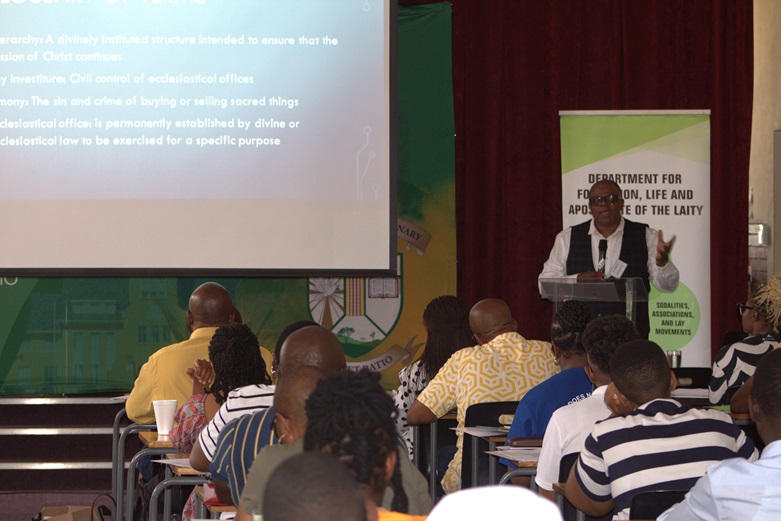
More than 60 participants from across the dioceses of the Southern African Catholic Bishops’ Conference (SACBC) have gathered at St John Vianney Seminary NPC in Pretoria for the Short Course: Leadership in a Synodal Church, taking place from 5 to 10 January 2026.
The week-long programme offers a space for reflection, learning, and formation on synodality at a significant moment in the life of the Church, as Southern Africa marks 75 years since the establishment of the hierarchy.
In an interview with the SACBC Communication Office, the Academic Dean at St John Vianney Seminary and Director of the short course explained that the programme is rooted in the synodal process initiated by Pope Francis, aiming to explore key themes of synodality while addressing common misunderstandings that have emerged among the faithful.
“One of the misconceptions is that synodality is about democracy or autocracy,” Fr. Sbongiseni Msomi said. He noted the first presentation by Fr Nhlanhla Mchunu, who “explained that the Church operates at a level of theocracy – in other words, God is at the centre of the leadership of the Church.”
He added that the course also engages critically with misunderstandings around clericalism, noting that it can manifest not only among clergy but also among lay people who struggle to accept their own vocation within the Church.
Participants in the course represent a broad cross-section of the People of God. They include lay leaders from sodalities and lay associations, parish pastoral councils (PPCs) and parish finance councils (PFCs), synod coordinators from dioceses, priests, religious sisters, and even representatives from other Christian traditions.
Fr. Msomi highlighted the presence of a minister from the Dutch Reformed Church and a participant currently in the Rite of Christian Initiation of Adults (RCIA), describing this diversity as a living expression of synodality itself.
“In its very nature, the course is synodal because it includes everyone,” he said.
The programme begins with an exploration of the biblical foundations of synodality, set within the historical, political, and pastoral context that shaped Pope Francis’s vision. Throughout the week, participants will engage with Church documents on synodality, the teaching authority of the Magisterium, and the contributions of Vatican II.
Sessions also focus on the mission of the Church in the world, emphasising that the Church cannot be inward-looking but must journey outward in service and witness. A key element of the course is the practice of conversation in the Spirit, encouraging attentive listening, shared reflection, and meaningful participation.
Later sessions will address synodality in concrete contexts, including challenges at parish and diocesan levels, and the proper use of Church language and structures to support genuine co-responsibility.
Toward the end of the interview, Fr. Msomi expressed gratitude to the dioceses that responded to the invitation by sending delegates, with strong representation from dioceses such as Pretoria, Kimberley, Manzini, and Queenstown. He voiced hope that participants would return to their parishes and dioceses empowered to share what they have learned and to strengthen synodal practice on the ground.
0 Comments