
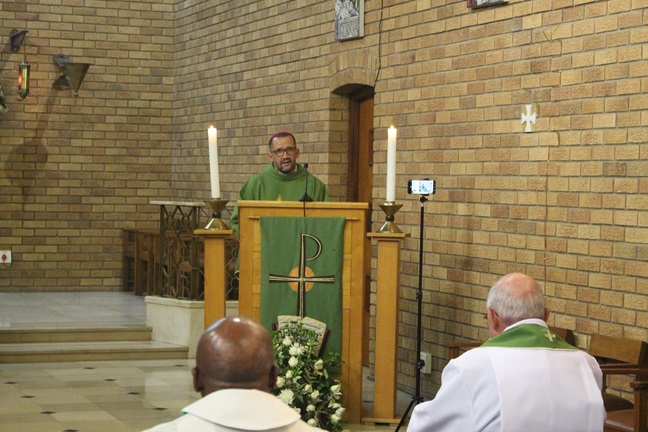
At the start of the August 2025 plenary session of the Southern African Catholic Bishops’ Conference (SACBC), Bishop Sithembele Anton Sipuka of the Diocese of Mthatha presided over the first morning Mass, marking the Memorial of the Dedication of the Basilica of Saint Mary Major.
In his homily, Bishop Sipuka reflected on the readings from Numbers 12:1–13 and Matthew 14:22–36, offering a scriptural lens through which to consider the challenges facing the Church and society.
Referring to the Gospel scene of the disciples “tortured by the waves” and rowing against the wind in the absence of Jesus, Bishop Sipuka stated, “This captures our moment. Here in South Africa, and across the world, we often feel like those disciples—rowing hard against contrary winds while Christ seems absent from our boat.”
The Local Ordinary of Mthatha Diocese also highlighted the growing marginalisation of religious authority, referencing the story of Miriam and Aaron questioning Moses. “The very foundation of divine authority is questioned,” he said.
Bishop Sipuka connected this biblical narrative to current developments. “We live in times of practical atheism. While people profess to believe in God, their practical life proclaims the opposite,” he said.
He gave concrete examples from his pastoral context in the Eastern Cape, noting that Sunday is now treated like any other weekday. “Without consultation, the Department of Education holds classes on Saturday and Sunday, preventing the children who still care about the faith from attending Mass and catechism,” he said. “Schools do not even have morning prayer assemblies anymore, to say nothing about religious education.”
Bishop Sipuka further pointed to how this distancing from religious values has affected public life. “It manifests in corruption that steals from the poor because people no longer recognise transcendent accountability. They do not care about the God-given dignity of those whose life they diminish and destroy through corruption,” he said. Citing the reality of over 60% youth unemployment, Bishop Sipuka attributed part of the crisis to the misuse of public resources and a lack of moral accountability.
In his reflection on Church life, Bishop Sipuka acknowledged the decline in vocations, attendance, and resources, adding that the faithful are increasingly turning to other forms of authority. “Materialism promises immediate gratification. Traditional practices like ubungoma offer spiritual power that competes with our loyalty and obedience to Christ,” he said.
However, Bishop Sipuka noted that in both the readings from Numbers and Matthew, God responds not with condemnation but with engagement. “Jesus does not abandon the struggling boat. He walks toward it on the very waters that threaten to destroy it,” he said. Quoting Jesus’ words from the Gospel, he emphasised, “Take courage, it is I; do not be afraid.”
Linking the message of the Jubilee Year to the present moment, he pointed to the Jubilee logo, which depicts the cross as an anchor. “It is not a static anchor. It is the anchor of pilgrims, of a Church on the move,” he said. “We are not called to despair in the face of storms, but to recognise Christ walking toward us.”
He concluded by calling his brother bishops to continue their pastoral role amid the challenges facing the Church and society. “Our people look to us not for perfect weather, but for the ability to recognise the approach of Christ in the storm,” he said.
He continued, “Our task is to help our people recognise His voice: ‘Take courage, it is I; do not be afraid.’ The boat doesn’t sink because Christ is in it—even when we can’t always see Him clearly.”
The August 05, 2025 morning mass marked the beginning of three days of plenary sessions, where the bishops are expected to reflect on key pastoral issues, including family life, youth, synodality, seminary formation, care of creation, the national dialogue, interreligious dialogue, and other matters.
0 Comments