
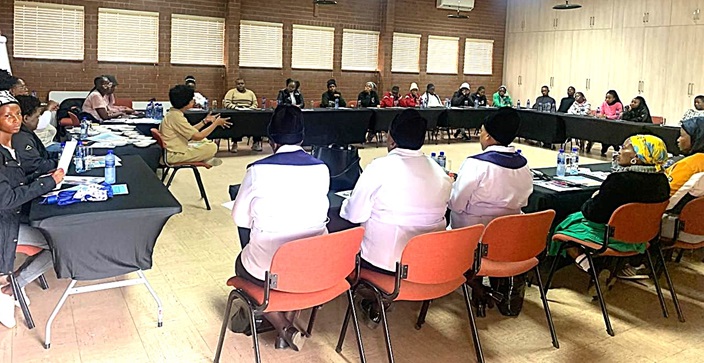
As part of International Fetal Alcohol Spectrum Disorder (FASD) Awareness Day, observed globally on September 9 each year, the SACBC Justice and Peace Commission, in partnership with the DG Murray Trust, hosted an awareness workshop at Khanya House on October 6.
The session brought together young people, educators, and pastoral agents to deepen understanding of the dangers of alcohol consumption during pregnancy and to promote healthier ways of coping with stress and peer pressure.
In an interview with the SACBC communication office, DG Murray Trust’s ‘Rethink your Drink’ Campaign Manager, Kashifa Ancer, said their “work is involved in advocacy to reduce alcohol harms in South Africa.”
Understanding the Crisis
Fetal Alcohol Spectrum Disorder (FASD) refers to a range of lifelong physical, mental, and behavioral conditions caused by alcohol exposure during pregnancy. Even small amounts of alcohol can harm a developing fetus, leading to irreversible damage to brain development, learning abilities, and emotional regulation.
According to Ancer, South Africa holds the highest recorded rate of FASD in the world, with particularly high numbers in the Western Cape and Northern Cape. “Some say one in nine children are affected, other research shows one in twelve, but the fact remains that South Africa has the highest recorded rate of the disorder in the world,” said Ancer. “Many children are going undiagnosed.”
She stressed that awareness must extend beyond expectant mothers, as “this kind of education and awareness is important not only for mothers and expectant mothers, but for communities at large — because fetal alcohol spectrum disorder only happens when there is a lack of support and awareness around the mother.”
Empowering Communities Through Awareness
The DG Murray Trust’s Rethink Your Drink campaign — a long-term partner of the SACBC’s alcohol harm reduction efforts — focuses on advocacy, community education, and policy reform. “We are here today to provide a workshop which is a learning for the people involved here in the harm reduction work at the SACBC,” Ancer explained, “to understand what FASD is, the impacts it has, and the role they can play in their communities to reduce its rate in South Africa.”
The workshop, facilitated by the Justice and Peace Commission, drew participants from different age groups, including youth as young as 14. “The SACBC invited several people of different age ranges… we have young people as young as 14 in the room, and we have people involved in the Church who provide education and awareness as part of their activities as well,” she noted.
This inclusive approach reflects a shared conviction: prevention begins with awareness and support. “When mothers are supported, children are supported. And when children are supported, the whole community and the whole country are supported.”
A Preventable Tragedy
While FASD remains a major public health crisis, it is entirely preventable. Ancer was emphatic in her message:
“Our message to everyone in South Africa around fetal alcohol spectrum disorder is to know that no amount of alcohol is safe at any stage in pregnancy.”
She added, “Unfortunately, we have high rates of fetal alcohol spectrum disorder, but the disorder is preventable. So for us to prevent it, we need to ensure that expectant mothers and women of childbearing age are not consuming alcohol — especially not in excess.”
FASD, she warned, is a lifelong condition that can affect schooling, work opportunities, and relationships: “They won’t only have challenges at school, but they’ll also have challenges as adults in their workplaces, in their personal and interpersonal relationships.”
Advocating for Policy Change
The workshop was also part of a broader campaign to advocate for sweeping changes in alcohol regulation and public health policy. The SACBC Justice and Peace Commission and its partners are engaging government and stakeholders to:
- Ban alcohol advertising to reduce its appeal, especially among youth;
- Restrict alcohol sales by limiting operating hours and enforcing stricter licensing regulations;
- Introduce Minimum Unit Pricing (MUP) to make cheap, high-volume alcohol less accessible; and
- Provide screening and treatment for alcohol use disorders, particularly for pregnant women.
Such reforms, Ancer explained, are part of the World Health Organization’s SAFER strategies for reducing alcohol harm worldwide — strategies that South Africa urgently needs to implement.
A Shared Mission for a Healthier Future
“We want to make sure that we start a child’s life on the best foot possible,” said Ancer. “And we start by creating awareness — by supporting mothers. Because when mothers are supported, children are supported. And when children are supported, the whole community and the whole country are supported.”
The SACBC’s partnership with the DG Murray Trust demonstrates how faith-based organizations and public health advocates can work together toward a healthier, more compassionate South Africa — one where every child has the chance to thrive.
0 Comments