
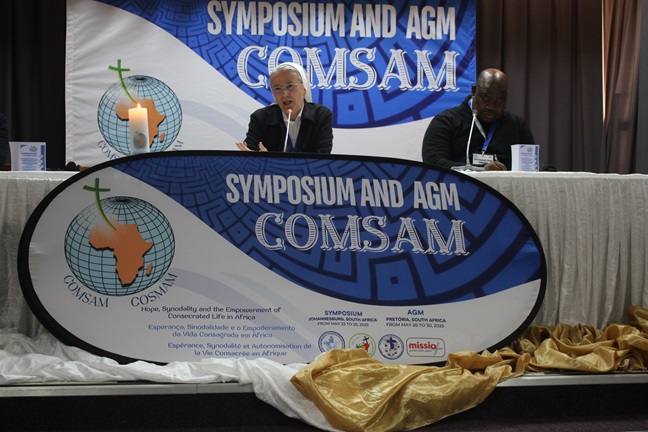
In an address to members of the Confederation of Conferences of Major Superiors of Africa and Madagascar (COMSAM), the Prefect of the Dicastery for Institutes of Consecrated Life and Societies of Apostolic Life offered a stirring reflection on consecrated life as pilgrims of transformation in Africa.
Entitled Consecrated Life in Africa: Pilgrims of Hope, Sr Simona Brambila MC, address challenged consecrated men and women to embrace the transforming hope of the Risen Christ amidst the complexities and challenges facing the African continent today.
The member of the Consolata Missionaries (MC) recalled Pope Francis’ final Urbi et Orbi Easter blessing on April 20, when the Holy Father proclaimed a message of unwavering hope: “Love has conquered hate. Light has conquered darkness… The Lamb of God has won!”
Sr. Brambila MC drew inspiration from these words, highlighting the Church’s call to witness to “hope that does not disappoint” (Spes non confundit)—a hope deeply needed in regions marked by suffering, such as the “Sahel, South Sudan, and the Democratic Republic of Congo,” she said.
Pilgrims of Hope: A Journey of the Whole Person
Drawing from the Jubilee theme, “Pilgrims of Hope,” Sr. Brambila MC began by exploring the symbol of the pilgrim: a person in motion, engaged body and soul, moving not only across physical spaces but through an inner journey of trust, openness, and transformation.
“Pilgrimage sets the whole person in motion,” she said. “But it also involves receptivity: the movement of opening, of awakening our outer and inner senses, of surrender and trust.”
The experience of being a stranger on the road, relying on others’ hospitality, allows for deep transformation—if one’s heart and senses remain open.
Sr Brambila MC, the first woman to head the Dicastery for Institutes of Consecrated Life and Societies of Apostolic Life, warned, however, that in a life overwhelmed by responsibilities and noise, “our ability to receive can atrophy. Our senses can become dulled… we risk ‘losing our inner senses,’ losing the ability to perceive, to welcome the Spirit’s movement.” When that happens, pilgrimage can degenerate into “an exhausting race that corrodes hope and detaches it from its vital source.”
The Italian Religious Sister went on to reflect on the image of the anchor, as presented in Pope Francis’ Jubilee proclamation:
“We have this hope as a sure and steadfast anchor of the soul” (Heb 6:18–20).
“This anchor is cast beyond the veil of the sanctuary, into the very depths of Heaven, into the heart of God,” she explained. “It symbolizes a visceral, indissoluble bond with the One who loved us first… who transformed the lance that pierced his heart into an anchor, so that our lives might be firmly grounded in this endless source of tender and strong love.”
In this anchoring, she said, prayer becomes the fuel of the journey. “Prayer opens the heart, disarms it, sets it on fire with desire, and allows us to receive God’s immense love—a love that heals, purifies, liberates, and ignites us for mission.”
Three African Symbols for the Journey
Sr. Brambila MC then offered three rich images drawn from African cultural and spiritual traditions, offering a compelling synthesis of inculturation and Gospel vision.
- The Tree
“The tree is shelter, shade, and meeting place,” she explained. “It is a living bridge between heaven and earth, a sacred space where dialogue happens—sometimes with God, with ancestors, with one another.”
“To what ‘sacred trees’ do we go for strength along our journey?” she asked. “And how can consecrated life become a sacred tree for others?”
She pointed to the tree’s dual symbolism: rootedness and transcendence— “a place of memory, rest, dialogue, and healing.”
- The Palaver Hut
A circular structure open to all, the Palaver hut is a place for listening, healing, and truth. In many African cultures, it is where conflicts are resolved, transformation happens, and peace is restored.
“You do not leave the Palaver hut the same as you entered,” Sr. Simona said. “It strips away our masks and returns us to the truth of ourselves.”
Consecrated life, she added, is called to be this kind of space—“a place of welcome, healing, and transformation—a sacred place where life is received and made to grow.”
- The Pot
Recalling her missionary experience in Niasa, north of Mozambique, Sr Brambila MC spoke of the “mwapu” (pot in the Macua language) as a place of the interpenetration of the different, as the “kitchen” of life. “The pot of polenta is one, but the portions are different,” said Sr. Simona, offering a beautiful image of unity in diversity.
“This pot represents the maternal womb of God,” she explained, “from which all creatures come, partaking of the same life-force. We all share in the same life, and so we must learn to eat from the same pot.”
This has deep implications, not only liturgically, but structurally and culturally:
“The Church and our congregations must reflect this unity. Charismatic interculturality is not just necessary—it is a gift, an opportunity for transformation.”
She challenged the audience to examine their own “inner pot”—the space within where thoughts, choices, and attitudes are formed.
“What do I ‘cook’ in the pot of my heart? What kind of nourishment do I offer others through my words, gestures, and presence?”
A Pilgrimage Accompanied by Mary
Concluding her reflection, Sr. Brambila MC entrusted all consecrated persons in Africa to Mary, Mother of Hope:
“Under her protective mantle, and guided by her tender and strong presence, may we truly experience the closeness of the most affectionate of mothers… she who, for the holy People of God, is a ‘sign of sure hope and consolation.’”
Echoing the words of Pope Benedict XVI, who described Africa as “a great spiritual lung for a humanity in crisis,” Sr. Brambila MC called for this Jubilee journey to be a time of deep renewal and communion.
0 Comments