
By Kati Dijane
As global leaders are gathering in South Africa for the G20 Summit – the first time the forum has taken place on African soil – a powerful faith-based response by the Catholic Church was taking shape on the sidelines.
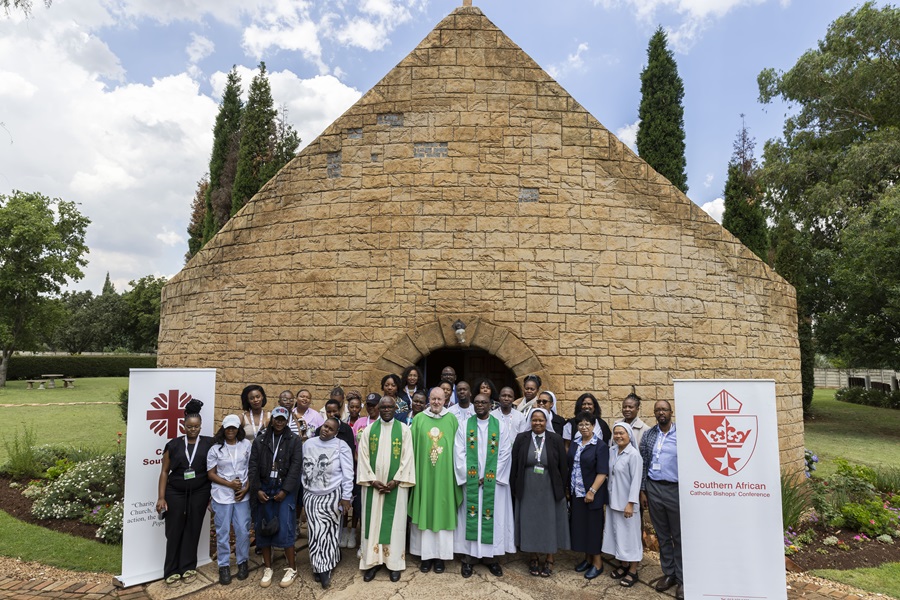
On Wednesday, 19 November 2025, Caritas Africa, Caritas Internationalis, the Symposium of Episcopal Conferences of Africa and Madagascar (SECAM) and the Southern African Catholic Bishops’ Conference (SACBC) hosted a side event at the Birchwood Hotel in Boksburg, Ekurhuleni, placing the moral urgency of Africa’s debt crisis at the centre of global discussions.
Guided by the theme “A Jubilee for Solidarity: Towards a People and Planet-Driven Financial Architecture for Africa,” the gathering brought together faith leaders, development experts and young activists to amplify the Catholic Church’s call for debt justice, systemic reform and the cancellation of unjust and unsustainable debts in the 2025 Jubilee Year of Hope.
A moral call rooted in the Gospel
Opening the dialogue, Sr Dominica Mkhize FSF, the national coordinator of Caritas South Africa, delivered a powerful reflection rooted in the Catholic Social Teaching.
“The G20 as a multilateral platform offers a space to shape a new vision for humanity as one family,” she said, reminding participants that all policies and economic decisions must protect the dignity of every person, especially the poorest, “whom God holds closest to His heart.”
Drawing from grassroots realities, Sr Dominica shared stories of families across Africa who live between despair and survival, parents forced to choose between food and medicine, children removed from school due to a lack of fees and communities abandoned by shrinking public services.
She referenced Pope Francis’ insistence that the Gospel has an “intrinsic social dimension” and Pope Leo XVI’s call in Dilexi Te for a love that is concrete and transformative. Africa’s debt crisis, she said, is not merely an economic issue, but an ethical and spiritual tragedy that robs millions of life, hope and opportunity.
“We call for the cancellation of unjust debts, climate financing that honours God’s preferential love for the poor and a global financial architecture that reflects mercy, justice and compassion,” she said.
Debt is a social and gender justice issue
Delivering the keynote address, Mrs Jacqueline Utamuriza-Nzisabira, an HIV/AIDS specialist for UN Women East and Southern Africa, provided a sobering picture of Africa’s debt burden. External debt across the continent has risen sharply, approaching 25% of national GDP, while debt servicing costs consume up to 30% of government revenue in some countries. This has left health, education, social protection and climate-resilient infrastructure critically underfunded.
“This is not just a financial crisis. It is a social justice crisis,” she said, citing the UN Secretary-General’s warning that inadequate debt relief is a “recipe for social unrest”.
She further highlighted how women and girls bear a disproportionate burden, through cuts to healthcare, education and gender-focused programmes. For UN Women, she stressed that debt justice is gender justice.
Mrs Utamuriza-Nzisabira also outlined the UN’s position on urgently reforming the global debt architecture, calling for increased concessional finance, fairer lending systems, stronger development banks, African-led financial mechanisms and greater fiscal sovereignty for nations of the Global South. She concluded her address, saying, “Debt should not be a chain around Africa’s neck; it must be a tool for liberation, a bridge to investment in health, education, gender equality, and a sustainable future. The UN stands ready to partner with African governments, civil society, regional bodies and the G20 to build a financial architecture that is fair, resilient and anchored in people and planet.”
Lived realities beyond statistics
A panel discussion, moderated by Sheila Pires, Communications Officer for the SACBC, featured Fr Bonaventure Mashata MAfa (Caritas Internationalis), Sr Nosipho Cwele (Coalition of Catholic Sisters) and Miranda Ngwerume (Advocate for Young Women for Life Movement, Mpumalanga).
During the discussion, Sr Nosipho Cwele emphasised that beyond numbers and policy discussions are real, suffering people.
“What is happening on the ground is more than just statistics. It’s human lives,” she said. Budget cuts in the NGO sector and delayed government funding have left rescued children hungry and vulnerable, she added. She urged leaders to stop politicising poverty and instead “do justice” for communities struggling to survive.
Young advocate Miranda Ngwerume echoed the need for accountability and reform at government level. While debt relief is essential, she warned that without transparency, saved funds could be lost to corruption and vanity projects instead of being invested in schools, laboratories, tertiary access and youth innovation. Reflecting on the G20 International Symposium on Global Justice and Solidarity held in Cape Town earlier this year, Miranda mentioned that there was a proposal of the “Ecological Impact Fund, which is supposed to fund the ideas that can help with the climate change that we are facing globally.”
“But how can young people solve Africa’s problems if they are denied the tools to do so?” she asked.
Turning debt into hope
Speaking on behalf of Caritas Internationalis, Fr Bonaventure Mashata MAfr framed the campaign as both a spiritual and structural mission.
Through the “Turn Debt into Hope” Jubilee Campaign, Caritas is calling on the G20 to:
- Cancel unjust and unsustainable debts without harmful conditions,
- Establish a permanent, transparent debt framework under the United Nations,
- Create a global public debt registry,
- Support the African Union’s Reparatory Justice Agenda.
He highlighted how biased credit ratings, predatory lenders and harmful conditions from international institutions keep African nations trapped in dependency, paying far more in interest than wealthy nations.
“This is not charity – it is justice,” he declared. “Every dollar spent on debt instead of hospitals and schools is a moral failure.”
Nyarai Mutongwizo, representing Caritas Africa, reinforced the fact that many African countries spend more on debt than on healthcare or climate action. She presented data showing that 21 African countries are either at high risk or already in debt distress, and that reducing debt servicing would dramatically improve education and health outcomes.
“When action is taken, humanity is saved,” she said.
A call to personal and collective conversion
In his closing remarks, Fr Hugh O’Connor, Secretary General of the SACBC, drew the conversation back to the heart of the Jubilee.
“Unless there is personal change and conversion, there is a risk that our activism becomes an outward show without inner transformation,” he warned. He challenged participants to reflect on their own consumption, privilege and complicity in unjust systems.
“We are called not only to ask the powerful to lift burdens, but also to lift burdens in our own relationships – through mercy, forgiveness and justice.”
The event concluded with Holy Mass at the Lumko Retreat Centre in Benoni, sealing the gathering not only as a policy engagement, but as a spiritual commitment.
0 Comments