
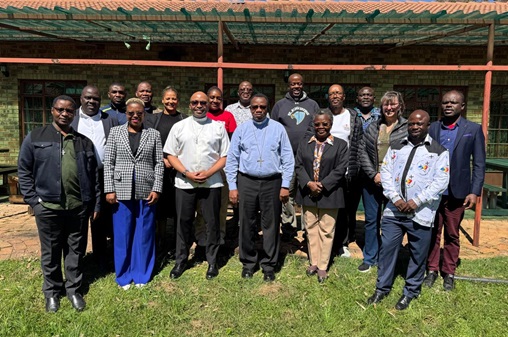
The Inter-Regional Meeting of the Bishops of Southern Africa (IMBISA), in a statement issued at the end of a four-day meeting, outlined a bold strategic direction for the Church: transforming its prophetic witness into meaningful policy engagement to bring lasting peace and justice to the region.
The meeting, held from April 8–11 at the Padre Pio Retreat Centre, was anchored in the spirit of the Jubilee Year and focused on building alliances that can catalyze systemic change across IMBISA member countries.
“As pilgrims of hope in this Year of Jubilee, we place ourselves at the service of humankind in the quest for lasting peace,” read the statement. Referencing Luke 4:19, it underscored the Church’s responsibility to “proclaim the year of the Lord’s favor” in both spiritual and socio-political contexts.
In the April 10 statement shared with the Southern African Catholic Bishops Conference (SACBC) Communication office, Justice and Peace Coordinators from the six Episcopal conferences in Southern Africa emphasized that the Church must not only speak prophetically but also act strategically engaging policymakers, civil society, and regional bodies to confront systemic injustice and promote human dignity.
“Conflicts in our region are deeply rooted and complex, but they consistently devastate the most vulnerable—women, children, and the poor,” the statement said. The Church was called to be a bridge between the moral call for justice and practical policy solutions, promoting homegrown responses to violence, poverty, and exploitation.
The workshop urged stronger alliances with regional and continental actors such as the Southern African Development Community (SADC) and the African Union. “Partnerships are critical. Peace must be pursued not just from the pulpit, but through political, social, and economic channels,” said one delegate. The finalization of the Memorandum of Understanding with SADC was cited as a vital next step.
During the four-day meeting, Justice and Peace coordinators from Eswatini, Lesotho, Mozambique, Namibia, São Tomé e Príncipe, South Africa, and Zimbabwe called for youth inclusion, environmental justice, ecumenical partnerships, and action against exploitative industries.
Delegates praised the SACBC Commission for Justice and Peace for taking legal action against mining firms and called for this example to be replicated in other regions.
“This class-action lawsuit is not just a legal move—it’s a prophetic stand against exploitation and environmental degradation,” the statement affirmed. The group noted that unchecked multinational corporate activity contributes to modern-day slavery and fuels regional conflict.
In line with Laudato Sì, IMBISA reaffirmed its commitment to ecological justice. “The cry of the earth and the cry of the poor are not separate—they are one,” a participant noted.
The role of young people was also emphasized as a non-negotiable in the Church’s strategic vision. “Young people are not just stakeholders—they are the now of God,” the statement declared, echoing Christus Vivit. It encouraged honest intergenerational dialogue and decision-making structures that actively include the youth.
The meeting that saw the participation of SACBC delegate Philani Mkhize from the Commission for Justice and Peace, called for enhanced capacity within Justice and Peace Commissions across IMBISA: improved documentation, effective monitoring and evaluation systems, resource-sharing, and local fundraising strategies. “If we are to influence policy, we must also strengthen our internal systems,” said another delegate.
Interfaith and ecumenical collaboration were recognized as key pillars of regional peacebuilding. Stronger ties with organizations such as the Fellowship of Christian Councils in Southern Africa (FOCCISA) were recommended, with the statement noting, “Peace must be a shared mission, pursued by all people of faith.”
On Thursday, April 10, 2025, the Chairperson of the SACBC Social Action Department, Bishop Thulani Victor Mbuyisa CMM, in his capacity as the Liaison Bishop for the Commission for Justice and Peace, greeted the IMBISA delegates and thanked them for their service to the Church in Southern Africa.
The workshop concluded with a renewed mandate: to ensure that the Church’s moral leadership is translated into action through advocacy, policy engagement, and sustained grassroots mobilization.

0 Comments