
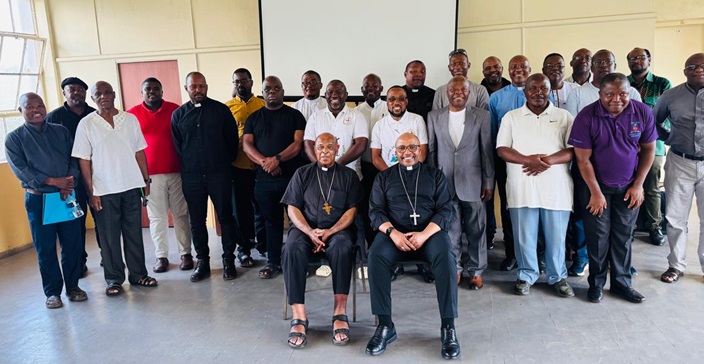
The Diocese of Eshowe devoted a full day to reflection on synodality as priests gathered for a presentation led by the Southern African Catholic Bishops Conference (SACBC) vice chairperson of the Commission for Synodality, Bishop Thulani Victor Mbuyisa CMM of Kokstad Diocese.
The session, held on Tuesday, November 11, aimed to deepen understanding of the Synod on Synodality and to explore how its vision of communion, participation, and mission could shape diocesan life.
Bringing Synodality to the Diocese of Eshowe
In an interview with the SACBC Communication Office, Cardinal Wilfrid Fox Napier, Apostolic Administrator of the Diocese of Eshowe, explained that the initiative was inspired by recent experiences at both the SACBC plenaries and at the 14th Plenary Assembly of the Interregional Meeting of Bishops of Southern Africa (IMBISA) held in Eswatini.
“It’s something that the Church is doing at the conference level,” he said. “We’ve had a couple of exposures to how the synodality concept is being implemented in other places. But at our IMBISA session in Eswatini, where we had a very good presentation by Archbishop Dabula, I just picked it up very easily. I felt this is something I must bring to the priests of Eshowe.”
The annual priests’ plenary provided the perfect moment to introduce this initiative. “We have a plenary session with the priests every year around this time,” the Cardinal said. “So, I said, let’s get Bishop Mbuyisa from Kokstad to come and do it. He’s close by and he’s very good at making presentations.”
A Day of Listening and Reflection
The day was dedicated entirely to the theme of synodality. The Archbishop Emeritus of Durban described how engaged the priests were during the presentation. “You could have dropped a pin in that hall while Bishop Mbuyisa was speaking. They were all absolutely glued to what he was saying.”
That attentiveness, he said, gave him “great courage that the priests are realising, if we don’t pick this up, we’re going to be one of the dioceses left out—not just in Southern Africa, but in the world.”
Leading Through Participation
As Apostolic Administrator of Eshowe Diocese, Cardinal Napier admitted that he initially faced a dilemma about when to begin the process while awaiting the appointment of a new bishop. “I wondered whether to start now and leave it halfway, or wait for the new bishop to take it up,” he reflected. “But if you’re talking about a synodal Church, you’re talking about the people, not the leader. So I decided to let the priests know what’s going on.”
He added that the priests’ meeting was an opportunity to ensure everyone understood the importance of walking together as Church. “We’re having a priest meeting right now,” he said. “Let’s have the priests know exactly how it’s going.”
The Meaning of Synodality
The member of the Order of Friars Minor (OFM) said the focus of the presentation was to help priests grasp the meaning of synodality in practical terms. “Bishop Mbuyisa imparted the whole concept of the Synod on Synodality,” he explained. “Having the three words—participation, communion, and mission—touches a nerve with all priests. They know what it means to participate, they know what it is to be in communion, and they certainly know what it is to be on a mission.”
He noted that such personal engagement is more effective than merely circulating Church documents. “It’s much better than if I just sent out the documents and said, ‘Read this and see what you can do about it,’” he said. “It has given us grounds upon which to build, by noting those people who seem to understand and to be touched by the concept of synodality, and who would therefore be willing to take it up on the committees or structures we set up.”
Next Steps for the Diocese
Looking ahead, Cardinal Napier said he plans to review the notes from the session and form a small team to guide implementation. “One of the strongest ideas that came from the priests themselves,” he shared, “was the need for a pastoral coordinator for the diocese. Up to now, we’ve had portfolios and chaplaincies that change whenever priests are reassigned. But if priests are truly engaging where they are, they’ll take that experience with them wherever they go.”
He hopes that by the time a new bishop is appointed, “he will come to a clergy that already know what’s expected of them by the Church, and in some cases will already have started implementing what needs to be done.”
Synodality and the Laity
Beyond clergy formation, Cardinal Napier highlighted the transformative impact synodality could have on lay people. “I’ve come to understand just how much this can make a difference to the laity, who often still see themselves as those who just sit and receive rather than as people who have something to contribute,” he said.
He believes the process of prayer, listening, and discernment will “help the laity realise that their role is to develop the Church—it’s not just to wait and receive the sacraments from the priest.”
The Cardinal added that synodality challenges parishes to re-examine their pastoral methods. “It’s going to make us look closely at our pastoral practices,” he said. “That’s where a pastoral coordinator will really come into the picture—to help people put into practical form what they’re going to do in their parishes.”
A Hopeful Beginning
Reflecting on the day, Cardinal Napier described the experience as deeply encouraging. “For me, this is still at the stage of a dream,” he said. “I’m still on a high because of the experience of the day. Now it’s about bringing it down to reality and putting foundations under it.”
0 Comments