
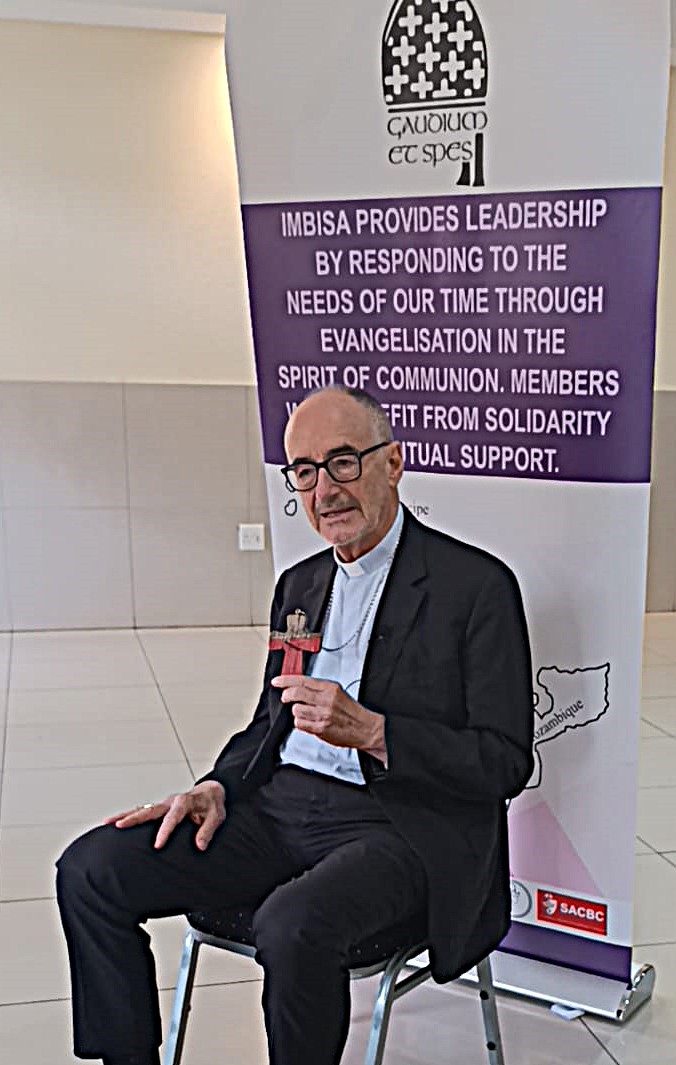
During his first-ever visit to the Kingdom of Eswatini, Cardinal Michael Czerny SJ, Prefect of the Dicastery for Promoting Integral Human Development, offered a reflection on what it means for the Church to “accompany” rather than “direct” the people of God — especially those living on the margins.
The Cardinal was speaking to the Southern African Catholic Bishops Conference (SACBC) communication office on the sidelines of the Golden Jubilee of the Interregional Meeting of Bishops of Southern Africa (IMBISA), taking place in Manzini under the theme “A Synodal Journey, nourished by compassion and blossoming in faith as pilgrims of hope.”
A Church that accompanies, not controls
“The Church is not a development agency,” Cardinal Czerny said, “but she walks alongside her people in their desire to grow and to flourish.”
He explained that the role of his Dicastery is not to replace governments or organizations, but to ensure that those working for integral human development never lose sight of faith and hope.
“Our mission is to accompany — to be a sign and experience of hope which people need in order to keep going,” he said.
Reflecting on his address to IMBISA delegates, the Cardinal emphasized that leadership in the Church — whether by bishops, priests, or pastoral agents — is not about finding ready-made solutions.
“A leader’s role is not necessarily to solve problems, but to walk with others, to be present, to encourage, and to remind them of God’s nearness,” he noted.
Walking with people on the move
Speaking ahead of his upcoming visit to South Africa, where he will mark the World Day of Migrants and Refugees, Cardinal Czerny reflected on the growing challenges facing migrants and refugees in southern Africa — from access to education and health care to rising xenophobia.
He said the Church’s response must always begin with encounter.
“There isn’t a single answer. What matters is that, in each place, the Church asks: how can we respond? Sometimes all we can do is be with people — and that is already something powerful, because they know they are not alone.”
The Cardinal recalled Pope Francis’s four verbs that guide the Church’s response to migration: welcome, protect, promote, and integrate.
For pastoral agents working among refugees and displaced persons, his advice was simple yet profound:
“Don’t think of yourself as the problem-solver or as an isolated representative of the Church. Invite others to come and meet migrants for themselves. No one who has met them face-to-face remains hostile. The meeting itself is already the beginning of the solution.”
Faithful presence in hospitals and in creation
Turning to the topic of health care, the Cardinal noted that even when the Church no longer manages hospitals directly, her pastoral mission remains vital.
“Governments may run the institutions, but they cannot meet the spiritual needs of the sick. We must ask how we can be present to people in their time of fear, pain, and hope — to bring Christ to them in those places.”
He also linked this same spirit of accompaniment to the Season of Creation, encouraging Catholics to take small, communal steps toward ecological awareness.
“If you care for creation, invite someone else along — to plant trees, to visit a river, or to meet communities suffering from drought. Caring for our common home begins in relationship.”
Hope, peace, and conversion of the heart
The Cardinal’s homily at the IMBISA Jubilee Mass on Thursday, 25 September, centered on peace — a message that resonated deeply as the Church prayed for conflict-torn regions such as Cabo Delgado, South Sudan, and the Holy Land.
“When we hear about war, maybe the only thing we can do is pray,” he said. “But do we really pray, or do we just complain about what we see on the news? Let’s turn our anguish into prayer.”
He also echoed Pope Francis’s challenge to seek “disarmament of the heart.”
“Before we make long speeches about peace, we must face the war zones within ourselves. True peace begins inside each of us and in our relationships.”
Looking ahead: “IMBISA’s Jubilee is a Synodal celebration”
As IMBISA marks its 50th anniversary, Cardinal Czerny praised the bishops’ decision to celebrate the milestone through a Synodal Assembly.
“Instead of looking back nostalgically at successes or failures, they are embracing the new way of being Church — walking together, listening together, discerning together. This is the most faithful and hopeful way to prepare for the next 50 years.”
A cross made of hope
Before departing for South Africa, the Cardinal spoke about the wooden cross he wears — made from the timber of a migrant boat that left North Africa for Lampedusa.
“The red symbolizes the suffering of Christ and of all those on the move; the white is the light of the Resurrection; and the nail unites us to the Crucifixion. It’s a contemporary crucifix — a reminder that Christ suffers today in the lives of the displaced.”
Cardinal Czerny concluded his visit expressing gratitude for the warm welcome in Eswatini and renewed his message to the Church in southern Africa:
“Be a Church that accompanies — walking not ahead or above others, but with them, as pilgrims of hope.”
0 Comments