
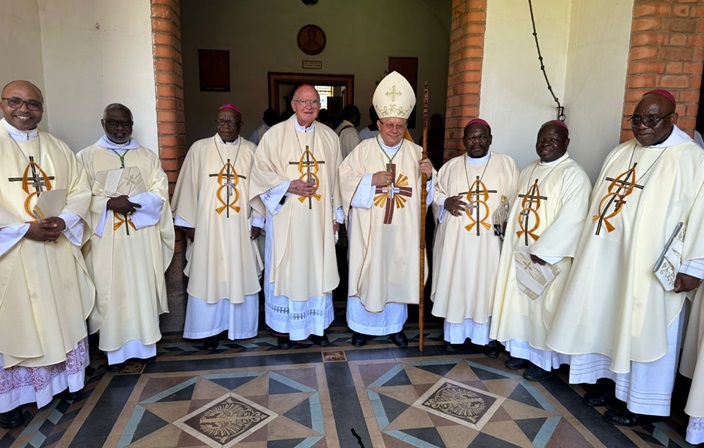
The President of the Southern African Catholic Bishops’ Conference (SACBC) has lauded the enduring vision and prophetic witness of Abbot Francis Pfanner, calling his “legacy of non-racialism…a way to promote respectful intercultural living” and urged the Mariannhill family to persevere in the beatification process.
Marking the 200th anniversary of the birth of Abbot Francis Pfanner, the founder of the Mariannhill Missionaries and the Sisters of the Precious Blood, Cardinal Stephen Brislin delivered an address highlighting the Abbot’s profound influence on the Church in Southern Africa and beyond.
Cardinal Brislin opened by conveying “sincere congratulations to the Mariannhill Family of priests, brothers, and sisters,” noting that the vision of their founder remains visible in their ministries more than a century later. “The impact of his founding vision, his struggles against many uphill battles, and his determination to respond to the needs of the time,” he said, continue to shape the missionary work of both congregations.
A Pioneer Who Challenged Boundaries
In recounting Abbot Pfanner’s life, the Cardinal underscored his determination and flexibility—qualities that enabled him to adapt the Trappist contemplative tradition to the pastoral and evangelizing needs of 19th-century South Africa. “Although a contemplative and a Trappist,” he noted, Abbot Pfanner, “suspended some of the Trappist rules in order to free monks – and even novices – to evangelise the un-evangelised in the surrounding areas of KwaZulu-Natal.”
The Archbishop of Johannesburg highlighted that today the Mariannhill Missionaries serve in 15 countries, a sign of the “fruits” of Abbot Pfanner’s far-reaching vision.
A significant and often-cited moment in Pfanner’s leadership was his decision—then unthinkable—to send Edward Mnganga, a Black South African, to study for the priesthood in Rome. It was, Cardinal Brislin observed, an early and courageous challenge to the racial structures that dominated South African society at the time.
A Prophetic Voice Against Racism
Central to Cardinal Brislin’s reflection was Abbot Pfanner’s uncompromising stance against racial segregation. He recalled the Abbot’s words published in the monastery newsletter Forget Me Not in 1889:
“Will the time finally dawn in South Africa when people will renounce this deeply ingrained and radically evil prejudice? As long as people are not willing to do this, they will indeed tame the black man but not convert him”.
“These words and sentiments,” Cardinal Brislin said, “must speak and chide us today,” particularly in the face of xenophobic tensions and resurgent ethnocentrism in the region.
He emphasised that Abbot Pfanner’s vision was rooted in the conviction that differences of language and colour are “mere accidents” and that all people are “sons and daughters of God.”
The Cardinal also highlighted Pfanner’s commitment to education as a tool for building a non-racial society. Quoting the Abbot’s own words, he recalled the inclusive ethos of the Mariannhill institutes:
“All boys in our institute receive free bed, board, and instruction, regardless of whether they are pagan, Muslim, Protestant, or Catholic, white, black, or coloured, English, Dutch, German, Italian, Indian, or local African.”
This, Cardinal Brislin said, is “a legacy of non-racialism” that provides a crucial model for the Church today, amid global and local divisions along cultural, national, and ideological lines.
A Pilgrim of Hope
Reflecting on the Abbot’s perseverance despite hardships, opposition, and humiliation, Cardinal Brislin described him as “a pilgrim of hope” whose life embodies St Paul’s encouragement in Romans 15:4-9.
“Everything that was written long ago in the scriptures was meant to teach us something about hope from the example scripture gives of how people who did not give up were helped by God.”
Call to Persevere in the Beatification Cause
In one of the most pointed moments of his address, the member of the Dicastery for the Causes of Saints appealed directly to the Mariannhill Missionaries and the Sisters of the Precious Blood not to abandon the cause for Abbot Pfanner’s beatification.
“Please do not give up on the Beatification Process,” he said. “There are always hurdles to be overcome, doubts, questions, and accusations raised. The going may seem tough and slow, but you owe it to him, to the Congregation, and to South Africa to proceed with this. You have the responsibility of seeing it through.”
Assuring them of the Bishops’ support, he added, “For ourselves, you have our support, our encouragement, and our good wishes.”
“May God continue to bless the Missionaries of Mariannhill and the Sisters of the Precious Blood today and for all days,” he concluded.
0 Comments