
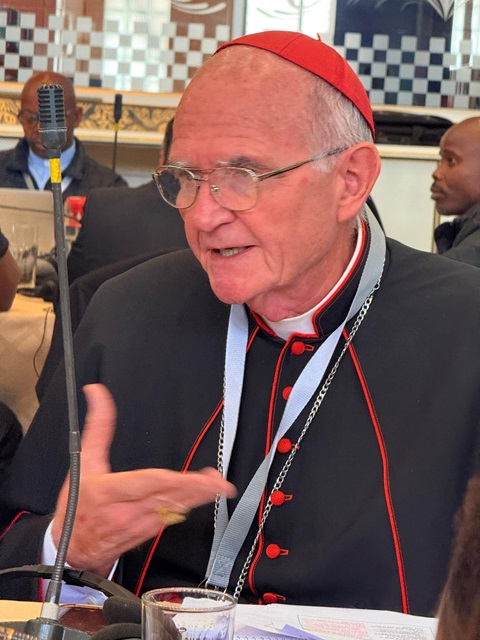
The Archbishop of Johannesburg and President of the Southern African Catholic Bishops’ Conference (SACBC) has issued a strong condemnation of recent xenophobic incidents targeting foreign nationals in South Africa.
Cardinal Stephen Brislin’s message comes amid growing reports of migrant families being denied access to public hospitals, clinics, and schools — a development that has drawn both national and international concern.
In a pastoral message addressed to all parishes of the Archdiocese of Johannesburg, Cardinal Brislin described the situation as “deeply abhorrent.” “The present situation of certain groups preventing non-South Africans from accessing medical facilities and schools is deeply abhorrent,” he said, referring to incidents that took place in Yeoville and Soweto, where mobs reportedly blocked foreign nationals from entering clinics.
“Irrespective of legal status, all have a right in South Africa to access medical care and a right to schooling,” Cardinal Brislin emphasized. “No group has the authority to abrogate the prerogative of law enforcement by mob action.”
“A Dereliction of Duty”
Cardinal Brislin expressed alarm at reports that law enforcement officers stood by idly during the incidents. “To fail to protect people in harm’s way is a dereliction of duty and should be met with strong consequences,” he added.
According to news reports, Operation Dudula activists in Soweto and Yeoville confronted foreign nationals at clinics, accusing them of “draining public resources.”
“These actions,” Cardinal Brislin said, “lack any moral purpose and contribute to normalising the politics of exclusion and deprivation.” He rejected the notion that migrants are responsible for resource shortages, calling corruption “the true underlying cause.”
Scripture and the Call to Conscience
Drawing on Scripture, Cardinal Brislin invoked verses from Exodus 22:21, Leviticus 19:33, and Deuteronomy 27:19, reminding Catholics of their moral duty toward foreigners and the vulnerable.
“Deuteronomy 27:19 is very clear, he said, ‘Cursed is anyone who denies justice to the foreigner, the fatherless or the widow.” He continued, “Jesus picks up the teaching and in the famous Sermon on the Mount, saying categorically, ‘When I was a stranger you welcomed me.’ Again in Hebrews 13:2, we read, ‘Do not forget to show hospitality to the stranger, for in doing so some people have welcomed angels unaware.”
Echoes from the IMBISA 14th Plenary Assembly
At the recent IMBISA 14th Plenary Assembly held in Matsapha, Eswatini, Cardinal Brislin presented the SACBC report, where he also raised concerns about rising xenophobia in South Africa.
“A movement called Operation Dudula has been preventing undocumented foreigners from accessing hospitals and clinics in certain areas, and there is the threat that they will start doing the same with schools,” he reported.
“The Church has been working with migrants, refugees and undocumented minors to assist them in any possible way. It is a huge task.”
The report linked xenophobic tensions to broader social and economic pressures, including unemployment, corruption, and the erosion of family and social cohesion.
“We cannot be unmoved by poverty, economic injustice, war, and suffering that affect many across the globe, across Africa, and in our region,” Cardinal Brislin wrote in the SACBC presentation. “We have to be signs of hope… and that means we cannot be silent.”
A Call to Hope and Action
In his closing message, Cardinal Brislin echoed Pope Leo XIV’s recent appeal that “we find true hope when we give of ourselves freely and with love.”
The Archbishop of Johannesburg urged Catholics to “stand with the vulnerable, speak against exclusion, and act with compassion.”
“Hope is not a mere desire,” Cardinal Brislin said. “It is a confident expectation centered on God — one that must be lived out through justice, mercy, and hospitality.”
0 Comments