
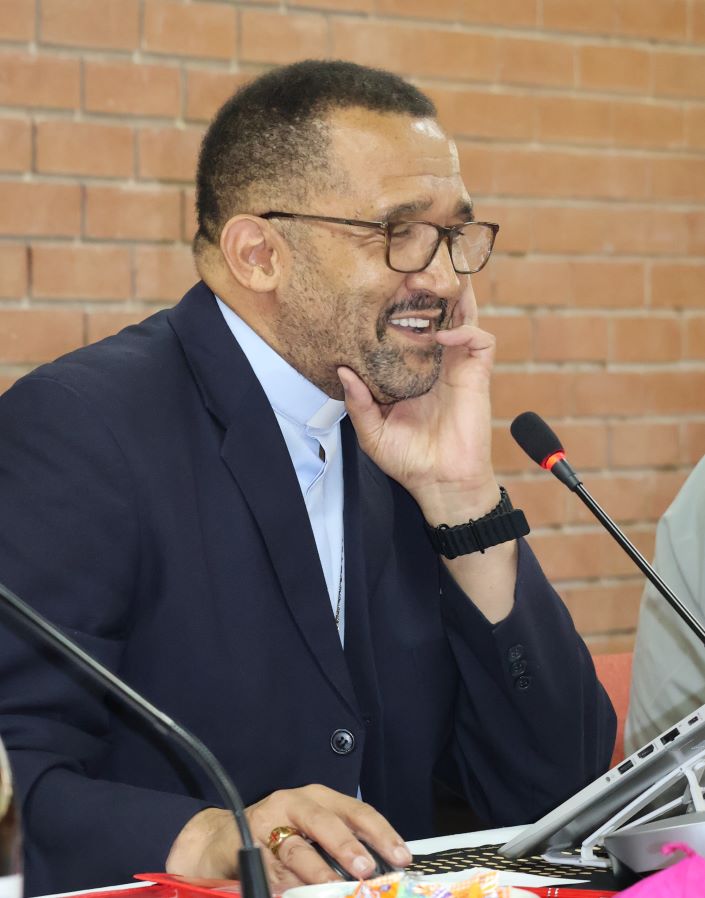
In his final Presidential address Bishop Sithembele Anton Sipuka outlines critical pastoral, administrative, and socio-political issues affecting the Catholic Church within the Conference’s jurisdiction. Bishop Sipuka also offers reflections on future challenges and directions.
Opening Address of the January 2025 Plenary Session of Bishops
Pretoria 22 January 2025 Bishop S. Sipuka
Welcome
Your Eminences, Your Excellency the Apostolic Nuncio, Your Excellencies,
Mgrs., Frs, Brothers and Sisters, good morning, and welcome to this first Plenary meeting of bishops of 2025. This address, our last to the Plenary, will understandably be longer but not excessively so.
Congratulations
At the end of this Plenary, we will install the newly appointed Archbishop of
Johannesburg and celebrate with the Archdiocese for having a new Pastor in Cardinal Brislin. Congratulations, Your Eminence, and thank you for your dedicated service in your previous Archdiocese of Cape Town. As you begin your ministry in the largest diocese by Catholic population, we assure you of our support and prayers.
The retirement of your predecessor, Archbishop Buti Tlhagale, who served for more than two decades, marks the end of an era and the dawn of a new one under your leadership. We wish you well in leading the Archdiocese of Johannesburg in this new phase.
Tribute to retiring bishops
Archbishop Tlhagale’s retirement signals a shift in Johannesburg and the broader Conference. He is part of a cohort of bishops reaching retirement age, which indicates we are entering a new era in our Conference. I want to begin by appreciating these esteemed leaders. Their contributions have profoundly impacted our journey, and I want to highlight some milestones achieved under their guidance. Allow me to start with the eldest, Cardinal Napier.
Cardinal Napier
He has served this Conference for nearly 44 years and has been President twice. He represents a crucial link between our current generation of bishops and those of the past, ensuring continuity in our ministry. His leadership during the challenging apartheid times was prophetic and exemplified the courage to speak out against injustice. Cardinal Napier’s commitment to justice and truth inspires our ongoing work on justice issues and promoting reconciliation in conflict-affected regions through the Justice and Peace Department, the interventions and statements of the SACBC and the Denis Hurly Peace Institute.
Cardinal Napier’s courage continues to characterise him even today. He is forthright and engages with issues when they arise with anyone. Yet, as courageous and forthright as he is, he also has a charming and playful side. Any 40-year-old man would be glad to have half of his wit and sharpness of mind. He is a man completely dedicated to the Church. He is highly involved in the Vatican’s affairs and engages in international issues. Yet he is simple, practical, down-to-earth and approachable to ordinary people. Thank you, Cardinal Napier, for the example of your dedication and leadership.
Archbishop Tlhagale
Last week, we celebrated Archbishop Buti’s farewell. His community affectionately calls him Umgulukudu, or “gangster,” which reflects his no nonsense approach. If someone engages with him irresponsibly, he responds directly, compelling the individual to take responsibilities seriously. He once declared that he was not a father to his seminarians and priests because they must be children if he was a father to them. His straightforward attitude proved his determination to encourage local priests and laity to take charge and grow from the missionary era rather than merely maintain inherited structures.
His firm stance about taking responsibility is something I appreciate because, for some reason, many of our priests are not leading; at best, they are maintaining. A clear example is the time priests are taking to build SACOP into an effective pastoral body and a reflective platform for moving the Church forward. We need the priests to reflect systematically and help us integrate faith and culture meaningfully instead of this arbitrary syncretism that depends on the fancies of each priest. We need priests to think with us and cajole us about pastoral issues, which we may be blind to as bishops in the Conference area. Archbishop Tlhagale, with his studiousness, is an excellent motivation for thinking about the solution of pastoral issues and for a well-considered integration of culture and faith.
As President, Archbishop Buti initiated steps that advanced the Conference, including establishing the bishops’ fund and appointing the first woman secretary General, which earned us global admiration. Even though he had the biggest diocese in the country, he never missed events in dioceses that required him to represent the Conference, sometimes driving across the night to be back in time to his Diocese for confirmation.
After his term as President, we wanted him to head the media and communication desk. He said, “No, if you want me to add any value to the Conference, let me work in the office for migrants and refugees,” which, until then, did not exist. We had left the ministry to migrants and refugees to the Jesuit refugee services and dioceses close to the borders.
Archbishop Tlhagale built the SACBC office for migrants and refugees, establishing its offices across the SACBC dioceses and effectively highlighting the plight of migrants and refugees with admirable articulation and commitment in the Conference area.
His commitment to this ministry led to his invitation to join the United Nations Multi-Religious Council, which addresses the causes of conflict and displacement worldwide and supports peacebuilding, inclusiveness, and reconciliation. Thank you, Archbishop Skhokho saseGoli.
Bishop De Groef
I want to express my gratitude to Bishop De Groef for his dedicated service in the Conference, particularly as Chairperson of the Evangelisation department and later in the Department of Inter-religious Dialogue and Ecumenism. His leadership was crucial in producing a Conference directory for ecumenism in 2020 and facilitating dialogue with other ecclesial communities. This was followed by workshops with Dioceses to implement ecumenism at the Diocesan level.
Bishop Jan is diligent in follow-ups, often referencing past discussions to ensure accountability and continuity. He is a stickler for follow-ups and implementations. His strong memory and attention to detail highlight his commitment to ecumenism. While challenges exist, particularly in achieving comprehensive ecumenism, Bishop Jan’s leadership has been consistent, never giving up or despairing and doing what needs to be done.
If ecumenism has not been a resounding success in our Conference, it is not because of a lack of leadership and passion in bishop Jan but rather due to the many difficulties inherent in ecumenism itself. The biggest challenge in Ecumenism is the lack of appreciation of comprehensive ecumenism, which has three dimensions: praying together, acting together for charity and justice and growing in truth through dialogue. Most churches are happy to remain at the level of unity in charity and justice and not unity in faith because, as the saying goes, service unites and doctrine divides. Hence, they are happy to stay in service and not dialogue.
Yet, if being precedes action, it means that we must be concerned about the truth or principles that underpin and motivate our charity actions because our belief gives foundation to our actions. Our common action must be informed by a shared belief or at least by an openness to work towards a shared belief. Settling only for doing charity together and neglecting to work towards a common truth is yielding to the spirit of relativism, which permits anyone to believe what one wants to believe, yet as Christians, we are called to the common truth that we were promised the Spirit would lead us to.
This year’s 1700th anniversary of the Nicaean Creed provides an opportunity to deepen our faith dialogue and strengthen ties among Christian Churches. As the council of Nicaea brought many bishops together, so should its commemoration motivate Christian Churches to dialogue towards common truth. Thank you, Bishop Jan, for your ongoing efforts to make our shared faith meaningful
Bishop Risi
Bishop Risi is the next to reach retirement age, having served the Conference with remarkable zeal for nearly 25 years. Under his leadership, we are proud to be among the most up-to-date Conferences regarding liturgical matters. Even before the New English Roman Missal was published, we proactively introduced it in our area, and we continue to keep up with all revised liturgical texts, always ready to vote on necessary changes. Our last visit to the Dicastery for Divine Worship during the Ad Limina was one of the most productive dialogues, thanks to Bishop Risi’s diligent efforts in preparing for it.
The Department for Liturgy, Christian Formation, and Culture, under the leadership of Bishop Risi, consistently facilitates workshops and produces books to ensure a sound and comprehensive culturally integrated formation of the laity. Unfortunately, the department’s guidance appears to be ignored in some instances, particularly in Liturgy, where the mystery about liturgy is diminished and turned into a social gathering and entertainment platform.
Such peculiar practices include singing and dancing before the homily and, back in the Eastern Cape, the cacophonic ringing of bells, which has led to reduced singing of Catholic Hymns. Sometimes, you find people talking in between the sacred parts of the Mass and, most disturbingly, priests in chasubles doing traditional and amapiano dances in front of the altar. Such actions betray troubling forgetfulness of duty to lead the faithful in worshipping God and not to indulge in performance and entertainment. While we appreciate Bishop Risi’s commitment to liturgical formation, it is unfortunate that many fail to implement his teachings fully.
Bishop Risi has been essential in drafting the SACBC Pastoral Plan launched in 2020, aiming to foster a vibrant Catholic laity and enhance Evangelization efforts. Unfortunately, the COVID-19 pandemic disrupted these initiatives, and subsequent focus on the Synod process led to less attention being given to the Pastoral Plan. It would be detrimental for this carefully crafted Pastoral plan with a lot of work to fade into obscurity; revisiting it would be beneficial, particularly for the bishops who came after it was launched.
When it was launched, it was decided that each diocese should create its own Pastoral Plan based on the SACBC model. I am only aware of the Archdiocese of Pretoria and, recently, Mthatha taking this initiative. A significant challenge remains: the Pastoral Plan lacks a guiding implementation program, reminiscent of the 1988 Pastoral plan. Although Bishop Risi developed a program for his diocese, it was not officially adopted. With the Synod on Synodality concluded, it’s crucial to find a way to connect the Pastoral Plan to these new developments.
Archbishop Nubuasah
Archbishop Nubuasah is the youngest of the retiring bishops. When he first arrived in Botswana in the 1980s, you would be excused to mistake him for one of the Manhattan singers because he had an afro hairstyle and wore bell-bottom trousers like them. He has since outgrown that appearance. Archbishop Frank seldom speaks, but when he does, he is frank, true to his name and cuts straight to the core of the issue being discussed.
He can be rightly called the Apostle of the Batswana because, for over 40 years, he has dedicatedly served the Batswana people and, for the past 10 years or so, has been the only apostolic link as a bishop in the whole country. He has remained committed to his apostolic work despite the inconvenience of not being granted a permanent visa, with all the frustrations that this entails, including sometimes being unable to attend bishops’ Plenary meetings.
When I first got to know him, he was the head bishop for the HIV/AIDS department. During this time, HIV/AIDS was still a crisis in the Conference area, and the Catholic Church was the No.1 NGO to provide comprehensive care and treatment to those infected and affected. He was compassionate but also provided leadership. One of his arguments, when condoms were pushed as a solution to the AIDS pandemic, was to ask: “If you knew that someone was HIV positive, would you comfortably sleep with that person because you have a condom?” and the answer often was no.
I believe that although AIDS-related deaths have significantly reduced, thanks to the availability of antiretroviral therapy, the growth of infections among young people is concerning. We are, therefore, not over the cliff yet about the AIDS challenge, and we take inspiration from Archbishop Frank to continue with this ministry. Re a leboga Rra.
The leadership we have witnessed in this Conference is a testament to the strong foundation laid by these five big brothers. As we transition into this new era, I urge all of us to draw from their wisdom and experience to guide our future endeavours.
Further Pastoral Issues
Let me proceed to further pastoral issues for our consideration as we begin this Plenary.
Declining numbers and income
The last statistics from 2016 showed that the number of Catholics in the Conference area constitutes about 7% of the total population, which is close to 4 million. I sense that we have gone down, especially after COVID-19. The numbers have decreased, and those who have remained do not have the culture of financially supporting the Church; so, what must we do?
We need to explore cooperative and consolidated investing strategies among SACBC dioceses because relying solely on the contributions of the laity is no longer sustainable. We started with the bishop’s fund, but we now need to find alternative ways of generating income, managing resources effectively, and pooling our efforts to invest wisely.
Jubilee Year and 1700 anniversary of the Nicaean Creed
As we know, 2025 is a Jubilee Year in which the Holy Father has called for the revival of hope. This is also the 1700th anniversary of the Nicaean Creed. In the latest version of the Vatican Newspaper, Obsvatore Romano, the Holy Father has beautiful themes for reflection that we can use to deepen the theme of hope. Bishop Victor Phalana is developing some reflections on the Logo of the Jubilee, and I hope that he will share them with us. The theological Advisory Commission could also reflect on Christian hope, which goes beyond mere human optimism and on the articles of the Nicaean Creed and distribute them to dioceses of the Conference for reflection.
Shortage of Personnel
The Conference struggles to find suitable and able personnel to work in its various departments. More cooperation between the bishops and religious superiors is needed to identify and train young religious, especially women religious. As bishops, we should not expect to get readily trained religious to work in our Dioceses and the Conference without assisting in training them. Religious superiors need to move away from the tendency to want to train their members only for their ministry and projects and be stingy about training them for the local Church and the Conference as well.
Towards more precise statistics
The issue of accurate statistics has been raised in the Conference several times because the annual statistics that we present to Rome are based on parish records, which mainly indicate historical belonging, only indicating that a person was baptised as a Catholic. We need an indication of active Catholics that helps to determine participation in the church’s mission and financial support. This is even true now as we discuss the re-demarcation of diocesan boundaries and the possible creation of new Dioceses. We need to have precise statistics about active membership.
For this reason, we have embarked on an initiative to digitalise our parish data to provide more precise statistics in Mthatha. It involves transferring all data in the baptismal books into a computer program that updates as people progress in their faith journey. As each Parish enters Data, the Diocesan Data is centrally updated. With this program, priests do not need to send paper-based statistics to the Chancery. When the Chancery needs to send statistics to Rome, it only takes pressing a button because the real-time data updates the central system.
Furthermore, the program enables you to print baptism, confirmation, marriage certificates, and removals by just typing the name and surname of the person requesting the certificate. The foreseen features of the program include a Monthly Parish Plan, a Yearly Parish Plan, a Quarterly Financial Report, a Yearly Report by the priest to the bishop, and the Development of a detailed trend of Collections in the Parish over a specific period.
This program belongs to Mthatha, but Mthatha is willing to share it with the Conference or bishops who may want to use it. I will demonstrate how it works on the computer later during the Plenary.
Situations in the Countries of the Conference
Botswana
We are joyfully appreciative of the recent successful and peaceful elections in Botswana. These elections saw a party that had ruled the country for almost 60 years replaced by another party, and it all happened without conflict. It is a breath of fresh air on the African continent, often characterised by the tendency to cling to power for its sake and very often at the expense of ordinary people, as we can presently observe in Mozambique and another famous country across Limpopo.
Another positive development about Botswana is that the issue of capital punishment is now being debated, hopefully paving the way for its abolition. However, a lingering concern remains; like in South Africa, the pervasive violence against women continues to plague Botswana.
The Church must escalate its efforts to advocate and speak strongly against violence towards women, including making it an item of agenda for the National Dialogue. We have been on this many times with no observable change; a decisive systemic change is needed, even if that means amending the constitution to deal with Gender Based violence effectively.
Eswatini
The effects of climate change have been felt in Eswatini, with recent severe floods causing widespread destruction across the country. Homes, businesses and infrastructure, including bridges, have been torn apart, leaving many communities grappling with the aftermath. It is pleasing to learn that the government has committed E6 billion for rehabilitation and reconstruction efforts, aiming to restore the country’s infrastructure, support the affected families and hopefully mitigate future challenges.
South Africa
1. Education
Last week, we were treated to the good news of the 87.3% matric result for 2024, the highest South Africa has ever seen. What is more edifying about this improved pass rate is that, once more, our Catholic schools have significantly contributed the most to this high pass rate.
Yet, while this pass rate is commendable, a question remains about whether these results are indicators of high-quality students. Over the past few years in the Eastern Cape, especially last year, Matric students have been forced to attend school every day, from Monday to Monday, and it has been impossible to get them to come to Church because, on the weekends, they are at school. They had matric camps close to exams, some sleeping at school and being coached for exams from morning to evening.
Such a teaching method is narrow, too result-oriented, and focused on assessment. It encourages regurgitation, making students poor candidates for tertiary education and lacking in critical thinking. These candidates will rely on artificial intelligence for their assignments and will memorise for exams. Furthermore, by focusing on getting learners to pass matric while depriving them of the time to rest on weekends, be with family, do home chores and attend Church, you are truncating them because you are developing only their brain and not the total person, and even that development of the brain, you are developing the memory part of it and leaving out the critical and creative part. So, while congratulating South for the high passing rate this year, we question the effectiveness of education.
2. The National Dialogue
With so many national issues that the government has been unable to solve, civic bodies and prominent people have proposed the idea of having a national dialogue involving citizens. The government has also bought into it, and the President has now formally confirmed that it will take place. Even before the agenda of this dialogue, the central point is how this national dialogue forum is constituted. It appears the President has already indicated, if not appointed, people who will lead and be members of the dialogue forum, which is problematic.
The government should not be responsible for appointing the leaders and members of the national dialogue team because doing so would render the Dialogue team an extension of the government as it is answerable to the government. The nation must constitute the national dialogue forum, not the government. During this plenary, we will consider how the national dialogue platform can be formed and its agenda. I suggest that the electoral system, professionalisation of civil service, rural economic development, liquor regulation laws and violence against women and children should be included in the national dialogue agenda.
- The G20 chairpersonship
This year, the chairpersonship of the 20 largest economies in the world falls on South Africa. While this does not mean that South Africa will dictate terms by being chair, it has some advantage of influencing the direction of discussion. We should propose to the South African government what it should push for in the G20 meeting. Again, rural economic development is what we could suggest, with a particular focus on food security and green energy. Additionally, climate change, whose devastating effects continue to ravage our Conference’s countries, must be prioritised as it poses an existential threat that demands immediate and unified action.
International issues
True to its character, this Conference has looked beyond its borders to express solidarity with bishops’ Conferences and countries experiencing conflict. It has engaged about the situation in the Holy Land. We thank God for the positive developments there about the prospect of a ceasefire in a war that has killed so many innocent lives. We lament that it has taken so much suffering and loss of life for the leaders to finally understand what the Church has been saying all along: that war is not a solution. We pray that this ceasefire is the beginning of the end of war and the start of a just and peaceful existence for all the people in the Holy Land.
We pray and hope that the solidarity visit made to Mozambique when post-election violence erupted will strengthen the Church to facilitate a peaceful resolution to the present conflict. More could have been done to show solidarity with the Church in Sudan as we have done before through the Denis Hurly Peace Institute. I hope the incoming leadership will find ways to make up for this lack and continue engaging for a peaceful resolution of the conflict in Sudan.
The End of an Era
As we mark the end of the big era with the retirement of our five big brothers (big five), we also mark the end of the little era as we conclude the term of the current SACBC leadership, the Presidency and the Board. In concluding this last address as President, I want to express my deepest gratitude for the trust and confidence you placed in us to lead the Conference over the past 6 years.
Leading the Conference during COVID-19, which thwarted our pastoral plan and precipitated the decline of active membership in the Church, was no small task. We thank God and you for your support in what we have accomplished in advancing the Conference’s objectives and beg for forgiveness where we could have done better but failed. We are humbled by the confidence you showed in us.
As we turn the page to a new chapter with new leadership, we are filled with hope and anticipation for the future and pledge our utmost support. The challenges of today will shape the future of this Conference, and with the continued faith and support of all in this house, the new leadership will be empowered to rise to meet them. Together, we look to a new era driven by fresh vision and progress toward fulfilling our shared mission in service to God’s mission and His people.
God bless you.
+Sithembele Sipuka
SACBC President
0 Comments