
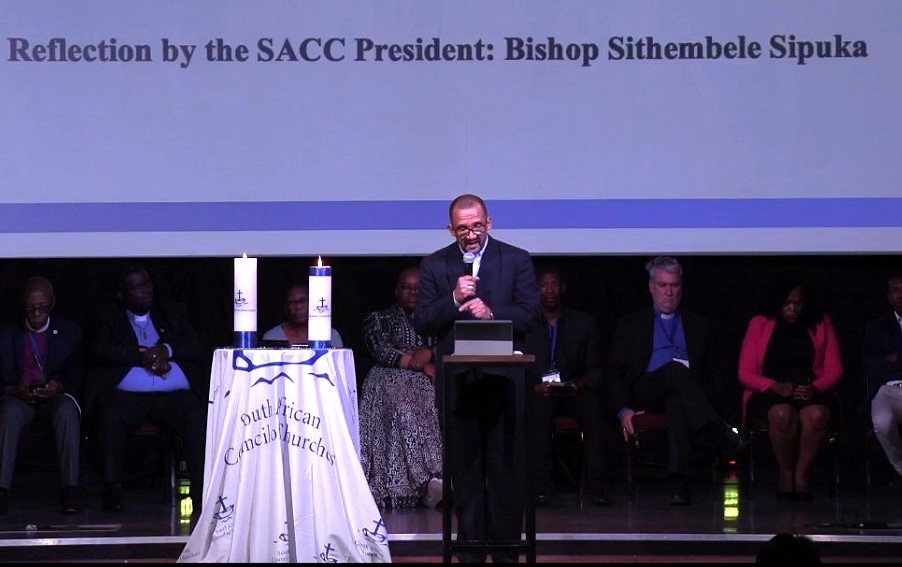
The President of the South African Council of Churches (SACC) has raised concern about what he calls “the spiritual displacement of our children” through the growing trend of schools holding classes every day of the week, including Sundays.
In his address at the SACC Central Committee meeting, Bishop Sithembele Anton Sipuka reflected on the theme “The Spiritual Displacement of Our Children: When Schools Displace Church and Family.” He described the practice of “Monday-to-Monday schooling” as a challenge to the role of both family and faith in the formation of children.
“We are witnessing nothing less than the systematic displacement of God from the formation of the next generation,” he said. “This is spiritual orphaning — we are raising children who are cut off from their spiritual heritage, from the community of faith, from the formation of conscience, and from the transcendent anchors that give life meaning and direction.”
Lack of Consultation
In his address on Thursday, November 6, Bishop Sipuka noted that the practice of seven-day schooling has been introduced in some parts of the country without sufficient consultation or explanation.
“It has been implemented haphazardly, without formal explanation to parents or the public, without consultation with stakeholders, and certainly without engagement with the churches who have historically been partners in the education of South African children,” said the Local Ordinary of Mthatha Diocese.
While acknowledging that education authorities may be motivated by the need to improve matric results, he described the approach as short-term.
He said, “There is a panic reaction to poor matric results. We are treating symptoms while the disease advances. What is being done is putting a Band-Aid on a bullet wound.”
Family and Parental Role
In his address, Bishop Sipuka highlighted that parents remain the primary agents of education, with schools acting in loco parentis — in the place of parents, not as their replacement.
“When the state can command access to our children seven days a week without the consent of parents,” he said, “we have crossed a dangerous threshold.”
He expressed concern that the extended school schedule limits time for family interaction, moral instruction, and participation in church life.
Holistic Education
Drawing from Christian anthropology, Bishop Sipuka said that education should nurture the physical, intellectual, and spiritual dimensions of a person. He warned that current practices risk neglecting all three.
On the physical dimension, he said learners are becoming exhausted.
“Our children are tired of learning. They want to do something else. This is not normal, nor is it healthy. When we confine learners to classrooms and desks seven days a week, we are creating physically exhausted young people.”
On the intellectual dimension, he criticised over-reliance on rote learning.
“Education is not the pumping and coaching of subject content into young minds,” he said. “True intellectual formation develops the capacity to think, to question, to analyse, to create. What we are observing is a departure from authentic intellectual growth.”
He said that the increasing dropout rates at universities are evidence of an education system that “produces learners who can pass matric examinations but cannot think independently.”
On the spiritual dimension, Bishop Sipuka cautioned that schooling on Sundays prevents learners from attending church and from participating in the life of faith communities.
“When children cannot attend church because they are required at school on Sundays, we are witnessing the paganisation of the nation. We are raising a generation without God, without moral anchoring, without spiritual resources, without the formation of conscience.”
Call to the Churches
Bishop Sipuka reminded the committee of the SACC’s vision document “The South Africa We Pray For,” which calls for holistic education that develops both intellect and character.
“The SACC calls for education that strengthens young people’s ownership and appreciation of the asset value of their spiritual and cultural roots,” he said. “Monday-to-Monday drilling contradicts every principle we articulated in that manifesto.”
He urged churches to engage the Department of Basic Education and advocate for consultation with parents and faith communities.
“The time for polite murmuring has passed,” he said. “We must formally engage the Department of Basic Education, demand justification for this policy, and insist on proper consultation.”
Looking Ahead
Bishop Sipuka called on church structures at all levels to document the effects of seven-day schooling and to support parents in reclaiming their role in their children’s education.
“Education in South Africa was built by churches. The best schools in this country, even today, are often affiliated with churches. We understand what many educational technocrats have forgotten: that education is not merely job training or examination preparation, but the formation of the whole person.”
He concluded by warning that if the trend continues, the country risks forming a generation disconnected from faith and community.
“In the long term, we will have a generation that is physically exhausted, intellectually dependent, and spiritually empty. They will be clever but not wise, skilled but not ethical, productive but not whole.”
“The seven-day-a-week schooling imprisons our children. It is time to proclaim their freedom. It is time to set them free,” said Bishop Sipuka on November 6, 2025.
0 Comments