
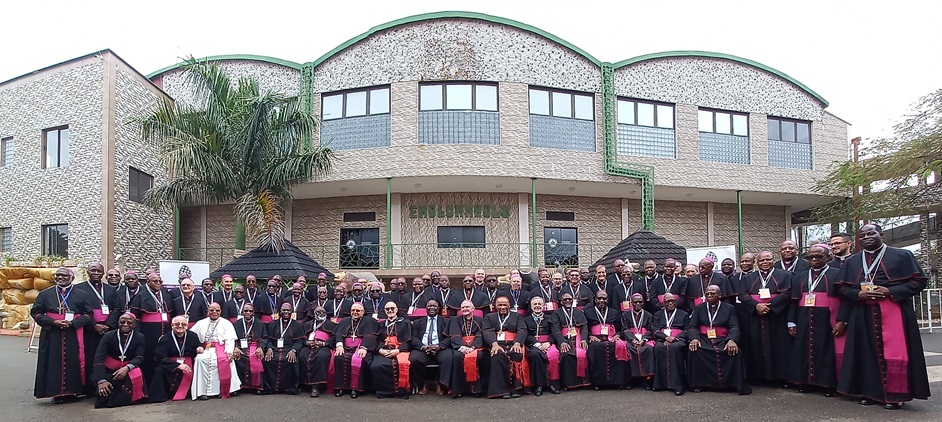
The 14th Plenary Assembly and Golden Jubilee of the Interregional Meeting of Bishops of Southern Africa (IMBISA) offered bishops from across the region an opportunity to reflect on the Church’s mission of communion, service, and renewal.
Among them was Bishop Victor Hlolo Phalana of Klerksdorp, who, in an interview with the Southern African Catholic Bishops Conference (SACBC) Communication Office, said he is “taking home the importance of our fraternity and collegiality as bishops — that now and then it’s important for us to come together and to share friendship, share ideas, pray together and also just be there to listen to one another.”
Bishop Phalana explained that the gathering was more than an administrative meeting; it was a spiritual celebration of unity and history. “Everything was done in the context of the jubilee — IMBISA having now completed 50 years. So, it was worth coming together to celebrate that milestone,” he said.
A key theme throughout the Jubilee was synodality, which Bishop Phalana emphasized as central to the future of the Church. “We learned that the whole issue of synodality is very, very important and that we need to commit ourselves to synodality and do some implementation of synodality in our own dioceses,” he said. “We need to encourage our people to understand what synodality is because it is calling for some transformation in the Church — transformation in the Church structures, in the way of doing things.”
He noted that despite differing views, bishops across the region expressed renewed commitment to this path. “It was very good for us to talk about it again, and I could hear the bishops recommitting themselves to this path of synodality, aware of the fact that there could be some in the Church who are not happy with it,” he reflected. “But at least IMBISA has given synodality their thumbs up, and they are saying no, we will adhere to the call of both Pope Francis of good memory and also our present Pope Leo, they all support and encourage synodality. That’s the path the Church will take.”
Turning to one of South Africa’s urgent social challenges, Bishop Phalana spoke about the Church’s pastoral response to the Zama Zamas (informal miners working in unsafe and illegal conditions).
“I think it will have to start maybe with our Justice and Peace Commissions and maybe the Office of Migrants and Refugees coming together to look at our pastoral response to the reality of Zama Zamas,” he said. “Once they come into a country like South Africa, they are immediately declared illegal, and they are also called criminals. We know that most of them are here because they are looking for a better life. Some of them were lured into this kind of work because of a promise of a job.”
Bishop Phalana stressed that while the Church supports the rule of law, its mission remains rooted in compassion and human dignity. “Our response has to always be on the side of the law, to say okay, let the law take its course, people have to be legal in the country, but once they are here, they have to also enjoy the protection of the law of the country,” he said. “They have to be registered somehow. They have to be acknowledged somehow.”
Recalling the Church’s earlier appeals during mining tragedies, he said the Church’s “intervention previously with those who were trapped was to call for the government to save them.”
“Save lives. That was our position. Save lives. All the other things can be dealt with. But the most important thing, the most urgent thing at the moment — please help them, assist them to come out,” he said.
He continued, “Once they are out, then you can give them to Home Affairs, send them back home, take them to the hospitals and give them medical attention, but save them.”
“And that was our appeal. And we were doing it from a moral, spiritual point of view. And we were called names, of course, by those who were saying, ‘No, let them die.’ We said no, it is not Christian, and it is not human to let people die. They are here already, and they are vulnerable. We have to assist them and then help them to reconcile with their families, reconcile with their communities, and also let them get healthy,” he added.
Looking to the future, Bishop Phalana called for new, practical solutions. “We need to promote artisanal mining in South Africa and make it possible for young people who would like to do mining to get some kind of training, some support from government, a permit of some kind, skills, tools, whatever they might need to be able to go and do mining legally,” he said.
He continued, “Our engagement with the government will be to see to it that the government does its part in promoting artisanal mining, and for us, encouraging young people to form cooperatives and maybe somehow to come and get the skills and get the necessary training and assistance to be able to do that kind of informal artisanal mining. We supported it.”
Reflecting on the Jubilee Mass itself, Bishop Phalana described it as a joyful and deeply spiritual celebration. “It was beautiful, well organized, full of joy, and of course, people looked beautiful and colorful in their traditional attire and their sodality uniforms,” he said. “We were honored to participate in such a celebration.”
Bishop Phalana further said he was moved by the generosity of the faithful who contributed to the success of the celebration. “A huge marquee that cost over 100,000 was donated by a Christian, saying, ‘You don’t have to pay for it. It is my way of saying thanks to God.’ And so many people offered services — another one offered transport for all the guests… So, people came on board and offered and expressed their gratitude to God by giving. And I think this is the spirit that the Church needs. We need to inculcate the spirit of giving.”
He concluded with a heartfelt appeal and testimony: “The Lord has blessed you. How do you say thanks to God for his blessings? Let our Catholic brothers and sisters continue on this path. The Church will survive through the generosity of its people. I was so happy today — it was a beautiful celebration and I’m happy to have been part of it because I feel revived and rejuvenated and inspired.”
0 Comments