
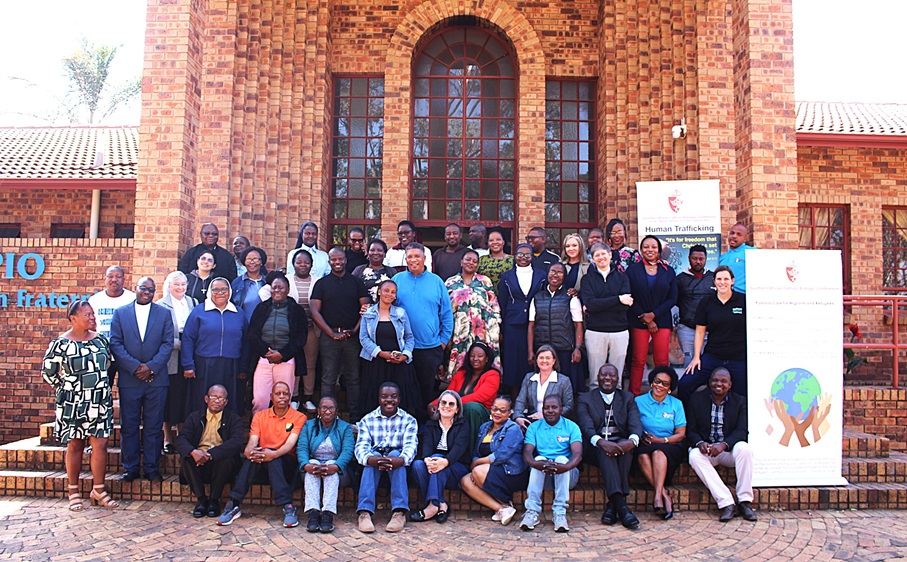
The Padre Pio Retreat and Conference Centre in Pretoria hosted a two-day Annual General Meeting (AGM) on migration and human trafficking, bringing together 46 diocesan pastoral agents from South Africa, Botswana, and Eswatini.
Organized under the leadership of the Southern African Catholic Bishops’ Conference (SACBC), the meeting aimed at strengthening pastoral strategies in response to migration challenges and the growing threat of human trafficking.
In an interview with the SACBC Communication Office on the sidelines of the Annual General Meeting (AGM) of diocesan pastoral agents on migration and human trafficking, Bishop Joseph Kizito, SACBC Liaison Bishop for Migrants, Refugees and Human Trafficking, urged the Church to speak out more strongly for people on the move and for victims of human trafficking.
Bishop Kizito said the August 26 to 27 AGM under the theme ‘Migrants, Missionaries of Hope’ aimed at empowering diocesan pastoral agents and to not only “care for migrants, but to walk with them” in a synodal spirit, as “migrants and refugees also have a lot to say, a lot to share, a lot to enrich the hosting country and the hosting communities. We are not doing things for them, but with them.”
A Prophetic Call in the Face of Exclusion
In the Wednesday, August 27, interview, Bishop Kizito raised serious concerns about growing reports of migrants and refugees being denied access to healthcare in public facilities. “It is not the policy of the government to deny people the basic rights of health and education,” he said.
He continued, “This exclusion has been hijacked by politicians for their own agenda. The government promotes inclusion, but weak implementation and political opportunism have left migrants and refugees on their own.”
The Local Ordinary of Aliwal Diocese recalled the SACBC’s July 10, 2025, statement signed by the conference president Cardinal Stephen Brislin and echoed the voice of Archbishop Siegfried Mandla Jwara CMM, whose statement, published on August 22, 2025, condemned the practice of turning migrants away from clinics and hospitals. Archbishop Jwara CMM insisted that access to healthcare is a basic human right.
Bishop Kizito also warned about recent calls to expel foreign children from South African schools. He said, “Education and health are basic rights. If the Church does not stand up and become a prophetic voice, we risk becoming a Church driven by politics rather than by the Gospel.”
Strategic Pastoral Plan 2025–2029
A central focus of the AGM was the presentation of the first draft of the Strategic Pastoral Plan 2025–2029 on migration and human trafficking. Bishop Kizito described the plan as a roadmap to guide dioceses across the SACBC region.
“Like any department, we need a vision, a mission, and a plan. This five-year strategy is grounded in the pastoral cycle and informed by a SWOT analysis. We looked at our strengths, our weaknesses, our opportunities, and our threats — and above all, we asked: what does the Gospel and the Synodal Church say about migrants?” he explained.
Human Trafficking: A Growing Threat
The meeting also examined the rising challenge of human trafficking. Bishop Kizito noted that South Africa has become a recruitment ground, a transit hub, and a destination country.
He said, “Human trafficking happens in our own communities, through social media, through false job offers. Unemployment makes our young people vulnerable. We as the Church must raise awareness, be vigilant, and work with others to stop it.”
A Call for Unity
As the AGM moved toward its conclusions, Bishop Kizito called for stronger collaboration. “We cannot do this alone,” said Bishop Kizito.
“We must work with other churches, with government, with civil society. If we stand together — bishops, priests, religious, laity — we can respond to xenophobia, human trafficking, and statelessness with compassion and courage,” he added.
The AGM, he affirmed, is a milestone in shaping a united pastoral response to migration and trafficking in the SACBC region.
0 Comments