
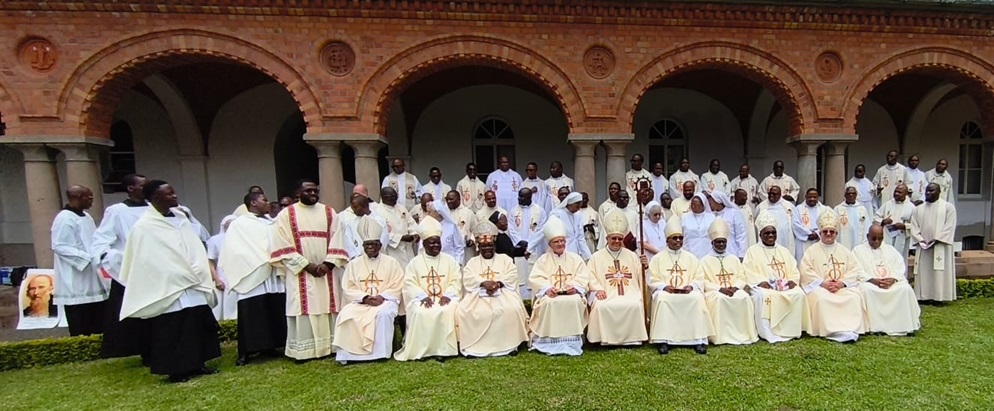
On the Solemnity of the Immaculate Conception, the Church in South Africa gathered at Mariannhill Monastery to mark the 200th anniversary of the birth of Abbot Francis Pfanner, founder of the Missionary Sisters of the Precious Blood and the Missionaries of Mariannhill.
The solemn Mass presided over by the Apostolic Nuncio to Southern Africa, Archbishop Henryk Jagodziński, was concelebrated by Cardinal Stephen Brislin, Archbishop Siegfried Mandla Jwara CMM, Archbishop Emeritus Paul Mandla Khumalo, Bishop Neil Augustine Frank OMI, Bishop Stanisław Dziuba OSPPE, Bishop Thulani Victor Mbuyisa CMM, Bishop Vincent Mduduzi Zungu OFM, and Bishop Xolelo Thaddaeus Kumalo.
In his homily, the Archbishop Emeritus of Johannesburg placed Abbot Pfanner’s life within the spiritual lineage of the missionaries “who dedicated themselves to the salvation of the African soul.”
A “debt of gratitude” to the pioneer of Mariannhill
Archbishop Buti Joseph Tlhagale began by echoing the words of Pope Paul VI in Kampala in 1969, when he spoke about the debt of gratitude. “Remember your leaders… consider the outcome of their life and imitate their faith,” he said.
Archbishop Tlhagale noted that the celebration was fitting to “pay appropriate homage to Abbot Pfanner and all the missionaries who dedicated themselves to the salvation of the African soul.” Describing the early days of evangelization, Archbishop Tlhagale spoke of the transformative impact of the Austrian Trappist who arrived in South Africa in 1880:
“We were a dark people walking in the darkness of the night. But the flaming torch of Abbot Pfanner brought us the amazing light of Christ, which gave us a new experience of fullness, out of the slavery of darkness.”
It was this light, he said, that opened to African Catholics “the freedom and dignity of the children of God.”
A life that called others to holiness
Interweaving Pfanner’s biography with the spiritual fruits of his mission, Archbishop Tlhagale recalled the Servant of God who became an “active missionary monk,” establishing the monastery of Mariannhill in 1882 and nurturing a community shaped by prayer, education, and social upliftment.
“Over 200 years,” Archbishop Tlhagale said, “legitimate expectations have built up. Young Catholics have joined older Catholics in receiving the message of conversion and sainthood.”
The member of the Oblates of Mary Immaculate (OMI) reminded the faithful that the prayers offered at Mariannhill for Pfanner’s canonisation are also a testimony to the holiness that has flourished among his spiritual descendants, and “bear testimony to the effective missionary work of Abbot Francis,” whose “sole purpose on the African soil, was to build a homeland for Christ and to convince the indigenous people that God has poured out his love into their hearts through the Holy Spirit.”
The visible fruit of a missionary legacy
Drawing attention to the enduring impact of the Servant of God, Archbishop Tlhagale cited the growth of the Church in the region as a sign of grace. “Mariannhill diocese has about 300,000 Catholics; 102 members of the Precious Blood Sisters; 116 religious priests and 80 diocesan priests. Mariannhill has the highest number of diocesan priests.”
Such fruits, he said, reveal the deep Christian roots planted by Abbot Pfanner “in spite of the stubborn challenge from African traditional religious beliefs.” “Generations of young people formed at St. Francis College,” he added, learned from Pfanner’s legacy, “their vocation to the apostolate, to a life of service to the Church and to the community, and in so doing render glory to Christ.”
Conversion of the heart and the truth of the Gospel
Archbishop Tlhagale also reflected on Pfanner’s insistence that the Christian faith entails a decisive turning toward the living God. “Accepting Jesus Christ as the Son of the living God also meant conversion or the abandonment of the false claim… that African ancestors wield supernatural powers. They do not,” he affirmed.
Quoting St. Paul’s letter to the Romans (14:8,12), Archbishop Tlhagale reminded those gathered that “alive or dead we belong to the Lord … It is to God therefore, that each one of us (African included) must give account of himself (herself) and not to our dear ancestral spirits.”
Mariannhill: a place of prayer and pilgrimage
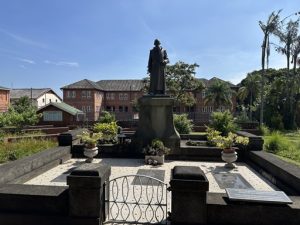
Describing Mariannhill monastery today, Archbishop Tlhagale called it “a site of pilgrimage,” shaped by decades of uninterrupted prayer and missionary dedication.
“Many visit Mariannhill because they consider it a shrine,” he said, not due to miracles alone, but because of the unbroken devotion of the Sisters and Friars, “for whom every day is a dies Dei, a day that belongs to the Lord.”
In his concluding remarks, Archbishop Tlhagale recalled the Solemnity of the Immaculate Conception. He said, “Many pray fervently that one day, when it pleases our heavenly Father, many might gather here in veneration of our father in the faith…Abbot Pfanner.” “These prayers,” he added, “are offered to God through the intervention of Mary, our Mother, whose feast we celebrate today.”
Prayers at the tomb
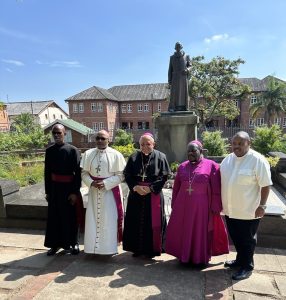
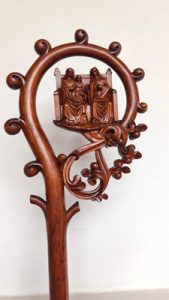
After the Eucharistic celebration, the Apostolic Nuncio to Southern Africa, together with some of the Bishops, proceeded to the tomb of Abbot Francis Pfanner, where he prayed for the Servant of God’s prompt beatification. The Apostolic Nuncio notably used Abbot Pfanner’s crosier during the Mass, a symbolic link to the founder whose missionary zeal transformed Mariannhill into a centre of evangelization, education, and spiritual life.
0 Comments