
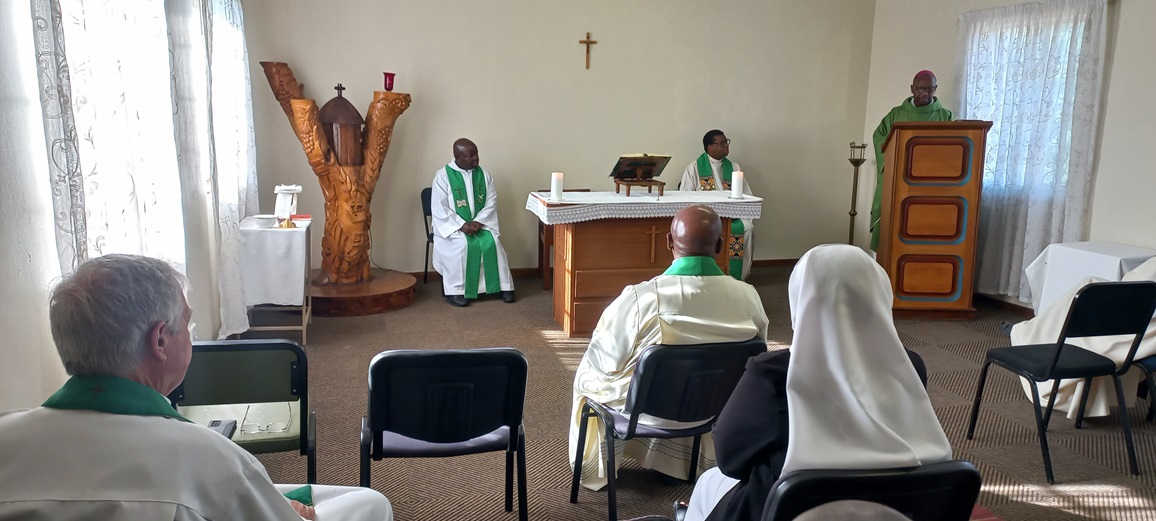
In his homily at the morning Mass for bishops gathered for the Southern African Catholic Bishops Conference (SACBC) Board Meeting at St John Vianney Seminary, Archbishop Zolile Peter Mpambani SCI invited his brother bishops to reflect deeply on the Gospel’s challenge to “count the cost” of following Christ.
Drawing from the day’s Gospel passage (Luke 14:25-33) — “Which of you, if he wishes to build a tower, does not first sit down and count the cost to see whether he has enough to finish it?” — Archbishop Mpambani said discipleship requires more than mere affiliation to the Church.
“It is possible,” he noted, “to be a follower of Jesus Christ without being a disciple. It is one of the supreme handicaps of the Church that in it there are so many distant followers of Jesus and so few real disciples.”
In the Wednesday, November 5 homily, the SACBC First Vice President cautioned against a passive approach to faith. “We often hear people say, ‘I believe in going to church, sitting at Mass, receiving the blessing, and going home.’ But they do not want to participate. This attitude goes against what synodality calls us to — participation,” he emphasized.
Archbishop Mpambani reminded the bishops that the act of coming to church is not an individual exercise but a communal one. “When we come to church, we come to form communion with those we worship and pray with. But forming communion alone is not enough — we must also participate in the mission of the Church,” he said.
The Local Ordinary of Bloemfontein Archdiocese connected the Gospel message to practical ministry, urging strategic planning both in spiritual and pastoral life. “Nothing must be embarked upon without proper planning. In every sphere of life, we are called to count the cost,” he said.
“Even in running our dioceses and parishes, we need to plan strategically — to say, this is what we are doing and how we are doing it. Our Pastoral Plan helps us worship and serve God’s people effectively,” he added.
He went on to highlight that the synodal way strengthens such intentional planning by ensuring inclusivity and collaboration. “The synodal process helps us to put into practice what we have planned, making sure that everyone is involved, knows what is expected, and contributes meaningfully to the mission of the Church.”
Reflecting on the first reading (Romans 13:8-10), Archbishop Mpambani linked Christian life to love as the fulfilment of the law. “We are told we must also plan to live our lives in harmony with one another. Loving can be costly too,” he said. “Owe no one anything except to love each other, for he who loves his neighbour fulfils the law.”
He explained that love is a perpetual obligation that can never be fully repaid. “It’s not about you owe me — it’s about I owe you. The debt of love remains with us permanently and never leaves us,” he said. “If a person sincerely seeks to pay this debt of love daily, he will naturally keep all the commandments — for love never destroys but builds up.”
Archbishop Mpambani described love as “the principle for living that promotes harmony and respect in relationships,” urging the bishops and faithful alike to foster mutual understanding, empathy, and peaceful coexistence. “This harmony,” he said, “is strengthened by active listening — not only with our ears but with our hearts.”
Concluding his homily, Archbishop Mpambani recalled the words of St Augustine: “Love God and do what you like.” He said, “If love is the mainspring of our hearts, if our lives are dominated by love for God and neighbour, then no other law is needed — for there is only one law that governs us: the law of love, which we owe one another forever.”
The bishops’ morning Mass set a reflective tone for the day’s deliberations at St John Vianney Seminary, reminding all present that true discipleship — in life and ministry — requires both careful discernment and self-giving love.
0 Comments