
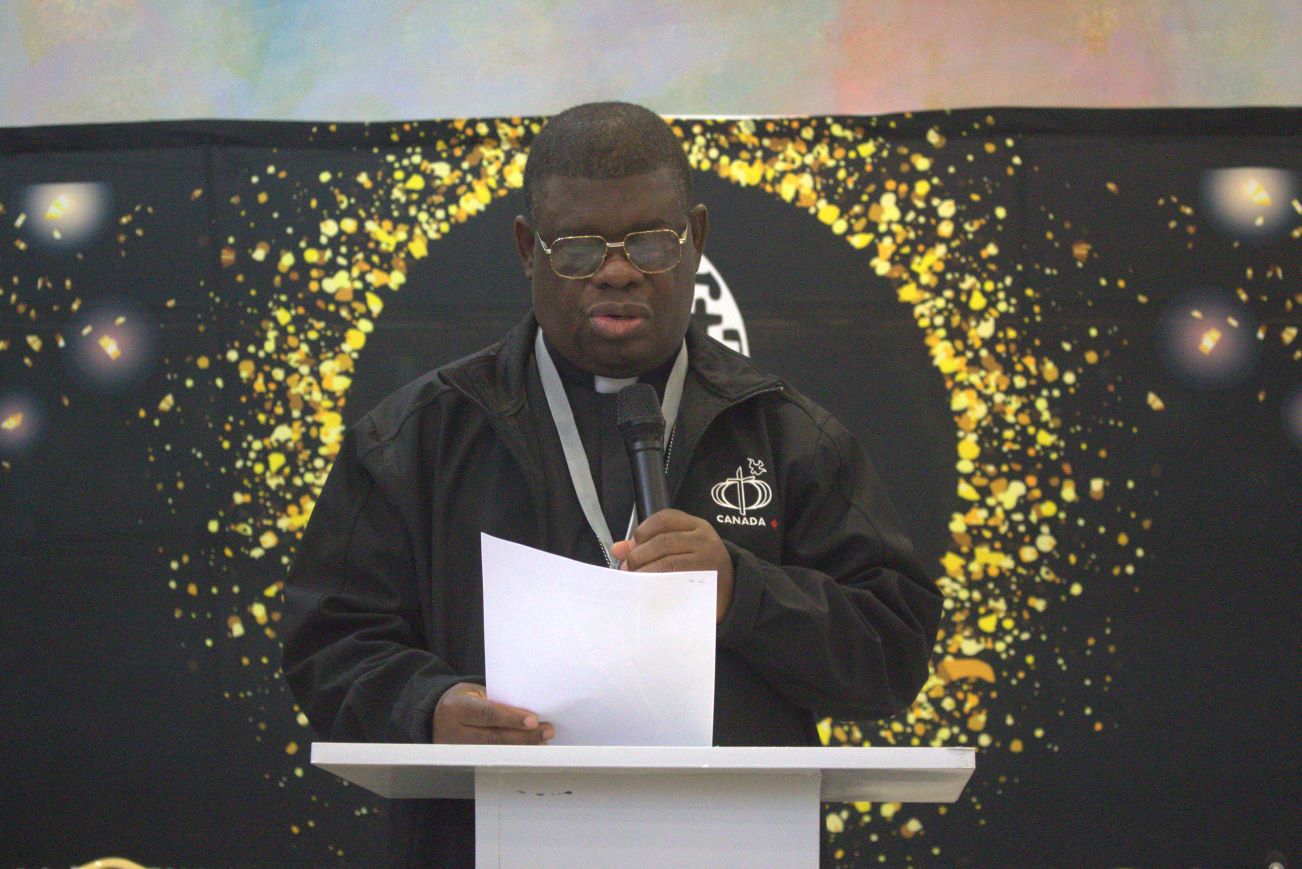
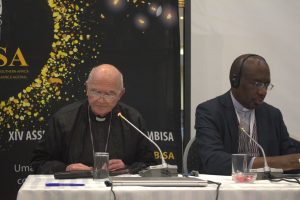
The 50th anniversary of the Inter-Regional Meeting of Bishops of Southern Africa (IMBISA), held in Matsapha, Eswatini, brought together Catholic leaders from across the region to celebrate five decades of faith, dialogue, and pastoral collaboration.
Among the participants was Bishop Charles J. Kasonde of Solwezi Diocese in Zambia and President of the Association of Member Episcopal Conferences in Eastern Africa (AMECEA), who shared profound reflections on Africa’s journey of synodality, solidarity, and self-realization.
“I’m here representing AMECEA,” said Bishop Kasonde. “We have nine member countries—Malawi, Zambia, Tanzania, Kenya, Uganda, South Sudan, Sudan, Ethiopia, and Eritrea—along with Somalia and Djibouti as affiliates… It’s an honour to celebrate IMBISA’s Golden Jubilee, marking 50 years of faith and resilience in Southern Africa.”
A Historic Milestone
The IMBISA Golden Jubilee comes at a time of major ecclesial developments in the region. In July 2024, the bishops of Malawi, Zambia, and Zimbabwe announced their decision to form a new sub-regional body — the Association of Catholic Bishops’ Conferences of Malawi, Zambia, and Zimbabwe (ACBC-MAZAZI) — as reported by Vatican News. This initiative, Bishop Kasonde explained, aims to strengthen pastoral collaboration among nations that share a deep historical and cultural bond.
“We are saying a sub-region,” he clarified. “Zimbabwe still belongs to IMBISA, Malawi and Zambia still belong in AMECEA. We share a common heritage…Zambia was Northern Rhodesia, Zimbabwe was Southern Rhodesia, and Malawi was Nyasaland.
“So that already creates a lot of common– a lot of similar things and the heritage, the tradition. And this is what we said: maybe at that level of pastoral solidarity, we could come up with a sub-region, meaning we’ll still be attached to our usual regional groupings and try to cultivate the spirit of coming together in solidarity. And if in the future it grows and it is seen to be a way of being a regional group, then that is the time that we can make such a decision,” he added.

A Jubilee Rooted in History
Reflecting on IMBISA’s beginnings, Bishop Kasonde recalled the complex political landscape of the 1970s:
“During apartheid, even the Church was affected… Zambia was seen as a safe haven for political exiles, which led to restrictions on relations with Southern Africa”, said Bishop Kasonde.
The AMECEA president went on to talk about the establishment of the regional body and how “Zambia became part of AMECEA in 1961… while IMBISA was formed later in 1975,” after signs of freedom began to emerge in the region.
He praised IMBISA’s 50-year journey as “a testimony of commitment, resilience, and evangelizing zeal,” emphasizing that the Church in Southern Africa has remained a beacon of unity amid social and political struggles.
Synodality: Walking Together in Faith
The IMBISA Jubilee coincided with the ongoing global Synod on Synodality, which is now in its implementation phase (2024–2028). Bishop Kasonde described synodality as an intrinsic part of African spirituality:
He said, “When we talk of synodality, synod means walking together in faith towards our Lord Jesus Christ. So this spirit of synodality is the spirit of commingling, coming together in fellowshipping with a common purpose. And when you look at our ideology of Ubuntu, I am because we are, so an individual is a product of this community, this community, and also the community spirit. And this is what we say, synod is the coming together.”
Bishop Kasonde also recalled the important role of the Lumko Institute in nurturing faith and fostering community-based formation. “We have built our lives” on what Lumko stood for – the initial formation of our people through catechesis… The nourishment of faith comes from training emissaries of the Word of God, so already those are signs of synodality.”

Africa’s Paradox of Wealth and Poverty
Turning to the socio-political realities of the continent, Bishop Kasonde lamented the contradictions that continue to define Africa’s story:
“It is regrettable. We are very rich people with abundant resources,” yet among the “poorest in the world,” he said.
According to Bishop Kasonde, much of it is because of “how we were colonized and how we are governed. We have not fully recovered… In the war-torn areas, the reason why there are fights there is because there are resources.”
“Others make you fight each other whilst they are busy extracting your resources, your minerals. So, if we could put our acts together with our politicians, we can do better as Africans and be able to develop our land and also harness our resources for the betterment of our people,” he added.
As IMBISA marks half a century of service to the Church in Southern Africa, voices like Bishop Kasonde’s remind the faithful that synodality is more than a theme—it is a way of being Church, deeply rooted in Africa’s own story of communion, resilience, and hope.
0 Comments