
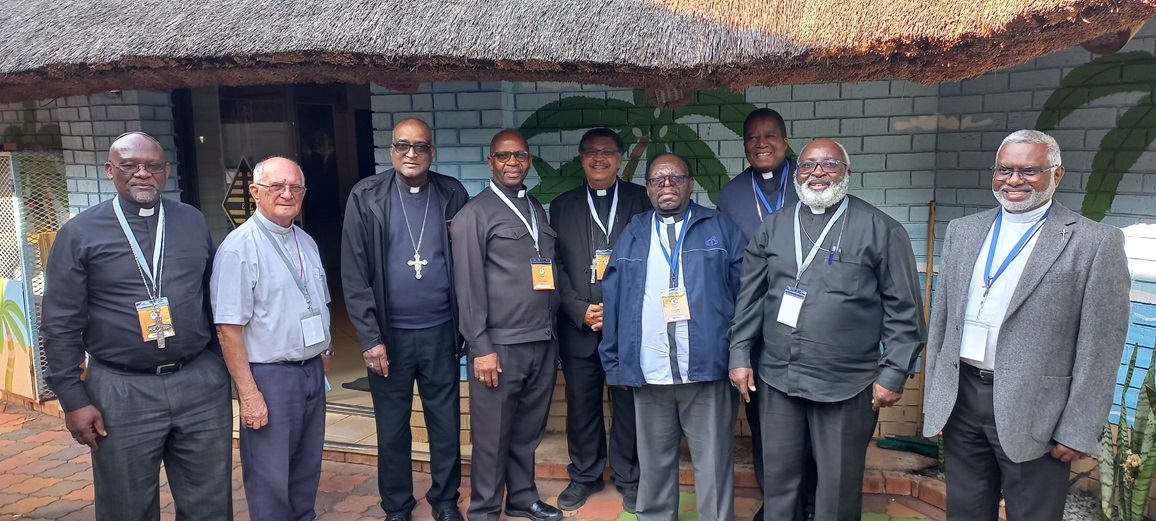
The Church in Southern Africa is mourning the passing of Bishop Edward Gabriel Risi, Bishop of Keimoes–Upington, who died on the morning of Thursday, 4 December 2025, at the age of 76.
His death came after several months of ill-health, during which he was repeatedly in and out of hospital. Yet, despite his frailty, Bishop Risi – a member of the congregation of the Oblates of Mary Immaculate (OMI)- remained remarkably determined to fulfil his episcopal duties—right up to the moment of his final public ministry: the 14th Plenary and Golden Jubilee Celebration of the Inter-Regional Meeting of the Bishops of Southern Africa (IMBISA) in Manzini, Eswatini, in September 2025.
It was there, in Manzini, amid jubilee celebrations marking fifty years of IMBISA, that Bishop Risi granted what would become his last recorded interview with the SACBC Communications Office. Reflecting on the theme of the Jubilee ’A Synodal Journey, nourished by compassion and blossoming in faith as pilgrims of hope’, he offered insights that now read as both a pastoral testament and a final blessing.
A Bishop Determined to “Be Among His Brothers”
Only weeks before the IMBISA gathering, Bishop Risi had arrived at Khanya House in Pretoria for the SACBC August Plenary, visibly emotional. He was just recovering from a prolonged period of hospitalization—his doctors had doubted whether he would be strong enough to attend. Yet he insisted on being present.
When he later travelled with other SACBC bishops to Eswatini for the IMBISA Jubilee, it was a quiet but striking act of fraternity. His brother bishops remarked on his joy at being with them again. It was clear to all that Bishop Risi desired nothing more in his final months than to pray, reflect, and journey with his fellow shepherds.
“Synodality Means Doing the Conversation — Not Talking About It”
Speaking shortly after the closing Mass of the IMBISA Jubilee, Bishop Risi introduced himself simply, as he always did:
“I am Edward Risi, the Bishop of Keimoes-Upington in South Africa. We are celebrating 50 years… and I am very happy with the way we proceeded at this meeting today.”
Turning to the Jubilee theme, he highlighted that synodality cannot remain a theory or a slogan:
“The main issue is the Synod — the question: How do we introduce to our people the conversation in the Spirit? We didn’t talk about it in an intellectual way; we did it by doing the exercise.”
For Bishop Risi, synodality meant participation, encounter, and listening. During the plenary, delegates were invited to imagine the Church fifty years from now. He understood that such a long-term vision demanded something essential:
“If we are talking about the future, then we must talk about the youth. Youth at all levels. That is how we must introduce them to IMBISA.”
His emphasis was clear: young people are not simply the future—they are the present, and they must be intentionally included in the synodal journey.
He also insisted that this formation must include the young clergy:
“Our young priests in a very special way… expose them to the different realities of the IMBISA region—the Portuguese-speaking region, the English-speaking region, and so forth.”
In these final reflections, Bishop Risi returned to a conviction he had articulated consistently over his decades of ministry: the Church cannot grow unless its youth and clergy are rooted, connected, and formed in community.
A Liturgist Moved by Beauty: “Everything Was Very Well Organized”
Long recognized as one of Southern Africa’s foremost liturgists, Bishop Risi could not help but speak about the IMBISA Jubilee’s final Mass. “Everything was very well organized, including the liturgy of the Mass today, which was well supported and well organized. The singing flowed… There were no unnecessary breaks.”
For him, liturgy was never a performance but an expression of the Church’s soul. His praise of the IMBISA celebration was more than a compliment—it was the affirmation of a shepherd who had spent his life guarding the beauty, dignity, and harmony of Catholic worship.
A Life of Service, Teaching, and Liturgical Leadership
Born on 6 January 1949 in Johannesburg, Edward Risi’s vocation began early. He entered the Oblates of Mary Immaculate at only 17 and was ordained a priest in 1974. His ministry included pastoral service in Johannesburg’s township parishes, leadership as OMI provincial, and years of teaching and mentoring as novice master.
He was appointed Bishop of Keimoes–Upington in 2000, serving faithfully for twenty-five years. He became one of the SACBC’s most respected voices on liturgy, formation, and pastoral renewal.
His former school, St Benedict’s College, paid tribute to him with deep affection, recalling his lifelong ties to the institution and the school swimming pool named in his honour. They described him as a leader of faith, service, and education—an “Old Boy” who never stopped giving.
His Final Months: Persevering to the End
Bishop Risi’s final months were marked by physical weakness but spiritual strength. Since May 2025, he had battled serious illness, including the heart condition that would ultimately take his life. When he was admitted to Garden City Hospital on 2 December and moved to intensive care, the bishops of the SACBC began preparing for the worst.
Yet even in frailty, he kept giving. His presence at the IMBISA Jubilee in September 2025 stands as a testament to his commitment and his love for the Church in Southern Africa.
0 Comments