
Article by: Sr Margaret Mary SU – Mthatha Diocese
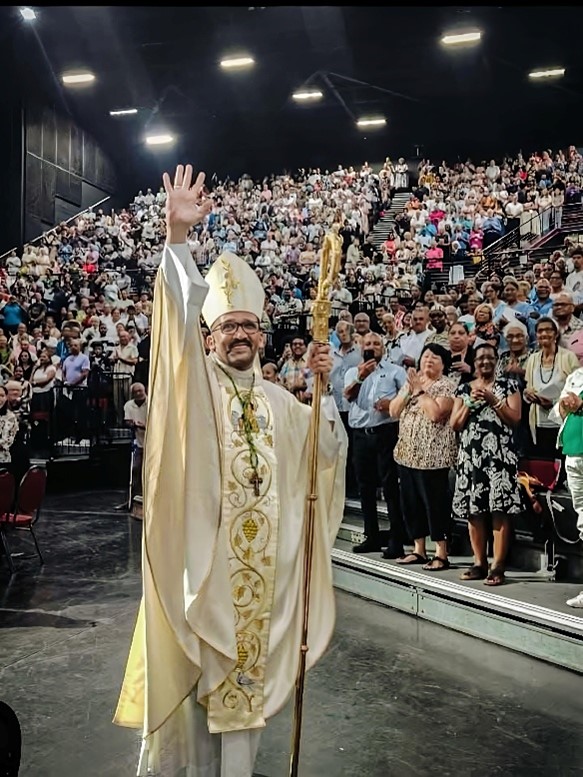
14 March 2026 was a day long-awaited by Catholics across South Africa, and particularly by the faithful of the Archdiocese of Cape Town. Before a gathering of more than 5,000 people at the Grand West Arena in Goodwood, Archbishop Sithembele Anton Sipuka was formally installed as the new Archbishop of Cape Town, ending a period of anticipation that had begun on 09 January 2026 when Pope Leo XIV announced his appointment.
The congregation was a diverse assembly of the Church and civil society: Cardinals, Archbishops, and Bishops from South Africa and beyond, priests and religious, ecumenical and interfaith leaders, government officials, the Mayor of Cape Town, and thousands of the lay faithful who had travelled from nearly every province in the country.
Archbishop Sipuka brings with him eighteen years of episcopal service in the Diocese of Mthatha, where he was first appointed as Bishop after a period of ministry at St Peter’s Major Seminary of Philosophy in Pretoria and St John Vianney Major Seminary of Theology from 1994 to 2008. Within the eighteen years in Mthatha, he has occupied various leadership roles and encountered both consoling and challenging pastoral missions. His journey to Cape Town has not been without its complexity; the appointment also brought change for the Diocese of Mthatha. With his canonical taking of possession of the Archdiocese, Bishop Thulani Victor Mbuyisa CMM, Bishop of Kokstad, has been appointed Apostolic Administrator of the now vacant Diocese of Mthatha, by mandate of the Dicastery for Evangelisation under the special faculties of Pope Leo XIV.
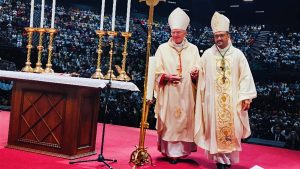
The installation also marked the formal end of Cardinal Stephen Brislin’s role as Apostolic Administrator of Cape Town, a responsibility he had assumed following his own transfer to the Archdiocese of Johannesburg.
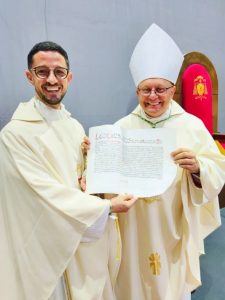
The installation proceeded with the solemnity and order befitting the occasion. The reading of the Apostolic Letter of appointment from Pope Leo XIV formally conferred on Archbishop Sipuka the governance of the Archdiocese.
What is the difference between Episcopal Ordination and Installation?
Episcopal Ordination is a sacred act by which a priest is consecrated as a Bishop. In the context of Archbishop Sipuka, his episcopal ordination was on 03 May 2008, when he became the Bishop of the Diocese of Mthatha.
Installation is an act of formally placing an already existing Bishop into a specific diocese where he is officially handed the authority, responsibility, and pastoral care of the diocese. This act is what took place on 14 March 2026 in the Archdiocese of Cape Town.
As Archbishop Sipuka is an Archbishop of the Metropolitan of Cape Town(Diocese of Aliwal North, Diocese of De Aar, Diocese of Oudtshoorn, Diocese of Port Elizabeth, and Diocese of Queenstown) he will receive a pallium from Pope Leo XIV, which signifies his share in the pope’s pastoral authority
Homily
Cardinal Stephen Brislin, the immediate predecessor, delivered the homily of the day. Drawing on the nature of episcopal ministry, Cardinal Brislin offered a reflection centred on the relationship between shepherd and flock. He was characteristically direct: the bishop does not define the flock; it is the flock that defines the bishop. “Without the people,” he said, “the shepherd walks alone in green fields.” He spoke of three dimensions of episcopal service which are Teaching the Truth; Sanctification, which is a call to deepening one’s relationship with God and leading all to God, ”we are expected that at the end of time as pastors, to deliver to the Lord, a holy people, a people sanctified” Cardinal Brislin; and Governance emphasising that Church governance is unlike anything in the political sphere. It calls instead for gentleness, humility, an understanding of human weakness, and a deliberate attentiveness to quiet voices as much as to prominent ones.
The Cardinal also reflected on the Apostles themselves, with all their failings, as the very men whom bishops are called to succeed. He reminded, “We gain more from the people we serve.” Meaning that encountering people in their joys, sorrows, struggles, and faith deepens a shepherd’s own relationship with God.
Congratulations and Fraternal Support
Archbishop Henryk Jagodziński, the Apostolic Nuncio to South Africa, Eswatini, Lesotho, Namibia and Botswana, addressed the assembly on behalf of the Holy Father. He reminded those gathered that the installation was not merely a moment of transition, but one of renewal and that the mission of the Church endures in every generation.
The Nuncio conveyed the Pope’s confidence in the pastoral gifts Archbishop Sipuka brings to his new role, and called on the faithful, priests, deacons, religious, and laity alike to support their new Archbishop with collaboration, trust, and prayer. He spoke directly to the Archbishop, saying, “You are now called to shepherd this community with the heart of Christ the Good Shepherd.”
Archbishop Zolile Mpambani SCI of Bloemfontein, who spoke on behalf of the Southern African Catholic Bishops’ Conference (SACBC), noted that the many leadership roles Archbishop Sipuka has occupied over the years speak to his consistent availability and dependability in the Lord’s service.
Archbishop Thabo Makgoba of the Anglican Church offered warm words of fraternal solidarity, stressing the importance of Christian unity as a witness of hope. Drawing on the words of St Oscar Romero, he encouraged Archbishop Sipuka not to aspire to have more, but to be more and to commit himself to the work of gathering God’s people together.
Archbishop Sipuka’s Address
Archbishop Sipuka extended an expression of gratitude to Pope Leo XIV, whose appointment made the day possible; to Cardinal Brislin, whose stewardship left him a functioning and alive Archdiocese; to Bishop Sylvester David OMI, who had held things together on the ground since the Cardinal’s departure; and to the people of Mthatha, who shaped him over eighteen years.
“Cardinal Brislin, if you had refused Johannesburg, I would still be happy in Mthatha! Thank you for leaving, but thank you more for what I perceive as a fully alive and functional Archdiocese.” Archbishop Sipuka
He also acknowledged his ecumenical counterpart with warmth, noting that Archbishop Makgoba had preceded him in certain leadership roles and that it felt right to now join him as a fellow Archbishop of Cape Town.
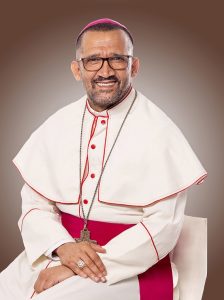
On his approach to his new role, Archbishop Sipuka was clear: he had come to learn, not to impose. He spoke a few words of Afrikaans, acknowledging that it was his intention to develop the language now that he was one of the people of the Western Cape. He reminded his listeners that whilst he desires to learn, he brings experience from having served as a bishop for many years and held significant leadership roles in the Church.
The Archbishop did not shy away from naming the challenges facing South Africa: poverty, severe economic inequality, gender-based violence and femicide, crime, corruption, and a fraying social fabric. He drew attention to the many forms of prophecy alive in the country’s civic organisations, the judiciary, trade unions, journalists, activists, and the electorate as evidence that the mechanisms for accountability and renewal remain intact.
He challenged the people present on two specific fronts: wealth and poverty. He pointed, “Is there anything I am doing to uplift others? Is what I have proportionate to what I give? Am I offering mere tokens to appease my conscience, or am I sharing meaningfully in ways that make a real difference?” Archbishop Sipuka
Episcopal Coat of Arms: United and Sent
The heart of Archbishop Sipuka’s address was his vision for the Archdiocese and, through it, for Cape Town and the country. He spoke of a world and a nation increasingly prone to division rather than unity. The spirit that had once animated South Africa during the Mandela era, he observed, was dissipating. Old wounds were reopening. New resentments were festering.
In this context, he said, he had sensed a clear call to work towards the unity of humanity, harmony among religions, unity among Christians, and communion among Catholics. This, he explained, was the meaning behind his motto, United and Sent.
He comes with a committed heart to align himself with the efforts already underway in Cape Town towards genuine encounter and inclusion. He noted that placing people together physically, in the same schools, churches, and workplaces, had not been sufficient. Hearts needed transforming. Perceptions, fears, and deep-seated resentments had to be addressed with intentionality, not simply managed.
He pointed to synodality, the Church’s renewed emphasis on listening, communion, and shared mission as a methodology that could help do the hard work that genuine unity requires.
The State of the Catholic Church in Southern Africa
The appointment of Archbishop Sipuka comes with significance for the SACBC, which currently oversees 29 ecclesiastical territories across South Africa, Botswana, and Eswatini. The vacant dioceses in the region are Eshowe, Keimos-Upington, Francistown, and Mthatha. Hence, the church is still faced with the pressing task of filling these episcopal gaps while continuing her mission of unity and service.
Conclusion
Indeed, the Archdiocese of Cape Town has a new Shepherd. There was a great sense that the Church in Cape Town had turned a page with sober clarity about the work ahead with their new shepherd.
“Let us walk this journey together. Let us do the hard work of genuine unity. Let us learn from each other. Let us be united in love and sent on a mission.” Archbishop Sipuka
.
0 Comments