
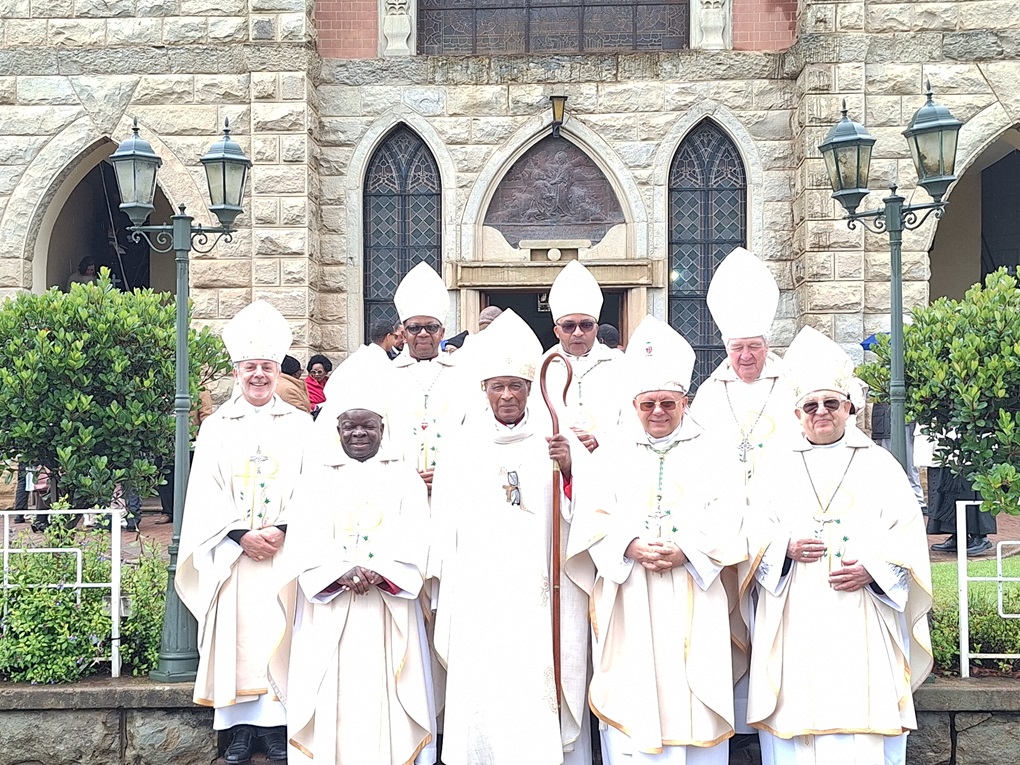
Bishops from the Southern African Catholic Bishops’ Conference (SACBC) have paid tribute to Cardinal Wilfrid Fox Napier OFM, recalling his pastoral leadership, humility and commitment to building communion in the Church, as he celebrated five significant milestones in his life and ministry.
Cardinal Napier’s fivefold jubilee was celebrated on Sunday, 8 November 2026, at St Patrick’s Cathedral in Kokstad Diocese, where bishops, clergy, religious and faithful gathered to honour his 85th birthday, 65 years of Franciscan religious profession, 56 years of priesthood, 45 years of episcopal ordination and 25 years as a cardinal.
The first indigenous Bishop of Kokstad, Cardinal Napier served the Church in Southern Africa in several leadership roles, including as Archbishop of Durban and President of the SACBC. His ministry also extended to the universal Church through his involvement in Vatican bodies and the Synod of Bishops.
Bishops José Luís Gerardo Ponce de León IMC of Manzini, Vincent Mduduzi Zungu OFM of Port Elizabeth, Thomas Graham Rose of Dundee and Stanisław Jan Dziuba OSPPE of Umzimkulu reflected on the influence he had on their lives and ministries.
A ministry marked by faithfulness and humility
Bishop Zungu described Cardinal Napier’s life and ministry as a reflection of God’s faithfulness, pointing to his decades of service as a Franciscan, priest, bishop and cardinal.
Looking back on more than 65 years of religious life and his many years of priestly and episcopal ministry, he expressed admiration for the cardinal’s energy, dedication and enthusiasm.
“I always wonder where he gets this energy, this dedication, this enthusiasm and the ability always to be at the service of the Church, with a smile and with great humility, without wanting any attention to himself,” Bishop Zungu said.
He expressed gratitude to God for Cardinal Napier’s vocation and witness, praying that the Church would raise up more men and women of similar calibre.
Bishop Rose, who has known Cardinal Napier since his seminary days, also highlighted his simplicity and Franciscan spirit.
He recalled meeting him as a young seminarian when Cardinal Napier came to preach a retreat. A light-hearted memory of the future cardinal borrowing his shoes for a game of squash has remained with him over the years. For Bishop Rose, however, what stands out most is the cardinal’s ability to relate to people without placing importance on status or position.
“He’s not a man who stands on his position, his status. He can talk to anyone,” he said.
He also reflected on the influence of the communities that shaped Cardinal Napier, particularly his family and the Franciscan friars. His years in Ireland as a young South African, Bishop Rose observed, gave him a sense of belonging and confidence within the Franciscan community.
“He’s thoroughly a man who found his home in the Church, and I think he’s done us proud,” he said.
A shepherd who helped rebuild Umzimkulu
For Bishop Dziuba, his relationship with Cardinal Napier goes back to 1994, when the cardinal became Apostolic Administrator of the Diocese of Umzimkulu following the resignation of Bishop Gerard Sithunywa Ndlovu.
At the time, Bishop Dziuba was a priest in the diocese and witnessed Cardinal Napier’s efforts to bring stability and rebuild diocesan structures during a difficult period. Coming from Durban, where he was Archbishop, Cardinal Napier regularly visited priests and communities, celebrating parish feasts, confirmations and jubilees.
Bishop Dziuba recalled his commitment to restoring unity and strengthening the life of the diocese through personal contact with clergy and the faithful. He also remembered the contribution of Cardinal Napier’s secretary, Colleen, who played an important role in the administration of the diocese.
The relationship continued over approximately 15 years, during which Cardinal Napier remained closely involved in the life of Umzimkulu. When Bishop Dziuba was later appointed bishop, he found in Cardinal Napier an older brother and mentor who helped him understand the responsibilities of episcopal ministry, particularly Church administration and governance.
“I am grateful to him for giving us an example of humility and working together with priests, with the communities, with the people and giving his time for us,” he said.
Despite his demanding responsibilities in Durban, Cardinal Napier, he added, always made time for the diocese. Bishop Dziuba expressed gratitude for the cardinal’s service, from his responsibilities in the universal Church to his pastoral presence in smaller dioceses.
Making space for dialogue and communion
Bishop Ponce de León recalled Cardinal Napier’s commitment to creating spaces where bishops and religious superiors could share their experiences and challenges.
He first encountered him while serving as a religious superior and participating in meetings between bishops and religious congregations within the metropolitan province.
One of his earliest impressions was Cardinal Napier’s personal attentiveness. During their first meeting, the cardinal addressed him by name, something that surprised him.
Later, when Bishop Ponce de León became Bishop of Manzini, he continued to appreciate the regular meetings organised by Cardinal Napier, particularly the opportunities they provided for bishops to speak openly about their pastoral experiences.
He recalled how the meetings were structured to allow bishops to share among themselves before engaging with religious superiors. “He always made sure that everyone really had the space to talk and to be heard,” Bishop Ponce de León said.
He also recalled that Cardinal Napier preached at his episcopal ordination in 2009, describing his leadership as an example of faithfulness and fraternity. Reflecting on the cardinal’s many years of service, Bishop Ponce de León compared his perseverance to the Gospel image of the wise virgins who kept their lamps burning while awaiting the bridegroom.
“Clearly he’s been having enough oil to continue the journey of everything that has been asked of him for so many decades,” he said.
A legacy of service
The bishops’ reflections highlighted different dimensions of Cardinal Napier’s ministry: his Franciscan simplicity, pastoral availability, commitment to dialogue and willingness to accompany other bishops in their responsibilities.
From his early years of priestly ministry in rural communities around Kokstad to his leadership of the Archdiocese of Durban and his service at the national and universal levels of the Church, Cardinal Napier has remained closely connected to the communities and people entrusted to his care.
As the first indigenous Bishop of Kokstad, his fivefold jubilee was also an occasion for the local Church to celebrate a son of the soil whose ministry has extended far beyond the diocese.
0 Comments