
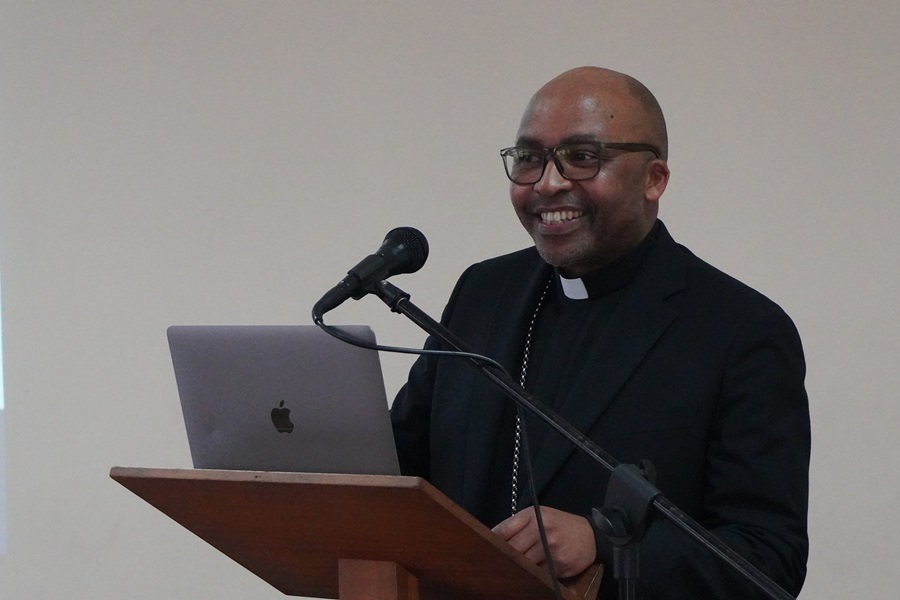
The Liaison Bishop of the Southern African Catholic Bishops’ Conference (SACBC) Commission for Justice and Peace has called on political parties to make a formal commitment to ethical municipal governance, warning that persistent failures in service delivery are rooted in deeper problems of corruption, political interference and a lack of accountability.
In a statement issued on 11 November, following South Africa’s 4 November local government elections, Bishop Thulani Victor Mbuyisa CMM urged political parties to use the period leading up to the next municipal elections in 2031 to pursue what he described as “a moral renewal of politics.”
His appeal comes as political parties begin coalition negotiations following an election that has left numerous municipal councils without an outright majority. The Electoral Commission of South Africa (IEC) recorded a national voter turnout of 52%, with approximately 14.9 million people casting their ballots out of 29.2 million registered voters. This represents an improvement on the 45.9% turnout recorded in 2021.
Coalition talks must put communities first
With coalition arrangements expected to determine the leadership of many municipalities, Bishop Mbuyisa cautioned against political agreements driven primarily by the distribution of positions and political interests. He appealed to political parties to ensure that their coalition agreements include clear commitments to ethical governance, addressing structural barriers to effective service delivery and promoting the common good.
The Local Ordinary of Kokstad Diocese welcomed the increased voter participation, noting that it may reflect citizens’ growing expectations that electoral accountability will translate into meaningful improvements in their communities. However, he stressed that unreliable water and electricity supplies, inadequate sanitation, deteriorating roads, irregular refuse collection and neglected public facilities cannot simply be attributed to administrative shortcomings.
“These are not merely operational or administrative shortcomings, but symptoms of deeper structural problems rooted in failures of ethical municipal governance,” he said.
Ten priorities for ethical governance
Drawing inspiration from Pope Francis’ encyclical Fratelli Tutti, particularly paragraph 154, Bishop Mbuyisa called for “a better kind of politics, one truly at the service of the common good”.
He outlined ten structural challenges that political parties should commit themselves to addressing: the capture of municipalities by criminal syndicates; unstable coalition governments; impunity for corruption and failure to act on the Auditor-General’s findings; inadequate protection of whistleblowers; political interference in municipal administration; weak accountability of councillors; limited public participation; financially unsustainable municipalities; inadequate long-term infrastructure planning; and ineffective provincial intervention in failing municipalities.
He further called for these commitments to be incorporated into municipal Integrated Development Plans (IDPs) and translated into measurable targets through Service Delivery and Budget Implementation Plans (SDBIPs), enabling communities to monitor progress and hold elected representatives accountable.

Church promotes active citizenship
The statement follows the SACBC Commission for Justice and Peace’s civic education initiatives ahead of the November elections, which sought to encourage responsible citizenship, particularly among young people. Working with Citizens ZA and the IEC, the Commission organised activities focusing on youth participation, women’s civic engagement and democratic education among young Catholics.
The programme included youth gatherings bringing together young people from six deaneries of the Archdiocese of Johannesburg, as well as a Catholic Women’s Civic Engagement Indaba. Through parish-based activities, young people were encouraged to register and vote, understand their democratic responsibilities, and participate actively in shaping their communities.
A call for moral renewal
In his Wednesday, 11 November statement, Bishop Mbuyisa reiterated that political leadership should be understood as a vocation of service rather than an opportunity for personal or party-political advancement.
Concluding with a prayer for the healing of communities and municipalities, he invoked the words of the prophet Jeremiah: “I will bring it health and healing, and I will heal them and reveal to them abundance of prosperity and security” (Jeremiah 33:6).
He expressed the hope that the period leading to the 2031 elections would mark the beginning of a genuine moral renewal of politics, inspired by Pope Francis’ vision of political leadership as an expression of political charity and a calling in service of the common good.
0 Comments