
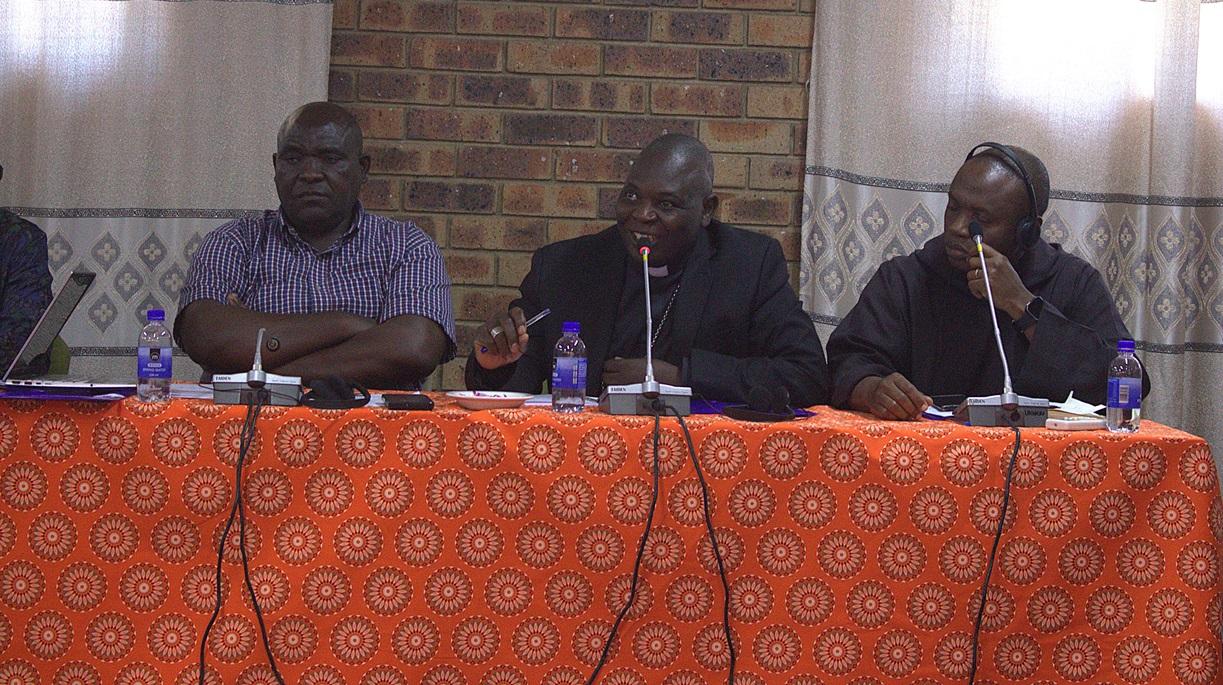
Bishop Rudolf Nyandoro calls for justice for displaced communities as Church leaders in Southern Africa examine the human and environmental costs of mining.
Women and children are among those who suffer most when communities are displaced by mining activities and resource-related conflicts in Africa, says Bishop Rudolf Nyandoro, Bishop of Gweru, Zimbabwe, and Secretary General of the Inter-Regional Meeting of the Bishops of Southern Africa (IMBISA).
Speaking to the Southern African Catholic Bishops Conference (SACBC) communication office during a regional justice and peace workshop in Pretoria, South Africa, Bishop Nyandoro stressed that communities forced from their homes often receive inadequate compensation, leaving families without sufficient food, shelter and livelihoods.
“When violence is taking place, we see that women are suffering with children,” he said. “They are on the ground. They have to look for food and for shelter.”
Bishop Nyandoro, who is also Vice President of the Zimbabwe Catholic Bishops’ Conference (ZCBC) and liaison bishop for its Commission for Justice and Peace, was speaking during a five-day workshop held from 12 to 16 October at the Padre Pio Retreat Centre. The gathering explored how religious leaders can advocate more effectively on socio-political, economic and environmental issues across the IMBISA region.
Mining and the cost of displacement
Participants examined the unequal distribution of Africa’s natural resources and the impact of mining on vulnerable communities, including environmental destruction, water pollution, occupational diseases and forced displacement.
Although the region is rich in natural resources, Bishop Nyandoro warned that their benefits are often unfairly distributed. “The rich get richer, the poor get poorer,” he said, calling for natural resources to be managed for the benefit of all.
He expressed concern that displaced communities are sometimes left without compensation, while others receive amounts insufficient to replace their homes and livelihoods.
“We are saying there should be justice when these people are displaced,” he stressed.
In a separate interview with the SACBC communication office, Robin Zeelie, a candidate attorney at Richard Spoor Incorporated, highlighted the often-overlooked burden displacement places on women. Even when resettlement is properly organised, women frequently assume additional unpaid care responsibilities and lose access to natural resources and community support networks on which their families depend. These disruptions, she warned, can have consequences across generations.
Bishop Nyandoro also raised concerns about mining-related pollution, particularly when chemicals contaminate rivers used by rural communities for drinking water. He called for greater engagement with mining companies to address environmental damage and ensure that affected communities benefit from their activities.
A call for peace and responsible resource management
The concerns echo repeated appeals by Pope Francis, Pope Leo XIV and Cardinal Fridolin Ambongo Besungu OFM, President of the Symposium of Episcopal Conferences of Africa and Madagascar (SECAM), for peace, justice and an end to the exploitation of Africa’s people and natural resources.
During his 2023 visit to the Democratic Republic of the Congo, Pope Francis condemned the plundering of the country’s mineral wealth and called for an end to violence and exploitation, particularly in the conflict-affected east. Pope Leo XIV has also repeatedly appealed for peace in regions affected by conflict, urging efforts to protect civilians and promote reconciliation.
Cardinal Ambongo has likewise highlighted the suffering caused by conflict and the exploitation of mineral resources, calling for greater responsibility and justice in the management of Africa’s natural wealth.
In the interview with the SACBC communication office, Bishop Nyandoro said Church leaders must engage political authorities and mining companies to promote environmental protection, fair compensation and peace.
The 12 to 16 October workshop also addressed xenophobia, human trafficking, youth participation in politics, climate change and food insecurity. Participants heard testimonies from victims of xenophobic violence in South Africa.
As participants prepared to return to their respective countries, Bishop Nyandoro said they would share the workshop’s lessons with bishops, priests, religious and laypeople to strengthen local advocacy for justice and peace.
He stressed that Africa’s natural resources should benefit entire communities rather than a privileged few, ensuring that vulnerable families are not left to bear the human cost of exploitation.
0 Comments