

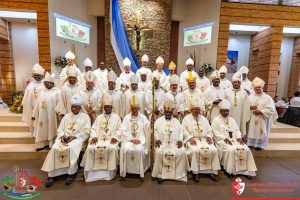
The members of the Southern African Catholic Bishops’ Conference (SACBC) have unveiled a memorial plaque at Khanya House in Pretoria, commemorating the 75th anniversary of the establishment of the ecclesiastical hierarchy in Southern Africa.
The unveiling took place during the bishops’ August Plenary Session, held from 4 to 6 August 2026, following Solemn Vespers celebrated in the Khanya House chapel. SACBC President Cardinal Stephen Brislin unveiled the plaque in the presence of the bishops and staff members of the Conference.
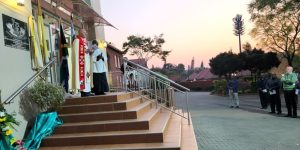
Installed on the wall at the entrance to Khanya House, the headquarters of the SACBC, the plaque provides a lasting reminder of the historic milestone celebrated by the Catholic Church in Southern Africa in 2026.
The 75th anniversary was officially marked in January, when the bishops gathered with clergy, religious and lay faithful for the opening Mass of the Jubilee Year at the Church of the Beatitudes in Zwavelpoort, Pretoria East. The anniversary commemorated the establishment of the ecclesiastical hierarchy in 1951, when the Church in Southern Africa entered a new phase of institutional and pastoral development through the establishment of dioceses and the appointment of bishops.
Reflecting on the anniversary at the beginning of the year, Cardinal Brislin described 2026 as “a very special year for the Church in Southern Africa”. He explained that the establishment of the hierarchy referred particularly to the development of the Church’s structure in the region, with dioceses established and bishops appointed to provide pastoral leadership.
“It’s something that we must really be very grateful for today,” the Cardinal said, noting that the development of the hierarchy enabled the Church to grow and strengthened pastoral care in dioceses and parishes.
The 1951 milestone came at a difficult moment in South African history. Apartheid had been introduced following the 1948 elections, and the Church was confronted by a society increasingly marked by racial discrimination, exclusion and oppression.
Looking back on that period, Cardinal Brislin recalled the challenges faced by the Church, including attacks on Catholic education and the closure of Catholic schools. Yet the Church also produced a courageous witness to human dignity, justice and equality, particularly through the commitment of religious women, priests and lay faithful who resisted unjust racial policies.
The Jubilee has therefore been an occasion not only to remember the institutional development of the Church, but also to give thanks for the faith and witness of generations of Catholics who contributed to its growth.
The memorial plaque unveiled at Khanya House now provides a permanent physical reminder of that history. Its location at the entrance to the SACBC headquarters also connects the anniversary with the Conference’s continuing responsibility to serve the Church across Southern Africa.
The August Plenary itself reflected that ongoing mission. In their resolutions, the bishops addressed a broad range of pastoral, social and ecclesial concerns, including migration and xenophobia, missionary identity, Catholic education, formation, vocations, the apostolate of the laity and the protection of human dignity.
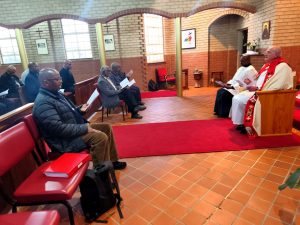
Among their resolutions, the bishops mandated the Department for the Promotion of Integral Human Development (former Catholic Social Action Department) to provide a comprehensive analysis and develop a Catholic response to the migrant and xenophobia situation. They also resolved to strengthen advocacy concerning assisted dying and to appoint moral theologians to develop a theological response to the issue.
In the area of evangelisation, the bishops recommended that all dioceses undertake an analysis and reflection on their missionary identity. They also addressed formation for clergy and laity, vocation promotion, the structures of sodalities and youth ministry.
The Plenary further resolved to appoint Fr Nhlanhla Mchunu as the next Secretary General of the SACBC, effective from 1 March 2027.
The unveiling of the memorial plaque during Solemn Vespers therefore offered a moment of prayerful remembrance within the Church’s continuing journey. While the Jubilee anniversary itself was celebrated at the beginning of the year, the plaque will remain at Khanya House as a lasting memorial to 75 years of ecclesial development and a reminder of the responsibility to carry the Gospel forward.
0 Comments