
As undocumented migrants and refugees in South Africa continue to live in fear following weeks of anti-migrant demonstrations and growing public hostility, the Apostolic Nuncio to Southern Africa has appealed for compassion, respect for the rule of law and the protection of human dignity, warning against allowing fear and anger to determine how vulnerable people are treated.
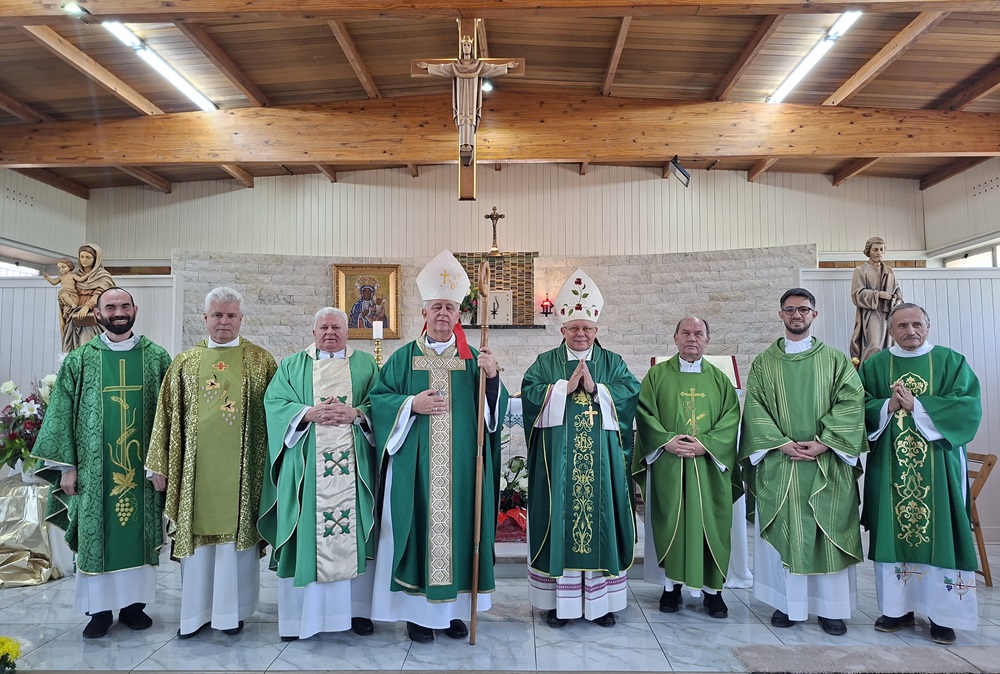
In an interview with the Southern African Catholic Bishops Conference (SACBC) Communication Office after celebrating Mass with the Polish Catholic community at St Joseph the Worker Catholic Church in Norwood, Johannesburg, Archbishop Henryk Mieczysław Jagodziński reflected on the Church’s responsibility to accompany migrants at a time when many are experiencing uncertainty and anxiety.
His remarks come after the 30 June protests against undocumented migrants, which were organised in several parts of South Africa. Although large-scale violence did not materialise in many areas, the demonstrations have heightened fear among thousands of undocumented migrants and asylum seekers. Many have remained indoors, while others continue to seek assistance from humanitarian organisations and Church agencies as uncertainty surrounds their future.
Some undocumented migrants have expressed a willingness to return voluntarily to their countries of origin but remain stranded as they await assistance for repatriation, while others—particularly refugees fleeing armed conflict—say returning home is not a viable option because of ongoing insecurity.
Against this backdrop, Archbishop Jagodziński insisted that while every country has the right to regulate migration through its laws, Christians must never lose sight of the dignity of every human person.
“The Holy Father, Pope Leo, reminds us of the Gospel words: I was a foreigner, and you welcomed me.” He acknowledged that migration is a complex reality shaped by many different circumstances.
“The question of migrants is not easy. There are many reasons why people migrate, and every man and every woman has a different story.”
Rather than judging people solely on their legal status, he encouraged a spirit of mercy and understanding. “Before judging, before taking decisions, we should be compassionate as our Heavenly Father is compassionate.”
Law must prevail over hostility
The Apostolic Nuncio stressed that respect for the law remains essential in every democratic society but cautioned against individuals taking matters into their own hands.
“In every democratic country, it should be the power of law—not law of power—that guides decisions,” he said.
While recognising that citizens have the right to express their concerns about migration, Archbishop Jagodziński emphasised that legal decisions belong to the competent authorities.
“Everybody has the right to express his sentiments and opinions, but it is up to the State to make juridical and concrete decisions.”
His comments echo the consistent teaching of the Catholic Church that governments have both the responsibility to regulate migration and the obligation to ensure that migrants and refugees are treated with dignity and justice.
A community shaped by migration
The interview took place during the pastoral visit of Bishop Jan Piotrowski of Kielce, President of the Commission for Missions of the Polish Bishops’ Conference, who celebrated Mass with the Polish Catholic community at St Joseph the Worker Catholic Church.
Archbishop Jagodziński described the Norwood community as a living witness to the history of migration itself.
He explained that Polish Catholics have gathered at the chapel since 1968, with the community largely shaped by two significant waves of migration: those who arrived during and after the Second World War, and others who left Poland during the period of martial law in the 1980s.
Many families eventually integrated into South African society through marriage, work and education, while remaining connected to their cultural and spiritual heritage.
Although members are now dispersed across different parts of the country, the community continues to gather regularly for worship and fellowship.
The Nuncio also noted the presence of Polish priests and religious sisters serving the Church in Southern Africa, describing the visit of Bishop Piotrowski as an opportunity to strengthen bonds with Polish faithful living far from their homeland.
“South Africans have a big heart”
For Bishop Piotrowski, his first visit to the Polish community in Johannesburg was both joyful and encouraging.
“I am very happy to celebrate Holy Mass for the Polish community in this chapel of Saint Joseph,” he said.
Meeting members of the community personally, he added, had brought him “a great deal of satisfaction.”
Asked about the current tensions surrounding undocumented migrants in South Africa, Bishop Piotrowski broadened the discussion beyond national borders, observing that migration has become a challenge faced by countries across the world.
“Jesus Christ shows us that everyone is our brother and sister,” he said.
“The acceptance of immigrant people is a great challenge—not only in South Africa, but also in Poland and throughout Europe.”
Despite the current tensions, the Polish bishop expressed confidence in the generosity of South Africans.
“I think that the South African people have such a big heart that there will be a place for all people here. This is my sincere wish.”
The pastoral visit concluded with encounters between Bishop Piotrowski, Polish priests ministering in the Archdiocese of Johannesburg, religious sisters, and members of the Polish Catholic community.
0 Comments