
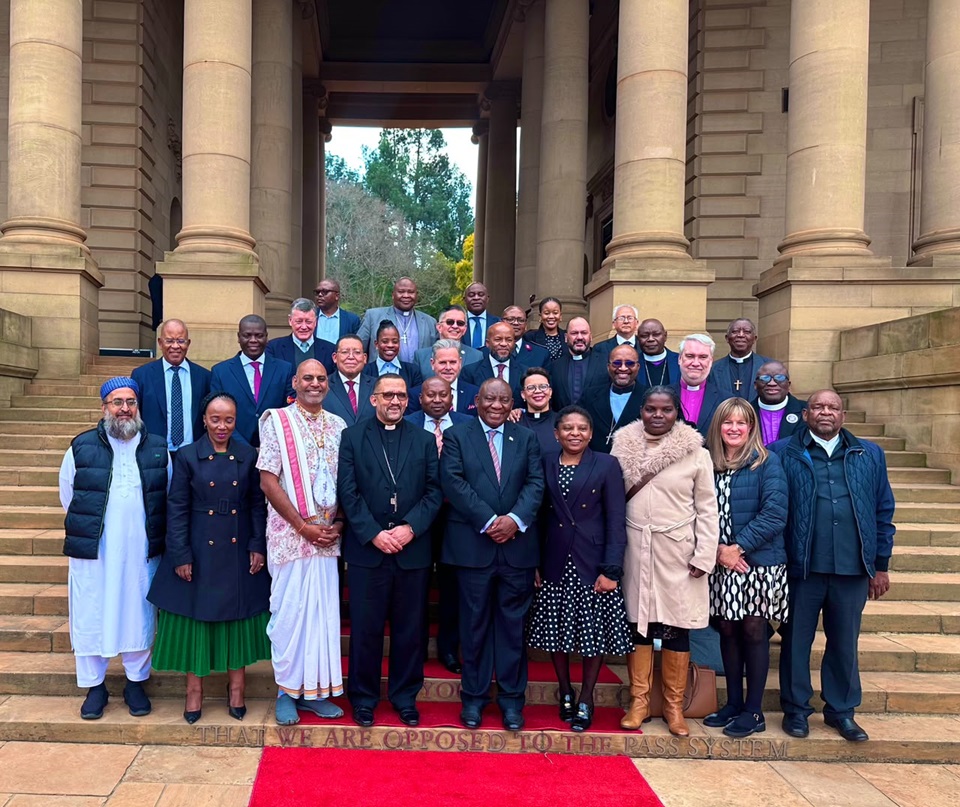
At a special meeting with President Cyril Ramaphosa at the Union Buildings, faith leaders call for an end to violence against migrants and urge government to address the deeper social and economic challenges facing South Africa.
“The cause is not the foreigner. The cause is the elephant in the room.”
With these words, Archbishop Sithembele Sipuka, President of the South African Council of Churches (SACC) and Archbishop of Cape Town, addressed President Cyril Ramaphosa during a special meeting with faith-based organisations at the Union Buildings on Wednesday, 17 June 2026.
Speaking on behalf of faith-based leaders gathered at the Presidency, Archbishop Sipuka condemned violence against migrants and called on government to address what he described as the underlying causes of social frustration: unemployment, failing public services, corruption and weak law enforcement.
“If tomorrow every African foreign national were to leave this country, our problems would still be with us,” said Archbishop.
The SACC President went on to say, “The lack of basic service delivery would persist. Unemployment would remain. The insecurity and the drugs would remain. Because the cause is not the foreigner. The cause is the elephant in the room.”
The meeting took place amid growing tensions surrounding migration in South Africa and ahead of a planned 30 June mobilisation by groups calling for undocumented foreign nationals to leave the country.
In recent weeks, protests have taken place in several parts of South Africa. Most recent protests took place on Wednesday, 17 June 2026, where residents in Mashishing, Mpumalanga, marched to the Departments of Home Affairs and Employment and Labour, calling for the verification of the immigration status and business permits of foreign shop owners. In Durban, tensions escalated at the Sherwood Community Hall, where Malawian nationals awaiting repatriation have been sheltering following protests and unrest.
Against this backdrop, President Ramaphosa invited faith leaders to discuss migration and the National Dialogue process, describing religious communities as important partners in the life of the nation.
“The faith community in our country has always been more than a place of worship,” the President said.
“It has provided moral guidance and spiritual sustenance to our people.”
“We come as pastors”
The member of the Dicastery for Interreligious Dialogue began his address by thanking the President for receiving the delegation and said the faith leaders had come seeking dialogue and cooperation.
“We do not come to lecture, Mr President,” he said. “We come as pastors who have been distressed by what they have witnessed across this land, and who believe that when the Church and the State walk together in good faith, a way forward can be found.”
Archbishop Sipuka spoke of the treatment of migrants in recent weeks. “We have watched with profound disquiet as fellow human beings — regardless of how they came to be in our country — have been hunted down, harassed, violated, their livelihoods destroyed, and their lives threatened unless they leave.”
He described such actions as “inhumane,” “a violation of ubuntu,” and “an affront to human dignity.”
At the same time, Archbishop Sipuka acknowledged the frustrations of many South Africans who struggle with unemployment, poverty and inadequate public services.
“Many who march worship with us on Sundays,” he said.
“They are people who feel abandoned — who experience the collapse of basic services, who live under the weight of unemployment, and who feel that government has been slow to hear them.”
Their concerns about porous borders, unlicensed trading and unsafe goods, he said, “are not imaginary” and deserve to be heard.
“But a real grievance does not make a violent remedy right.”
The elephant in the room
The Local Ordinary of Cape Town Archdiocese said migrants are often blamed for problems whose causes lie elsewhere. Using an isiXhosa expression, he told the President: “ukufa kusembizeni” which translates to “the problem is in the pot itself.”
He pointed to an education system that does not adequately prepare young people for employment, corruption that has weakened public institutions, and the exploitation of migrant labour.
“To blame the stranger is to let these true culprits escape scrutiny,” he said.
The role of the state
On his part, President Ramaphosa acknowledged public concerns about illegal immigration but said migration is not the cause of South Africa’s social and economic difficulties.
“These concerns are real. They need to be heard and to be addressed,” he said.
“Yet illegal immigration is not the cause of our social and economic difficulties.”
The President reiterated government’s five-pillar strategy for migration management, announced in his address to the nation on 7 June. The strategy includes stronger enforcement of immigration and labour laws, improved border management, efforts to combat corruption in immigration systems, legislative reforms and cooperation with regional partners through the Southern African Development Community and the African Union.
“We can protect our borders while protecting human dignity,” President Ramaphosa said.
“We can enforce our laws while upholding our Constitution. We can secure our communities while preserving the values of Ubuntu.”
The President also emphasised that immigration laws must be enforced by the state.
The “responsibility for enforcing our laws rests with the state,” he said.
“No individual may stop another to demand documentation or proof of nationality.”
“There is no place for racism, sexism, xenophobia, Afrophobia or any other form of intolerance.”
Archbishop Sipuka, in turn, called for the consistent application of the law.
“We are disturbed,” Archbishop Sipuka said, “by consistent reports that law enforcement has turned a blind eye to much of what has unfolded.”
“The enforcement of law is the work of the state, not of mobs.”
Archbishop Sipuka also expressed concern about what he described as the exploitation of the migration crisis for political purposes.
“We are also disturbed by indications that some politicians are making of this humanitarian crisis an opportunity for political gain — using inflammatory rhetoric and manufactured panic not in the service of communities, but in pursuit of political advantage.”
“Commitments on paper are not enough”
In an audio message shared with the Southern African Catholic Bishops Conference (SACBC) communication office after the meeting, Archbishop Sipuka said faith leaders had urged government to act against groups that have “taken law into their own hands against foreign nationals.”
He said they also raised concerns about the planned 30 June march and sought assurances that law enforcement would prevent further violence.
“We were given assurance that law enforcement will indeed be deployed,” he said.
While welcoming the government’s migration strategy, Archbishop Sipuka stressed that implementation is essential.
“Commitments on paper are not enough,” he said.
“These commitments must now move to action and visible implementation.”
Archbishop Sipuka concluded by appealing to Christians and all people of goodwill to reject hatred and violence and to assist those affected by recent unrest.
“We call on our communities to assist those who have been impacted with whatever humanitarian need they may have, be it food, accommodation, medication, and above all, closeness and human solidarity in this difficult time.”
As South Africa continues to debate migration and social cohesion, Wednesday’s meeting at the Union Buildings brought together government and faith leaders in a shared call for lawful, humane and lasting solutions.
“The stranger at our gate is not our enemy,” Archbishop Sipuka said.
“The cause is not the foreigner. The cause is the elephant in the room.”
0 Comments