
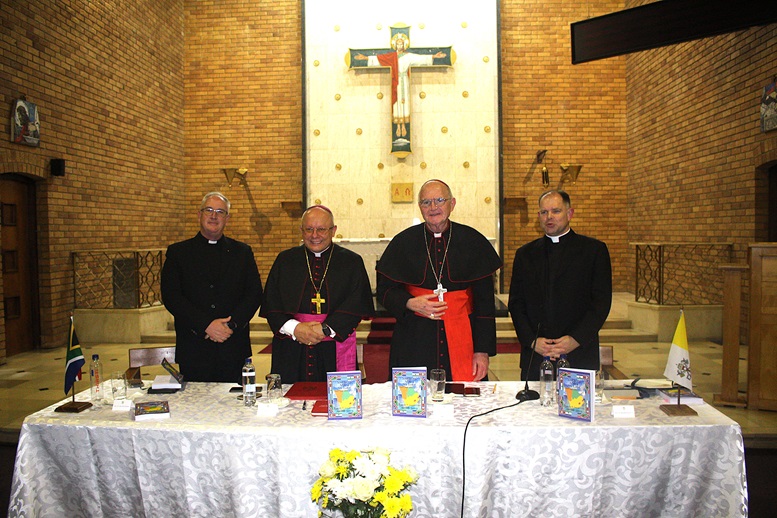
“This book is about love,” with these words, Archbishop Henryk M. Jagodziński, Apostolic Nuncio to Southern Africa, introduced his new book, Southern Africa, My Love – Part One (2024–2025), at its launch on Monday evening at St John Vianney Major Seminary in Pretoria.
The 15 June book launch brought together Church leaders, diplomats, clergy, religious and lay faithful, including Cardinal Stephen Brislin, Archbishop of Johannesburg and President of the Southern African Catholic Bishops’ Conference (SACBC), who wrote the foreword and delivered the keynote address.
The publication is a collection of homilies, speeches and reflections from Archbishop Jagodziński’s first years as the Holy Father’s representative to South Africa, Lesotho, Namibia, Botswana and Eswatini.
“This book is therefore not primarily about me,” he said. “It is about the peoples of Southern Africa: South Africa, Lesotho, Namibia, eSwatini and Botswana.”
“It is about the faith I have witnessed in cathedrals and chapels, in seminaries and schools, in hospitals and homes, in bustling cities and remote rural communities. It is about the hope I have encountered among people facing poverty, uncertainty, and hardship, yet who continue to trust in God’s providence.”
Diplomacy rooted in love
In his address, Archbishop Jagodziński acknowledged that speaking about love in the context of diplomacy may seem unusual.
“Diplomacy is often associated with negotiations, treaties, political interests, and international relations,” he said. “Yet perhaps the modern world suffers precisely because we speak too little about love, virtue, and moral responsibility in public life.”
The Nuncio explained that while ambassadors are accredited to Heads of State, a papal representative is a particular kind of diplomat because he represents the Holy Father, the Successor of Saint Peter.
This, he said, raises another question: why does Peter occupy such a unique place among the Apostles?
“The answer lies not in power, wealth, or human prestige. It lies in love.”
Recalling the Gospel scene in which the Risen Christ asks Simon Peter three times, “Do you love me?”, Archbishop Jagodziński said, “Peter’s mission began with love. Therefore, the mission of Peter’s successors must also begin with love.”
Love, he continued, is not merely a sentiment but a daily gift of oneself.
“Most of us will never be called to offer our lives in a dramatic or heroic manner. Yet every day we are invited to give something of ourselves: our time, our attention, our patience, our compassion, our willingness to listen and to accompany others.”
“In this sense, every authentic encounter is an act of love. This book is, in many ways, a collection of such encounters.”
Dialogue and the culture of encounter
The Apostolic Nuncio repeatedly returned to the theme of dialogue, drawing on Pope Leo XIV’s encyclical Magnifica Humanitas.
“Dialogue,” he said, “is one of the essential instruments for building peace and safeguarding human dignity.”
He explained that Pope Leo presents diplomacy not simply as a technique of international relations, but as “a noble service to peace, justice, and the common good.”
“In a world wounded by conflict, division, and mistrust, diplomacy must preserve spaces where people can meet, listen to one another, and seek understanding,” he said.
“True diplomacy does not seek the triumph of one side over another. Its purpose is reconciliation. It is not founded upon the logic of power but upon the culture of encounter. It is not driven by fear but inspired by hope.”
The ministry of a Nuncio
In his keynote address, Cardinal Brislin said the book offers readers a valuable insight into the life and ministry of an Apostolic Nuncio.
“We live in an age of social media,” he observed. “Things are written in shorthand, there are soundbites, but there is a danger that there is no quality of intellect, of thought, of logic that goes on.”
The Cardinal said the book launch served as a reminder of the importance of reading.
“When you read a book, what is conveyed to you are thoughts, insights, information, reason, sometimes controversy, that make you reflect on life itself.”
Cardinal Brislin noted that a nuncio must come to know the culture and challenges of the countries entrusted to him and develop a genuine understanding of the people.
“That’s why I think this book is very important,” he said, “because it gives some insight into what the life of a nuncio is about.”
A pilgrimage through Southern Africa
Reflecting on the book, Jesuit priest Fr Russell Pollitt described Southern Africa, My Love as “a pilgrimage, a testament to affection, and a deep connection with the people of this region.”
“It reflects a journey of faith that has intertwined with the lives, hopes, struggles, and joys of the people of Southern Africa,” he said.
Fr Pollitt noted that the book recounts the Nuncio’s visits to dioceses and communities across the region and his encounters with lay faithful, priests, religious, bishops, government leaders and diplomats.
“I want to suggest to you today that this book offers a glimpse of movement, encounter, humility, hope, and the challenges facing the peoples of Southern Africa,” he said.
The Jesuit priest highlighted recurring themes throughout the text: dialogue, synodality, unity in diversity and the Church as the Pilgrim People of God.
A love for the peoples of Southern Africa
The evening also included a reflection by Octavia Schubert of the Apostolic Nunciature, who described the book as evidence of the Archbishop’s deep affection for the people entrusted to his pastoral care.
She said the writings reveal a shepherd who combines theological depth with pastoral sensitivity and who consistently encourages readers to rediscover hope, communion and trust in God.
Words that endure
Towards the end of his address, Archbishop Jagodziński reflected on the power of words and his desire to preserve some of the reflections from the first years of his mission.
“Words can wound, but they can also heal. Words can divide, but they can also unite. Words can extinguish hope, but they can also rekindle it,” he said.
Recalling the ancient Roman saying Verba volant, scripta manent – “Words fly away; what is written remains” – he explained that many speeches disappear as soon as they are spoken, but some reflections deserve to endure because they are born from “genuine encounters with extraordinary people.”
“In a world often overwhelmed by bad news, conflict, and uncertainty, we need reminders that goodness still exists, that dialogue remains possible, and that hope is stronger than fear,” he said.
Entrusting the book to its readers, Archbishop Jagodziński concluded with the words of Saint Paul:
“So faith, hope and love remain, these three; but the greatest of these is love.”
After the reflections and the address by the Apostolic Nuncio, the evening continued with a question-and-answer session, during which invited guests expressed their gratitude and appreciation for the publication. Participants were also reminded that all proceeds from the sale of the books will go towards supporting the education and formation of seminarians at St John Vianney Major Seminary.
0 Comments