
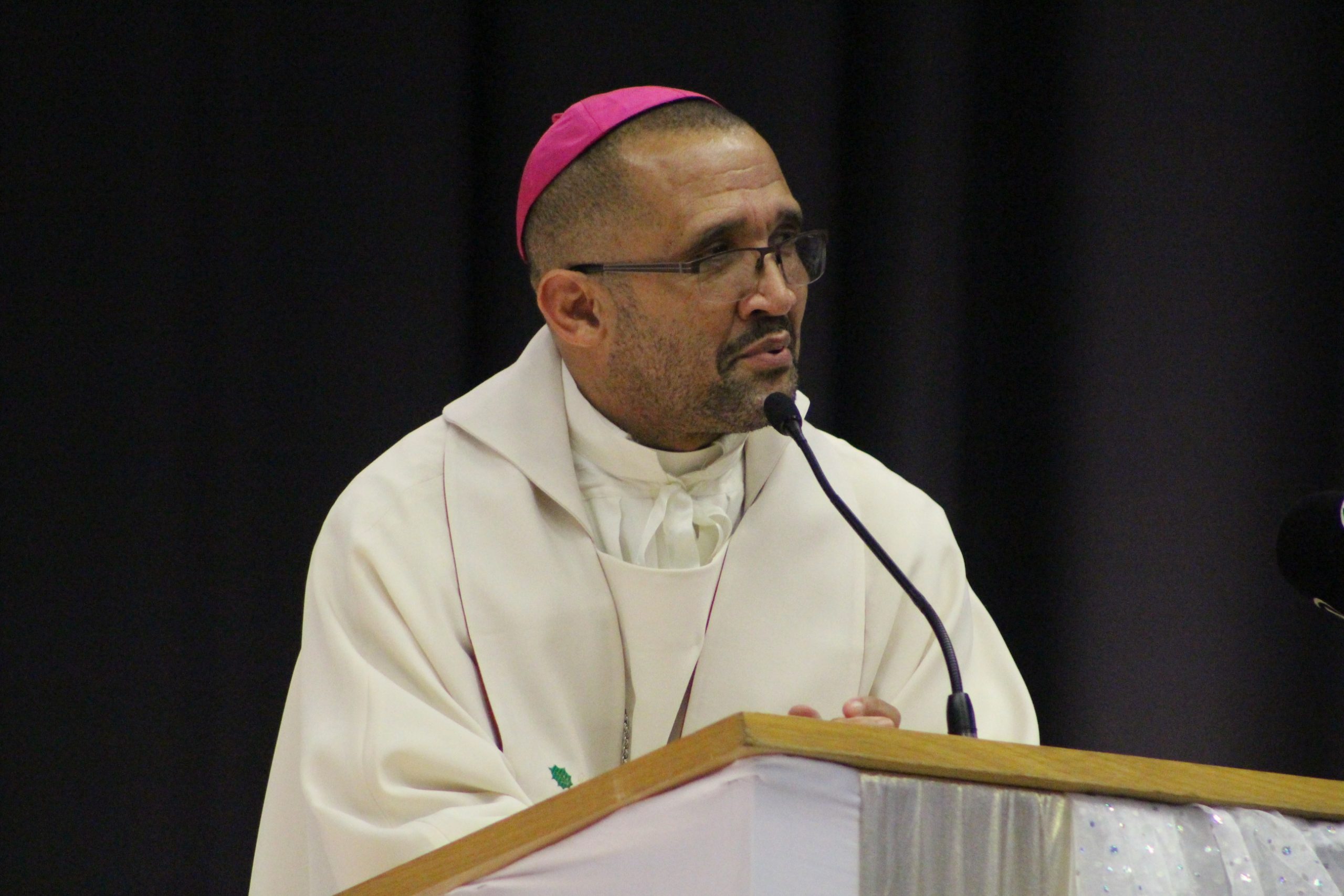
As anti-migrant protests continue to spread across South Africa, Archbishop Sithembele Sipuka has issued a pastoral letter urging Christians and all people of goodwill to reject violence, uphold human dignity, and respond to the growing humanitarian crisis with compassion.
The President of the South African Council of Churches (SACC) has appealed for calm, dialogue, and solidarity amid escalating attacks on foreign nationals in several parts of South Africa.
In a pastoral letter titled “Do Not Turn Away the Stranger” (cf. Lev. 19:33-34), Archbishop Sithembele Sipuka warns that the country is witnessing a dangerous rise in hostility, intimidation, and violence against migrants, many of whom are fellow Africans seeking safety and economic opportunity.
Issued on behalf of more than 30 member churches of the SACC, the letter follows a meeting of church leaders on 2 June who gathered to discern a Christian response to the growing crisis.
“We are compelled by the Gospel to speak and to act,” Archbishop Sipuka writes, quoting the biblical command to love the foreigner as oneself.
Recent weeks have seen anti-immigration groups organise marches and community actions in KwaZulu-Natal, Gauteng, the Free State, and the Western Cape, demanding that undocumented migrants leave the country by 30 June. In some areas, businesses have been targeted, families displaced, and migrants forced to seek refuge in temporary shelters.
Regional concern grows
The violence has drawn concern across Africa and prompted several governments to begin repatriating their citizens from South Africa.
According to reports, Ghana, Mozambique, Malawi, and Nigeria have all launched evacuation or repatriation programmes. Ghana has already organised charter flights for its nationals, with nearly 1,000 Ghanaians having left South Africa. Mozambique has repatriated more than 700 citizens and prepared further transport for additional evacuees. Nigeria is preparing flights expected to carry between 2,000 and 4,000 citizens home, while Malawi has announced plans to assist nationals wishing to leave.
Other countries, including Kenya, Lesotho, and Zimbabwe, have urged their citizens residing in South Africa to exercise caution amid the unrest.
In the 9 June Pastoral Letter, Archbishop Sipuka notes that such developments should cause South Africans to reflect deeply on the consequences of the current climate.
“Most of the foreign nationals we are turning against are fellow Africans,” he writes. “Who benefits when Africans turn upon Africans, and when the children of one continent are set against one another?”
Listening to the frustrations of communities
Archbishop Sipuka, who is also Archbishop of Cape Town and serves as a member of the Dicastery for Interreligious Dialogue, acknowledges that many South Africans participating in protests are expressing genuine frustrations.
The pastoral letter speaks candidly about unemployment, poverty, inadequate service delivery, crime, and concerns about undocumented migration, recognising that many communities feel abandoned by public institutions.
“It would be easy to condemn the anger without listening to the reasons behind it,” he writes. “But many who march and protest are members of our own congregations.”
Archbishop Sipuka, therefore, calls for honest engagement with concerns about employment opportunities, pressure on healthcare and education services, crime, and informal economic activity.
Yet he insists that these concerns cannot justify violence or collective punishment.
“To feel genuine pain is one thing; to lay that pain at the wrong door, and then to take the law into one’s own hands, is another.”
Ramaphosa’s intervention welcomed
The pastoral letter comes shortly after President Cyril Ramaphosa addressed the nation on migration and anti-foreigner protests.
In his national address, the South African President acknowledged that concerns about illegal immigration are real and deserve to be addressed. He admitted weaknesses in border management, immigration enforcement, and corruption within state institutions, and announced a series of measures to strengthen migration management.
Among the measures announced were intensified deportations of undocumented migrants, stronger border security, dedicated immigration courts, increased labour inspections, tougher penalties for employers who exploit undocumented workers, and greater cooperation with neighbouring African countries.
President Ramaphosa also rejected vigilantism and warned against groups taking the law into their own hands.
“We will and must not allow groups to use the legitimate concerns of South Africans to destabilise our country through inciting lawlessness and violence,” he said.
The President further stressed that South Africa remains committed to protecting the human rights of all persons within its borders and insisted that immigration enforcement remains the responsibility of the state alone.
Naming the deeper causes
Archbishop Sipuka broadly welcomes the government’s recognition of the challenges and its commitment to act.
Significantly, his pastoral letter echoes several themes raised by President Ramaphosa, particularly the acknowledgement that migration is not the root cause of South Africa’s economic difficulties.
Archbishop Sipuka argues that unemployment rates exceeding 40 percent cannot be blamed on migrants but are instead linked to systemic failures such as corruption, weak governance, inadequate education, and economic inequality.
“To blame the stranger is to let the true culprits escape scrutiny,” he writes.
He also points to employers who deliberately exploit undocumented migrants through low wages and poor working conditions, thereby undermining labour protections for everyone.
Where crimes are committed, he insists, offenders must be prosecuted regardless of nationality.
“Crime has no nationality,” the Archbishop writes. “The answer to crime is justice applied to the guilty, never violence visited upon the innocent.”
A Gospel response
Drawing on Scripture, Archbishop Sipuka reminds Christians that welcoming the stranger lies at the heart of the Gospel.
He recalls that Israel was commanded to love the foreigner because it too had once been a foreign people in Egypt. He also points to Jesus Christ, whose family fled to Egypt as refugees to escape persecution.
Archbishop Sipuka further invokes the teaching of Pope Francis, whose pontificate repeatedly defended migrants and refugees.
Quoting the late Pope’s message for the 2018 World Day of Migrants and Refugees, he notes that fear of newcomers may be a natural human response, but allowing fear to become hostility and rejection is incompatible with Christian faith.
“To attack the stranger is not only to wound a fellow human being made in the image of God,” he writes, “it is to raise our hand against Christ Himself.”
Call to churches and society
As President of the SACC and a member of South Africa’s National Dialogue Eminent Persons Group appointed by President Ramaphosa in 2025, Archbishop Sipuka urges churches to play a central role in healing divisions.
He calls on congregations to preach the dignity of every person, combat misinformation circulating on social media, facilitate dialogue between communities and migrants, and provide humanitarian assistance to those displaced by violence.
“Let us not theorise while people suffer,” he writes.
Churches are encouraged to offer food, shelter, blankets, medical assistance, and pastoral care wherever possible.
Archbishop Sipuka also renews the SACC’s longstanding call for a national and regional conversation on migration, arguing that South Africa cannot address migration challenges in isolation.
Choosing peace
Concluding his pastoral appeal, Archbishop Sipuka challenges South Africans to respond to hardship not with fear or hostility but with the values of ubuntu, solidarity, and Christian charity.
At a moment when several African governments are organising the return of citizens from South Africa and anti-migrant tensions continue to test the nation’s social fabric, the Archbishop offers a message rooted in the Gospel and in Africa’s shared humanity.
“The stranger at our gate is not our enemy,” he writes. “He is our neighbour, and in him we meet our Lord.”
Invoking Christ’s words from the Sermon on the Mount, Archbishop Sipuka entrusts the country to the path of reconciliation:
“Blessed are the peacemakers, for they will be called children of God.”
0 Comments