
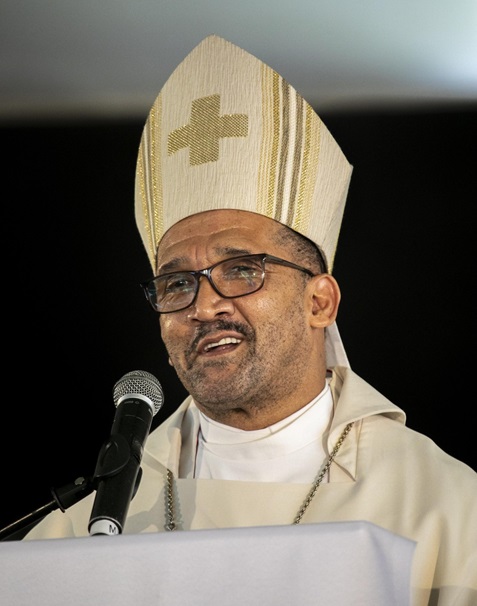
As the Church marks the first year of the pontificate of Pope Leo XIV, Archbishop Sithembele Sipuka of Cape Town has described the Holy Father as “a firm but steady Pope” whose leadership is helping the Church engage the challenges of the modern world while remaining united in its mission.
Reflecting on Pope Leo’s first year in office, Archbishop Sipuka said the Pope’s priorities became evident from the very beginning of his pontificate. His choice of the name Leo, inspired by Pope Leo XIII, signalled a commitment to Catholic social teaching and to addressing the realities of inequality, conflict, migration and human suffering.
“His papacy is not one of institutional self-absorption,” Archbishop Sipuka noted. “It is a papacy that invites the Church to engage with the world in its hopes and dreams, as well as its struggles and failures.”
The Archbishop recalled that Pope Leo’s first public words after his election, “Peace be with you,” have continued to shape his ministry. Over the past year, the Pope has consistently appealed for peace in areas affected by war and violence, placing human dignity above political and geopolitical interests.
According to Archbishop Sipuka, Pope Leo has also emerged as a strong advocate for migrants, refugees and vulnerable communities. In a world increasingly marked by anti-immigration rhetoric and exclusion, the Pope has repeatedly called on societies to recognise the humanity and dignity of those forced to leave their homes in search of safety and opportunity.
Another significant area of concern for the Holy Father has been the rapid development of artificial intelligence. Archbishop Sipuka highlighted Pope Leo’s insistence that technological progress must always serve the human person and not undermine human dignity, employment, freedom or social justice.
The Pope has called for ethical frameworks that place people before profit and ensure that the voices of poorer nations and vulnerable communities are included in global discussions about emerging technologies.
For Africa, Archbishop Sipuka believes these concerns are particularly relevant. The continent continues to grapple with poverty, inequality, unemployment and instability, making the Pope’s emphasis on justice, solidarity and care for the marginalised especially meaningful.
Within the Church, Pope Leo has continued the synodal journey initiated by Pope Francis while seeking to preserve ecclesial unity. Archbishop Sipuka noted that the Pope has resisted ideological labels, choosing instead a path of discernment, dialogue and balance.
Drawing from his Augustinian spirituality, Pope Leo’s leadership has been marked by humility, reflection and a commitment to communal discernment. While it is still early to assess the long-term impact of his pontificate, Archbishop Sipuka believes the first year has revealed a pastor attentive to the needs of both the Church and the world.
“Pope Leo XIV appears to be a man for this moment,” Archbishop Sipuka said. “He is helping the Church engage meaningfully with the urgent questions of our time while holding it together in unity. For many of us, he remains a source of encouragement and direction.”
0 Comments