
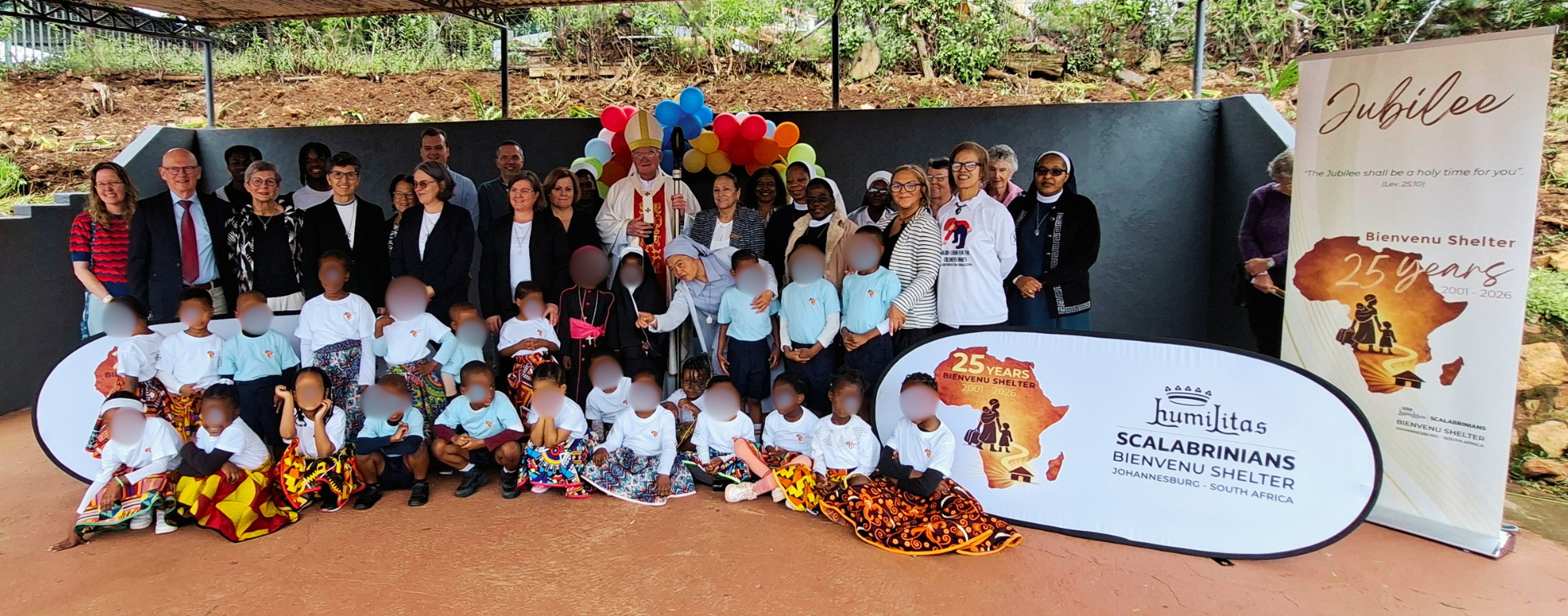
The year 2026 marks the Silver Jubilee of the Bienvenu Shelter for Migrants and Refugees, a shelter founded 25 years ago in the heart of Johannesburg to respond to the silent suffering of migrant and refugee women arriving in South Africa without shelter, without security and, very often, without hope.
Today, the centre continues to be a place of welcome and the rebuilding of lives. Over the past two and a half decades, thousands of women and children have passed through its doors. Many were fleeing war, violence, extreme poverty or persecution. Others were simply searching for a safe place to begin again.
For Sister Marivane Chiesa, director of the shelter and a Scalabrinian religious sister, the jubilee is not merely an institutional celebration, but above all a living memory of real people, real stories and transformed lives.
“We are not simply celebrating 25 years of existence. We are celebrating hope, solidarity and so many lives rebuilt along this journey,” she says.
According to the religious sister, Bienvenu Shelter was born from “a dream of compassion” shared among various religious congregations and Catholic Church organisations. From the very beginning, the mission was built together by the Scalabrini Sisters, the Sisters of the Holy Family, the Jesuit Refugee Service and the Archdiocese of Johannesburg.
“It was a work built by many hands. Many people believed in this mission and continue even today to walk alongside us.”
A place where women rediscover dignity
Entering Bienvenu Shelter means finding much more than temporary accommodation. It is a place where women wounded by violence, fear and exclusion can once again believe in themselves.
Sister Marivane explains that the care offered goes far beyond basic assistance.
“The women receive human, psychological, spiritual and social support. We try to help them recover their confidence and dignity.”
This journey continues at the Madre Assunta Centre, a training centre linked to the shelter, where women attend courses in sewing, cooking, computer skills, beauty and entrepreneurship.
“The goal is for them to leave here with tools to rebuild their own lives and support their children.”
According to Sister Marivane, many women later succeed in starting small businesses and becoming financially independent.
“We learn more than we teach”
Among those accompanying this mission every day is Adelia de Sousa, project coordinator and one of the institution’s longest-serving collaborators.
“I have been here for 25 years. I am practically the same age as the shelter,” she says.
Reflecting on the journey, Adelia describes it as a profoundly human experience.
“We learn more than we teach. Working with migrants and refugees teaches us that the world needs more care, more love and more empowerment.”
She explains that Bienvenu Shelter currently welcomes not only migrants and refugees, but also vulnerable South African women.
“Our doors are open to everyone, without discrimination and without labels of nationality.”
At the training centre, women from Congo, Zimbabwe, Lesotho, Mozambique, Malawi and South Africa itself discover something that goes beyond cultural differences.
“At first they arrive shy and suspicious. But after some time, we no longer see nationalities. We see friends.”
The Church responded to an urgent need
The origins of the shelter date back to the early 2000s, when Johannesburg was receiving increasing numbers of migrant women with children who had no support or safe place to stay.
Father Rampey, who has been linked to the Jesuit Refugee Service since the early years of the project, recalls that there were virtually no structures prepared to receive mothers with children.
“There were shelters for men or for women alone, but not for mothers with children.”
According to him, the birth of Bienvenu Shelter was a concrete response by the Church to the reality of the most vulnerable.
“The Sisters of the Holy Family provided the building. The Scalabrini Sisters took responsibility for the mission. The Jesuit Refugee Service referred the women. It was truly a collaborative effort.”
For the priest, this collaboration remains a concrete example of synodality.
“Synodality is not only about walking together in theory. It is about discerning together and acting together in favour of the marginalized.”
A witness of hope in a world marked by xenophobia
The work of the shelter continues in an increasingly challenging social context. In recent years, South Africa has once again faced tensions linked to immigration and outbreaks of xenophobia.
Sister Marivane acknowledges that these situations deeply affect the women welcomed at the shelter.
“Many relive the traumas they already carry from their countries or from the migration journey itself.”
During moments of violence or protests, some women stop attending courses or are afraid to move around the streets.
Even so, the religious sister insists that the work of the centre continues to be rooted in integration and human dignity.
“We are all migrants in this world.”
Cardinal Stephen Brislin also considers Bienvenu Shelter to be a prophetic sign for South African society.
“The centre reminds us of what we are called to be as Christians: people who welcome, protect, promote and integrate.”
The Cardinal says that in a world marked by exclusion and indifference, the shelter remains “good news”.
“Among so many stories of suffering, here we find a story of hope.”
“The Gospel does not allow us to remain comfortable”
For Sister Analita Candaten, Provincial of the Scalabrini Sisters who took part in the jubilee celebrations, the journey of these 25 years reveals the transformative power of solidarity.
“Many women arrive without hope, but here they are able to rediscover a new meaning for life.”
She stresses that the mission among migrants continues to be a concrete expression of the Gospel.
“The Gospel does not allow us to remain comfortable. It continually calls us to welcome, listen and walk with the most vulnerable.”
The religious sister also recalls the words of Christ: “I was a stranger and you welcomed me.”
“When we welcome migrants and refugees, we welcome Christ himself.”
Walking year after year
Despite financial difficulties and the reduction of international funding for humanitarian projects, Sister Marivane remains deeply hopeful.
“We continue walking step by step, year after year.”
According to her, Bienvenu Shelter continues thanks to the generosity of donors, volunteers, partner organisations and ordinary people who believe in the mission.
“When work is done with love, God never abandons us.”
Twenty-five years after its foundation, the Bienvenu Shelter for Migrants and Refugees continues to be much more than a shelter. It remains a place where women and children rediscover their dignity, recover hope and find the strength to begin again.
0 Comments