
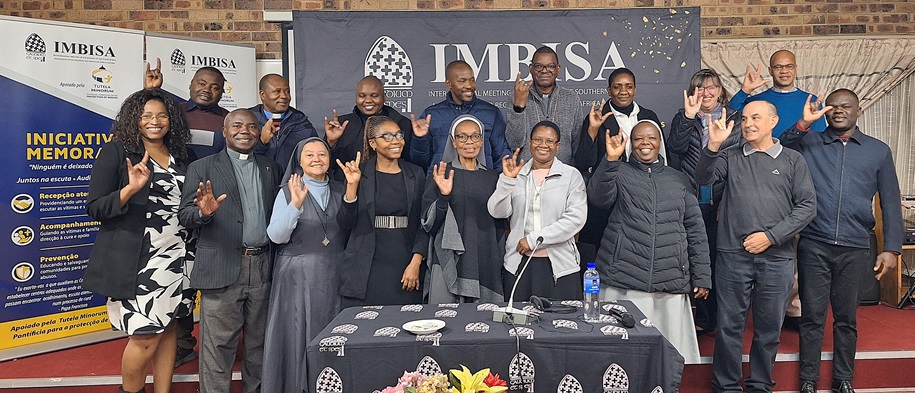
The Inter-Regional Meeting of Bishops of Southern Africa (IMBISA) convened a regional workshop on Communication and Disability from 27 April to 1 May at the Padre Pio Retreat Centre in Pretoria. The meeting brought together bishops, priests, religious, and lay representatives from across the IMBISA region to reflect on the inclusion of persons with disabilities in the life and mission of the Church.
Held under the theme “Bridging the Gap: A Regional Conference on Communication and Disability in the IMBISA Region,” the workshop focused on promoting accessible communication, strengthening pastoral approaches, and advancing the full participation of persons with disabilities in ecclesial life.
During the five-day workshop, participants shared experiences from their respective countries, highlighting both ongoing initiatives and existing challenges. Bishop John Joale Tlhomola of Mohale’s Hoek Diocese, Lesotho, described the workshop as an important moment of awareness, noting that disability has often not been sufficiently considered in pastoral planning. He emphasized the need to equip clergy and pastoral agents with skills such as sign language to foster inclusive ministry.
Speaking on behalf of the Southern African Catholic Bishops’ Conference (SACBC), Fr Mark James OP, Chaplain to the Deaf Community in Johannesburg and Pretoria, and Sheila L. Pires, SACBC Communication Director, highlighted developments in South Africa and Eswatini. They referred to the recognition of South African Sign Language as the country’s 12th official language and noted that SACBC chaplains and coordinators have been facilitating ministry with the deaf community since around 2014. They also indicated that the third Sunday in September has been designated for Mass with the deaf community, providing a regular opportunity for inclusive liturgical celebration.
Their presentation also included the work of SPRED (Special Religious Development), an initiative present within the Archdiocese of Johannesburg that supports the religious, spiritual, social, and emotional development of persons with intellectual disabilities, to enable their participation in the liturgical life of the Church. The programme is based on small faith communities formed by trained volunteers who accompany participants through relationships of acceptance and support.
Representatives from Namibia and Botswana underlined the Church’s identity as a listening and participative community. They stressed that persons with disabilities should be recognized not only as recipients of care, but also as active contributors to the life of the Church. Among the proposals discussed were the introduction of sign language in parishes and the adaptation of catechetical materials to include formats such as Braille.
A report from the Zimbabwe Catholic Bishops’ Conference outlined steps already taken at the national level, including the introduction of sign language training and the establishment of structures to coordinate pastoral care for persons with disabilities. While progress has been noted in some dioceses and parishes, particularly in urban areas, the report indicated that further work is needed to move from basic accessibility toward fuller inclusion and participation.
Meanwhile, the head of IMBISA Media and Communications, Bishop António Manuel Bogaio Constantino MCC of Caia Diocese, Mozambique, highlighted the importance of shifting from a model based primarily on charitable assistance to one that promotes inclusion and shared responsibility. He emphasized the need for ongoing formation in communication methods, including sign language, and encouraged the presence of interpreters at major liturgical celebrations.
Religious sisters also shared practical experiences from their ministries. Sister Sr. Selma Barbosa Costa CMCM, working in São Tomé and Príncipe, described initiatives that integrate persons with disabilities into catechesis, social projects, and community life. Participants emphasized the importance of collaboration with families and local communities in fostering inclusion.
During the workshop, attention was also given to theological and pastoral dimensions, including the need to address misconceptions that associate disability with sin or divine punishment. Participants highlighted the importance of catechesis that affirms the dignity of every person.
In a keynote address at the start of the workshop, the Prefect of the Dicastery for Promoting Integral Human Development, Cardinal Michael Czerny, underscored that all persons are created in the image and likeness of God and possess inherent dignity. The message noted that persons with disabilities often experience marginalization and called for their active inclusion in decision-making processes within the Church.
At the conclusion of the workshop, delegates issued a statement outlining key recommendations. These include integrating persons with disabilities into catechesis and pastoral structures, eliminating physical and communication barriers, and strengthening formation programs for clergy and pastoral agents. The statement also emphasized the importance of recognizing persons with disabilities as active participants in evangelization.
Participants committed to advancing these priorities within their respective conferences and dioceses, with a focus on fostering a more inclusive and accessible Church across the region.
0 Comments