
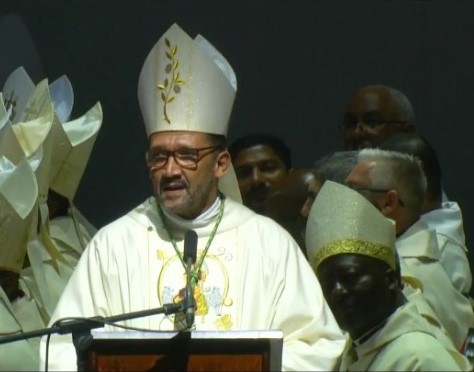
At his installation as Archbishop of the Archdiocese of Cape Town, Archbishop Sithembele Anton Sipuka outlined a pastoral vision centred on unity, synodality, and mission, urging the Church and society to confront divisions and work intentionally toward reconciliation.
In his 14 March 2026 address to thousands of faithful gathered at Grandwest Arena in Goodwood, Cape Town, the new archbishop began by expressing gratitude to Pope Leo XIV for entrusting him with the pastoral leadership of Cape Town. He also thanked the Apostolic Nuncio, Henryk Jagodziński, and acknowledged the presence of bishops, ecumenical leaders, civil authorities, and the faithful gathered for the celebration.
Archbishop Sipuka paid tribute to his predecessor, Cardinal Stephen Brislin, now Archbishop of Johannesburg, and thanked Bishop Sylvester David, the Auxiliary Bishop of Cape Town, for guiding the archdiocese during the transition following Cardinal Brislin’s transfer.
Reflecting on his new ministry, Archbishop Sipuka said he comes to Cape Town ready to learn from the people he has been called to serve. Having led the Diocese of Mthatha for many years, he said he wishes to journey with the faithful of the Western Cape in a spirit of mutual learning and service.
Reading the signs of the times
In the central part of his address, the new Archbishop of Cape Town reflected on what he described as a troubling sign of the present age: humanity’s growing tendency toward division.
“Humanity has been at its worst when disunited and at its best when united,” he said, warning that societies today appear to be drifting apart both globally and locally.
Turning to the South African context, he noted what he described as the fading spirit of national unity that once characterised the country during the leadership of Nelson Mandela. Moments such as Mandela wearing the Springbok No. 6 jersey symbolised a nation seeking reconciliation, he said, but today old wounds and new resentments threaten the country’s social fabric.
“United and Sent”
In the face of these divisions, Archbishop Sipuka said he sensed a call from God to contribute to unity through his ministry. Reflecting on the Church’s renewed emphasis on synodality—marked by listening, communion, and mission—he said the path of the Church must foster unity at many levels: among peoples, among religions, among Christians, and within the Catholic community.
This vision is captured in the motto he has chosen for his ministry: “United and Sent.”
He cautioned, however, that unity cannot be taken for granted. Simply bringing people together in shared spaces does not automatically produce reconciliation.
“We have changed rules without transforming hearts,” he said, stressing the need for genuine encounter and honest engagement with the fears, perceptions, and historical wounds that continue to divide communities.
A prophetic mission
Archbishop Sipuka also reflected on the prophetic vocation of the Church in addressing the country’s challenges, including poverty, inequality, crime, and corruption.
Despite these difficulties, he encouraged the faithful to remain hopeful, pointing to the many voices in society—civic leaders, journalists, activists, and faith communities—that continue to call for justice and accountability.
Concluding his address, the Archbishop invited the faithful to walk together in building unity through listening, humility, and service.
“Let us do the hard work of genuine unity,” he said. “Let us be united in love and sent on a mission.”
0 Comments