
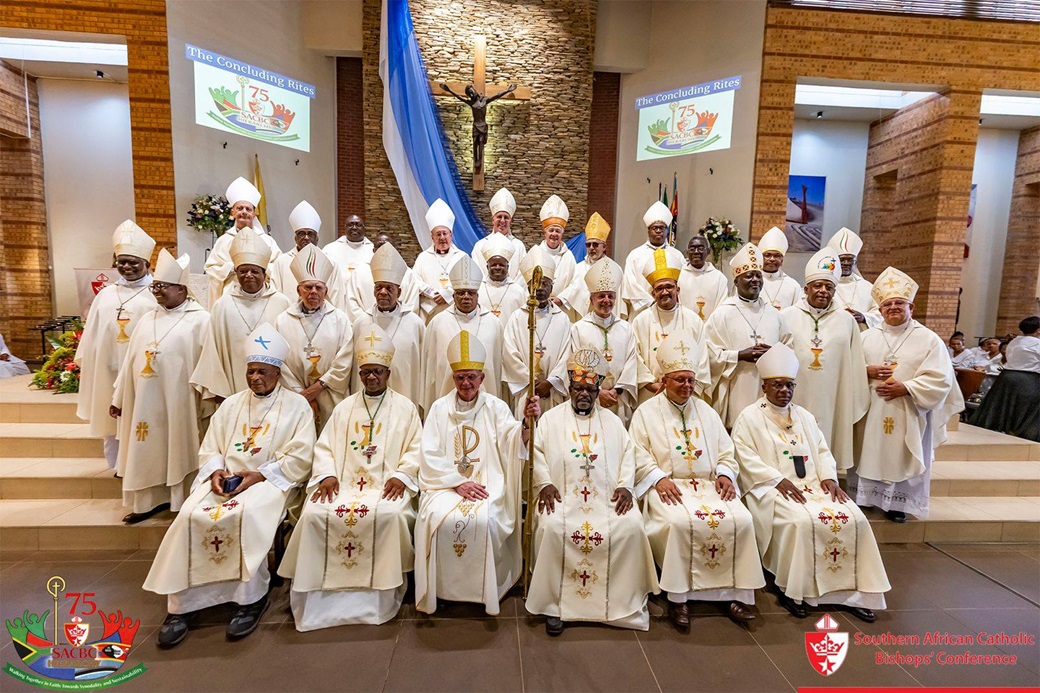
The Catholic Church in Southern Africa marked a historic milestone on Sunday with the opening Mass of the Jubilee Year celebrating the 75th Anniversary of the Establishment of the Ecclesiastical Hierarchy, held at the Church of the Beatitudes in Zwavelpoort, Pretoria East.
The solemn Eucharistic celebration brought together young and old, clergy, religious, and lay faithful, who arrived in great numbers to give thanks for three-quarters of a century of a locally rooted Church. The celebration was graced by the presence of the bishops of the Southern African Catholic Bishops’ Conference (SACBC), gathered in Pretoria for their January Plenary Session.
A Church born to be light in darkness
Presiding at the Mass, Cardinal Stephen Brislin, Archbishop of Johannesburg and President of the SACBC, reflected on the words of the Prophet Isaiah: “The people that walked in darkness have seen a great light.” He described the establishment of the hierarchy in 1951 as a profound moment of grace, calling the Church a gift of light, hope, and salvation in the midst of human frailty and historical darkness.
“The Church,” Cardinal Brislin said, “born of the Holy Spirit and established by Christ himself, continues to be the meeting place between God and his people.” Celebrating the jubilee, he noted, was not only an act of remembrance but an expression of gratitude for a Church that nurtures believers throughout life, unites the living and the dead, and remains a source of meaning and hope despite the sins and weaknesses of her members.
A local Church taking responsibility
The SACBC President recalled that the establishment of the hierarchy was not merely an administrative restructuring, but a decisive step towards a truly local Church, capable of taking responsibility for its own pastoral life while remaining in communion with the universal Church. The elevation of Pretoria, Bloemfontein, Durban, and Cape Town to archdioceses, and the creation of new dioceses, signalled a Church no longer governed directly from outside, but entrusted to local shepherds — many of them South African.
He paid tribute to the missionaries who planted the faith, founded schools, hospitals, and clinics, and laid the foundations of the Church, often with scarce resources. Their witness, he said, continues to enrich the Church through the diversity of charisms they imparted.
Witness amid oppression and injustice
Looking back over history, Cardinal Brislin acknowledged the severe trials faced by the Church, particularly during the apartheid era, when anti-Catholic sentiment and unjust laws sought to extinguish the light of the Gospel. While admitting moments of silence and even complicity within the Church, he affirmed that the Catholic Church’s official stance remained clear: justice, equality, and unity.
He singled out the courageous witness of religious sisters who defied apartheid laws by opening Catholic schools to children of all races, describing such acts as signs of a Church that chose truth over fear and dignity over oppression.
Facing new challenges with a call to repentance
Turning to the present, Cardinal Brislin warned that while apartheid has passed, new evils now threaten human dignity and life. Corruption, lawlessness, violence, poverty, and the breakdown of infrastructure continue to burden society. Echoing the Gospel proclamation, he insisted that the Church must never cease to call the world to conversion: “Repent, for the kingdom of heaven is close at hand.”
Repentance, he explained, means a return to ethical living, to truth, justice, peace, service, and respect for human dignity. It also demands renewed attention to family life, which he described as the “first Church” and the primary place of evangelisation, moral formation, and prayer.
Eucharist at the heart of renewal
As the Church looks towards the next 75 years, Cardinal Brislin emphasised that the journey cannot be sustained without God’s grace, especially through the Eucharist, the source and summit of Christian life. He expressed concern that reverence for the Eucharist has weakened in many places, urging a return to dignified, prayerful liturgy that focuses on worshipping God rather than self-expression.
Only by being nourished by the Word and the Body and Blood of Christ, he said, can the Church remain faithful to her mission of being light in the darkness.
A celebration of unity in diversity
The Jubilee Mass itself was a powerful expression of unity in diversity. The liturgy began with a solemn procession carrying the Vatican flag, followed by the flags of the three SACBC member countries — South Africa, Botswana, and Eswatini — symbolising communion with the universal Church and the regional character of the Conference.
Throughout the Mass, the choir sang in multiple languages, joyfully reflecting the cultural richness of Southern Africa as a true “rainbow nation” gathered in faith.
Message from Pope Leo XIV
At the conclusion of the Mass, the Apostolic Nuncio to Southern Africa, Archbishop Henryk M. Jagodziński, read a special message from Pope Leo XIV, sent to mark the Jubilee. In his message, the Holy Father thanked God for the Church in Southern Africa, honoured the missionary legacy that shaped it, and encouraged all the faithful to remain missionary disciples, bearing witness with humility, unity, and closeness in today’s complex world.
The Pope entrusted the Church in the region to Mary, Mother of Hope and Star of Evangelisation, and imparted his Apostolic Blessing as a pledge of joy and peace.
Jubilee celebrations begin
Following the liturgy, Cardinal Brislin, together with the two Vice Presidents of the SACBC and the Apostolic Nuncio, cut the Jubilee cake outside the church — a symbolic act marking the official beginning of a year-long programme of celebrations and reflection across Southern Africa.
As the Church gives thanks for the past 75 years, the Jubilee stands as both a celebration and a call: to remain faithful to the Gospel, to walk together in communion, and to allow the light of Christ to shine ever more brightly in Southern Africa and beyond.
0 Comments